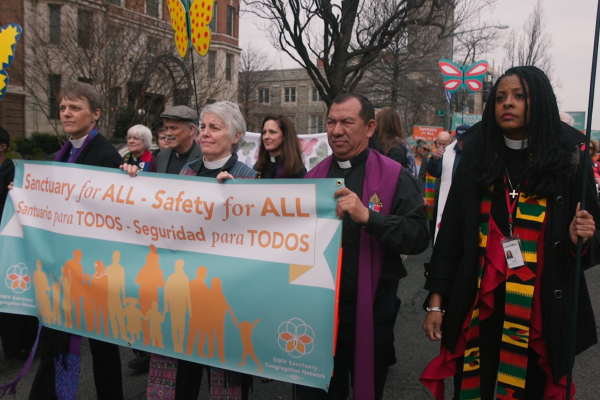
The financial rating firm said on Thursday that an analysis of 10 large so-called sanctuary jurisdictions found the Justice Department funds made up on only 0.2 percent of budgets, on average.
4. I Loved My Grandmother. But She Was a Nazi.
“My grandmother heard what she wanted from a leader who promised simple answers to complicated questions. She chose not to hear and see the monstrous sum those answers added up to. And she lived the rest of her life with the knowledge of her indefensible complicity.”
5. Why Is It Difficult to Get Christians to Care About the Earth?
This week, President Donald Trump signed an executive order gutting the Obama administration’s environmental safeguards. While it’s easy for news to get buried amid all the noise, this one didn’t seem to register for Christians. What gives?
6. These Border Bids Are Subtle Resistance to Trump’s Wall
A wall built out of Legos? Cacti? Theater stages? They’re creative. They also clog the procurement process.

A recent Washington Post profile of Karen Pence mentioned that her husband, Vice President Mike Pence, never eats alone with another woman or goes without her to events where alcohol is being served.
Twitter erupted with outrage and ridicule.
But the Indiana Republican’s practice is not unusual in many conservative Christian circles. As Emma Green pointed out in The Atlantic, it likely stems from something called “the Billy Graham Rule,” named for the 98-year-old international evangelist. Nor is it that much different in intention from the practices of conservative Jews and Muslims.

I am still surprised by the ubiquity of certain attitudes around gender and sexuality, specifically whether married men should have any kind of relationship at all (friendly, etc.) with members of the opposite sex. Forget for the moment the myopic gender construction involved in that particular problem. Let's just take it at face value. Married men must be supervised at all times lest they be tempted to break their marital vows — or run the risk of appearing to break their marital vows.

We celebrated the failure of a cruel bill. We celebrated our powerful unity across other theological and political differences and our clear opposition to cutting the poor out of the critical budget decisions which now lie ahead. Yes, we celebrated. But we remain vigilant.

“It seems like most congregations are eager for somebody else to do the work of reconciliation,” said Scott McConnell, executive director of LifeWay Research, “rather than embrace it for themselves.”
The vast majority of pastors (90 percent) said their churches would welcome a sermon about racial reconciliation. But almost three-quarters of pastors — 73 percent — say they have not been encouraged by church leaders to preach about reconciliation. A quarter (26 percent) said they have been urged to address the issue from the pulpit.

In the last year, dozens of organizations — from Google, Apple, and Microsoft to the NBA, Bruce Springsteen, and Nick Jonas — have pulled their money from the state in protest of the bill. Word of the new deal reportedly came hours before the NCAA was set to pull any future championship basketball games from the state for the foreseeable future.

With ashes on their foreheads, sackcloth draped around their necks, and the U.S. Capitol as a backdrop, Christians leaders used the words “evil” and “immoral” to describe the federal budget cuts President Trump has proposed and many Republican lawmakers favor.
“It is a time for lamentation,” said the Rev. David Beckmann, explaining the symbols of grief the clergy brought to Capitol Hill on March 29.

Seattle Mayor Ed Murray told reporters the Constitution forbade the federal government from pressuring cities, “yet that is exactly what the president’s order does. Once again, this new administration has decided to bully.”
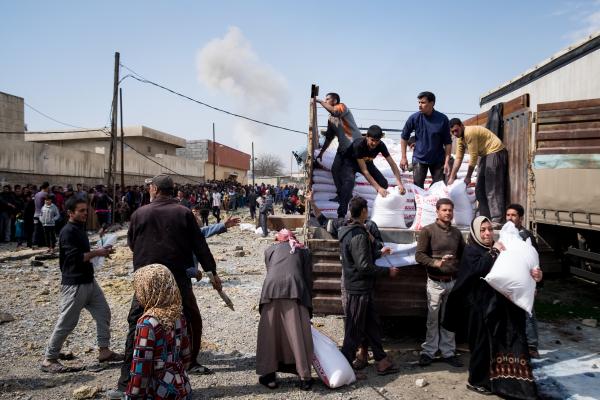
Every time more civilians are killed, it gives further weight to the idea that we have lowered value of human life — or at least, the value placed on Iraqi lives. Imagine the response, by comparison, if 200 American aid workers were killed in an errant strike. The seemingly low threshold for civilian safety makes the fight against ISIS harder, not easier. It makes ISIS propaganda more believable. At the very moment when ISIS should be gasping its final breath, these incidents inject life into their militancy.