

Italian archaeologists have discovered the remains of 38 skeletons buried in a Jewish cemetery in Rome more than 500 years ago, offering further evidence of their ubiquity and persecution under papal rule.
The well-preserved skeletons were found during excavations beneath a building, in an area identified on ancient maps as “Campus Iudeorum” — Latin for “Field of Jews” — in the Trastevere quarter of Rome, just across the Tiber River from the Italian capital.

The Northern Cheyenne Tribe, located in southern Montana, said the administration lifted the moratorium without hearing the tribe's concerns about the impact the coal-leasing program has on the tribe, its members, and lands.

In Trump’s first nominee, Judge Neil Gorsuch, abortion foes were convinced they had the jurist who would fulfill Trump’s campaign promise to appoint justices who would deliver the reversal they have worked decades to achieve. But now, after last week’s hearings before the Senate Judiciary Committee, some are voicing concern that Gorsuch might not be such a reliable anti-Roe vote after all.
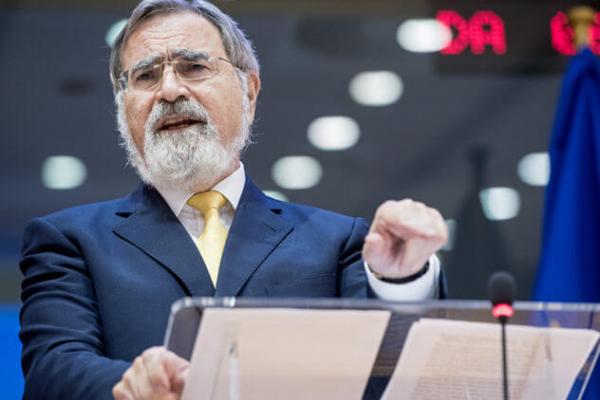
Rabbi Jonathan Sacks made a name for himself as chief rabbi of Great Britain for nearly a quarter-century, a time of great tumult that included the Sept. 11, 2001, attacks, the influx of millions of Muslims into Europe, and the ongoing pressures to absorb and assimilate newcomers into a mostly secular society.
As chief rabbi, from 1991 to 2013, he stressed an appreciation and respect of all faiths, with an emphasis on interfaith work that brings people together, while allowing each faith its own particularity.

Bourke-White traveled the world in search of complete stories: from Depression-era Hooverville to partitioning India to Apartheid-era South Africa to Nazi Germany. She became the first female war photojournalist and the first photographer for LIFE. After surviving a helicopter crash and getting stranded in the Arctic, Bourke-White’s colleagues declared her “Maggie the Indestructible.”

Pope Francis on Wednesday said it was "imperative and urgent" to protect civilians in Iraq, speaking as U.S. investigators looked into who caused an explosion in Mosul that killed scores of non-combatants. Addressing tens of thousands of people at his weekly general audience in St. Peter's Square, Francis said he was "concerned about civilian populations trapped in the neighborhoods of western Mosul."

Speaking from Baghdad to reporters at the Pentagon, the top commander of U.S. forces in Iraq said an ongoing investigation may reveal a more complicated explanation for the March 17 explosion that residents say killed at least 100 people, including the possibility that Islamic State militants rigged the building with explosives after forcing civilians inside.

As presidential orders and administrative policies continue to scale back environmental protections, it’s important for Christians to realize that this is a vitally important spiritual issue. Many Christians ignore environmental issues because they don’t view it as an important faith-related concern — but what if environmentalism was essential to evangelism? In many ways, taking care of our environment is a direct form of evangelism, but many Christians have yet to realize — and even reject — this truth.

During our nearly 40 years of friendship, I led several interreligious missions with Keeler, including meetings with then-Pope John Paul II at the Vatican. We co-led trips to Israel, including a visit to a civilian bomb shelter, and a poignant painful pilgrimage to the infamous death camps of Auschwitz-Birkenau.
Sometimes public figures can seem distant and impersonal, but that was never the case with the always gracious and welcoming Keeler.