
Remember Rep. Paul Ryan’s 2011 budget, The Path to Prosperity? Well, it’s baaa-aaack — and this time the path is smoother and wider and offers a quicker trip to judgment.
Christianity and most of the world’s faith traditions explicitly demand protection for the poor and the preservation of the lives and dignity of all. Well, the Chair of the House Budget Committee, Ryan, high-tails it down his Path, budget rolled in-hand, in the exact opposite direction from those moral commitments.
Bob Greenstein, president of the Center on Budget and Policy Priorities (CBPP), concluded that the Ryan budget “is Robin Hood in reverse — on steroids. It would likely produce the largest redistribution of income from the bottom to the top in modern U.S. history and likely increase poverty and inequality more than any other budget in recent times (and possibly in the nation's history)."
Any responsible budget plan requires a balanced approach that would both increase revenue and reduce spending. This proposal would cut taxes, merely hope for revenue, increase military spending, and slash most everything else that isn’t protected by large corporate interests.

The owner of a business who claimed he would provide atheist rescuers for Christians' pets left behind in the Rapture now says his service was an elaborate hoax and never had any clients.
Bart Centre, who lives in New Hampshire, came clean after the state Insurance Department delivered a subpoena because he appeared to be engaged in "unauthorized business of insurance" through his Eternal Earth-Bound Pets business.
"Eternal Earth-Bound Pets employs no paid rescuers," Bart Centre wrote in a blog post on March 16. "It has no clients. It has never issued a service certificate. It has accepted no service contract applications nor received any payments -- not a single dollar -- in the almost three years of its existence."

This Thursday, March 22nd, is World Water Day. The April 2012 issue of Sojourners includes Ched Myers’ 'Everything Will Live Where the River Goes', a Bible study on water, God, and redemption.
The following hymn celebrates our need for clean water and the Living Water:
Once a Woman Seeking Water
BEACH SPRING 8.7.8.7. D (“God, Whose Giving Knows No Ending”)
Once a woman seeking water at a well not far from home
Met a thirsty, waiting stranger from a people not her own.
Would she give a drink of water and respond to human need?
Could she know the joy and wonder she, the giver, would receive?...

Days after a lone gunman murdered a rabbi and three children at a Jewish school in Toulouse, France, a new study reports widespread anti-Semitism in France and across Europe.
The survey, completed in January and released Tuesday by the New York-based Anti-Defamation League, finds that 24 percent of the French population holds anti-Semitic views, up from 20 percent in 2009.
When asked if violence against Jews is rooted in anti-Jewish or anti-Israel sentiment, four in 10 Europeans (39 percent) responded that it was the result of anti-Jewish sentiment.
In France, 45 percent of those asked held this view, up from 39 percent in the previous survey.

Faith leaders and poverty experts Wednesday called the new House GOP budget proposal "immoral" and "irresponsible."
The budget released the previous day by Rep. Paul Ryan, R-Wis., included deep cuts to programs that would unfairly burden the poor, middle-income families and senior citizens, said the Rev. Thomas Kelly, who participated in a phone conference with the media.
"Using the deficit as an excuse to pursue a radical agenda that punishes the poor is simply dishonest and immoral," said Kelly, a Catholic priest and Ryan's constituent, on the call hosted by the Center for American Progress.
The Republican blueprint calls for cuts to Medicaid and other programs such as the Supplemental Nutrition Assistance Program -- also known as SNAP, or food stamps -- and would turn them into block grant programs, putting states in charge of tailoring them to local needs.
The cuts also aim to reduce the nation's deficit by $4.4 trillion during the next 10 years.
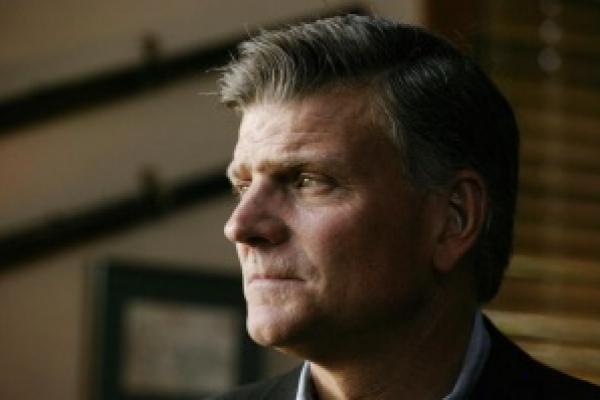
Religious leaders from the NAACP met with evangelist Franklin Graham Tuesday (March 20), less than a month after they accused him of "bearing false witness" when he questioned President Obama's Christian faith.
"All parties were in agreement that it is essential to our society and our faith that we refrain from demonizing Christians and people of other faiths when they do not agree with us," said the Rev. Nelson B. Rivers III, a NAACP vice president, in a statement released after the meeting at the Billy Graham Library in Charlotte, N.C.
"We look forward to continued discussions with Rev. Graham."
On Feb. 28, prominent clergy from the NAACP accused Graham of "bearing false witness" and inciting racial discord when he said he couldn't say whether Obama is a Christian and added that "under Islamic law, the Muslim world sees Barack Obama as a Muslim."
DC’s resident “bad-boy reporter,” Jason Mattera thought that he had caught a major scoop when he accosted U2 lead singer Bono at a recent event, challenging him to come clean about the finances of One, the musicians charity (as well as being a classic U2 hit – FWIW, I prefer with version with Mary J. Blige).
Sadly, it turns out that Mattera’s scoop was not so Magnificent. The man he thought was Bono may have looked and sounded like Bono. But it was, in fact, a Bono impersonator, TPMreports. And even more embarrassingly for Human Events’ editor was that it wasn’t until after he promoted the clip on Sean Hannity’s radio show today that it was revealed to be a look-a-like.
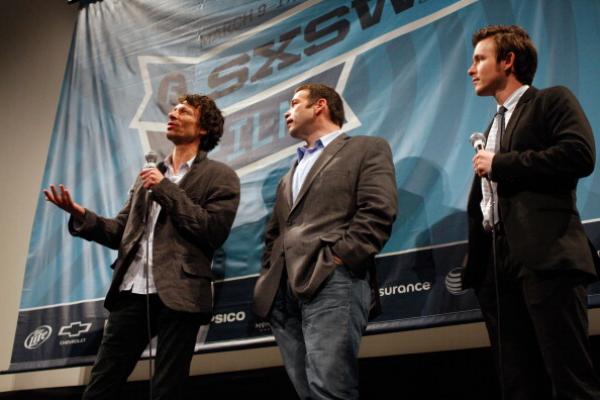
Do not confuse the upcoming film Blue Like Jazz with Christian market movies like "Fireproof" or "Courageous."
"A Christian movie genre has formed. Our first goal with this movie is that we didn't fit into this genre," said director Steve Taylor.
Author Donald Miller, who wrote the 2003 best-selling book Blue Like Jazz, from which the movie was adapted, agrees.
"We wanted to show that movies about the faith struggle that millions of Americans deal with don't have to be cheesy," he said. "They don't have to have bad actors. They don't have to be low budget production. They can compete with other films at the box office."

New research released today by the Pew Forum shows that the American public are becoming increasingly anxious of the amount of religious language being used by their public officials.
More people now say that there “has been too much expression of religious faith and prayer from political leaders” (4 in 10) than say that there has been too little (3 in 10). This figure is up nearly 10 percent from 2010 figures.
Supporters of former Pennsylvania Senator and presidential candidate Rick Santorum are the least concerned by the use of religious language by politicians, with 55 percent of them believing that there is too little expression of religious faith and prayer by religious leaders. Amongst Democrats or those who lean in that direction, a majority believe that religious language is invoked too often by political leaders.

A pair of scissors transported across state lines has emerged as a controversial element in Ohio's first case under a landmark 2009 federal law that expanded government powers to prosecute hate crimes.
The case involves a dozen members of an Amish sect in central Ohio who are charged with using the shears -- made in New York and brought to Ohio -- to forcibly cut the hair and beards of fellow Amish to avenge a religious dispute.
The travel history of the shears may seem like a peculiar point in the peculiar case that has focused national attention on Ohio's Amish community. But the hate crimes law -- like many other federal statutes, including health-care reform legislation -- is rooted in Congress' far-reaching power to regulate interstate commerce.
Enacted in 2009, the Matthew Shepard and James Byrd Jr. Hate Crimes Prevention Act was named for a gay University of Wyoming student who was beaten and tortured to death by two men in 1998, and a black man who was chained to a pickup truck and dragged to death in Texas that same year.