
Archbishop Michael Seneco, of Washington, D.C., is a gay man who plans to marry his longtime partner in September.
Bishop Jim Morgan, of Ogden, Utah, is also gay and has been with the man he considers his husband for 30 years.
In this church, the bishops’ marital relations haven’t caused a ripple among the clergy or the laity. No protests. No outraged believers. No furious voting.
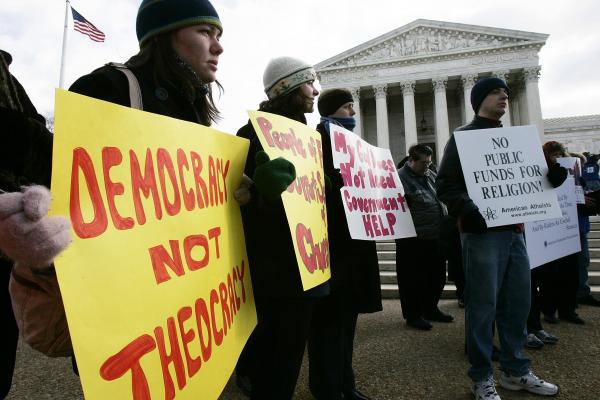
With the 2012 election less than six months away, congregations are getting the message that Americans want religion out of politics. But that doesn’t mean they plan to keep mum in the public square.
Instead, they’re revamping how congregations mobilize voters by focusing on a broader set of issues than in the past. Preachers are largely avoiding the political fray, and hot-button social issues are relegated to simmer in low-profile church study groups.
Why? For one, Americans are growing impatient with religious politicking: 54 percent want houses of worship to keep out of politics (up from 52 percent in 2008 and 43 percent in 1996), according to the Pew Forum on Religion & Public Life. Churches seem to be responding.
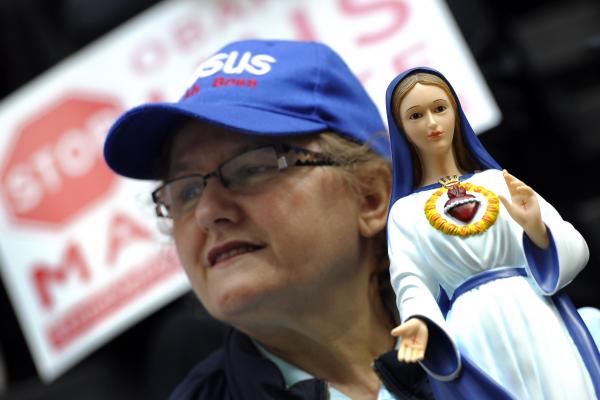
Dozens of Catholic universities, dioceses and other institutions filed lawsuits in courts around the country on Monday in a coordinated effort, spearheaded by the U.S. hierarchy and Catholic conservatives, to overturn the Obama administration’s contraception mandate plan.
The 43 plaintiffs, which include 13 dioceses and the University of Notre Dame, say the mandate forces religious employers to provide contraceptive and sterilization services to employees that violate their beliefs. They say that infringes on First Amendment religious freedom protections, and charge that the federal government’s exemption for religious organizations is too narrow.

Earlier this month, the public radio show This American Life held a wide-scale live event in New York City. I attended the two-hour event via satellite in Washington, D.C. Like its weekly radio broadcast, the live show included pieces from a variety of storytellers gathered around a common theme — in this case “the invisible made visible.”
The medium of radio doesn’t lend itself to visuals — it is "theater of the mind" after all — but the live-on-stage iteration of This American Life took full advantage of the occasion (and change in medium), including many extra bells and whistles they could never pull off on the airwaves alone.
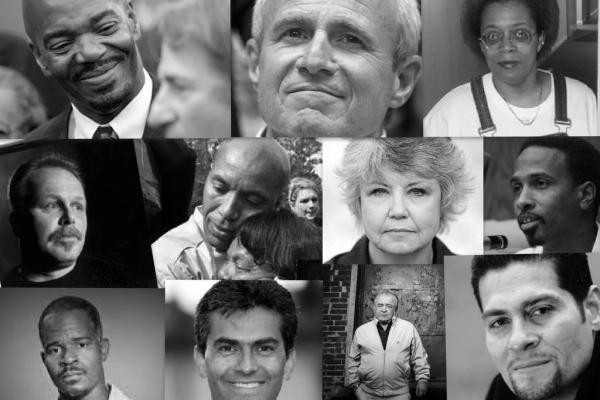
Nearly a quarter of a century after DNA testing was used to prove that a defendant had been falsely convicted of a crime, the American public has become familiar with the phenomenon and how the script plays out in our courtrooms.
The exonerated defendant stands before a judge and is informed that the conviction is vacated and the charges are dismissed. And then the former inmate —more than 100 have come from Death Row — is joined by family members and lawyers in a celebration on the courthouse steps.
Yes, it is a joyous occasion to step from behind prison bars after years — as many as 30 years in one case —of being locked up for a crime that was not committed.
But, as a report issued Monday by the National Registry of Exonerations makes clear, behind every one of these jubilant moments are tragedies, some of them of enormous proportion.
The report documents nearly 900 individual cases of exoneration. Combined, these (mostly) men and women served more than 10,000 years in prison for crimes they did not commit. In fact, in more than 100 cases, there was no crime at all — accidents were mischaracterized as murders and crimes were just concocted based on a web of lies and falsehoods.
A Day of Video + Song: Pomplamoose pumps out a fun new tune -- upcoming song from Sigur Ros -- turkeys and dubstep -- stop motion paper cut-outs -- Saturday Night Live's "Lazy Sunday 2" -- and Will Smith rapping the Fresh Prince theme song. See these in today's Links of Awesomeness...

Among my must reads are the Sunday New York Times Book Review and other book reviews I come across in various media outlets. There are too many books being published that I would love to read, but just don’t have the time. So, I rely on reading book reviews as one way of keeping in touch with what’s being written.
Here are my picks in this week’s books of interest:
The Cause
By Eric Alterman and Kevin Mattson, Reviewed by Jeff Shesol
Power and Constraint: The Accountable Presidency after 9/11
By Jack Goldsmith
Democracy’s Blameless Leaders: From Dresden to Abu Ghraib, How Leaders Evade Accountability for Abuse, Atrocity, and Killing
By Neil James Mitchell
From Huffington Post: Kristen Wiig got a musical sendoff on the season finale of "Saturday Night Live" as the popular and versatile cast member made her exit after seven years. In the show's final sketch, guest host Mick Jagger played the principal at a high school graduation and brought up Wiig, in cap and gown, as "one particular student who is leaving this summer."
Yes, kids, it’s that time again already. Seems it was only seven days ago when we posted our last batch of weekly church sign epic fails, and here we are again.
So let’s get to it: your weekly infusion of bad church signs.

Now that's my kinda Jesus (except you'd think the Messiah would go Microbrew, yes?)
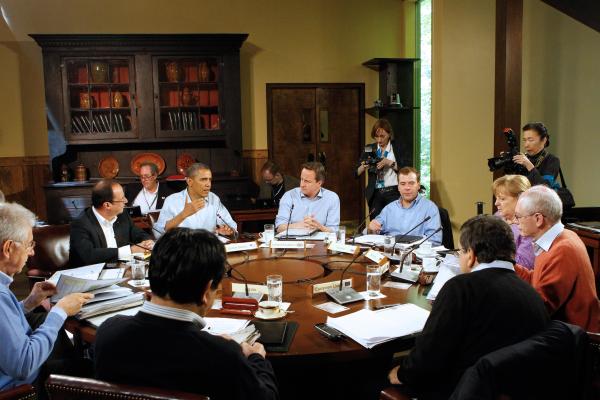
“This new alliance – is a nice complement at best, a deflection at worst. The role of the private sector is important, but they will not be able to make up for the G8’s broken promises...Smallholder farmers need the freedom to pursue their own growing strategies, not take overly-prescriptive tips on farming from G8 leaders, or one size fits all technologies from far away CEOs.” ~ Lamine Ndiaye, Pan Africa Head of Economic Justice at Oxfam
“This effort to involve international corporations more deeply in African agriculture is an important step forward in lifting millions of poor Africans out of poverty...However, nongovernmental organizations and official agencies will also need to increase their efforts to monitor and collaborate with companies that are doing business in Africa.” ~ The Rev. David Beckmann, President of Bread for the World