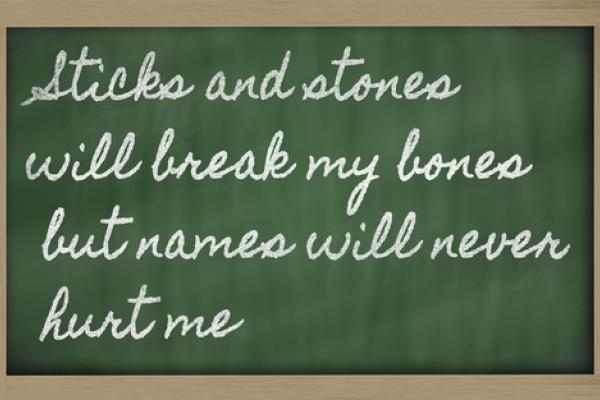
"Sticks and stones may break my bones but names will never hurt me."
I was sitting outside on the playground bench wiping the tears of a child when this proverb came to mind. It isn’t true, of course. Nancy was a second-grader going through an evaluation process to help us understand why she couldn't read. Kayla was one of her classmates. As they were climbing the ladder of the slide, Kayla yelled out, "Nancy is retarded!"
Ouch.
Words can break our hearts.

Across five states and 20 years, on the couch at the psychoanalyst’s, wadded Kleenex in my hands, and kneeling on the marble floor of the confessional, incense curling through my hair, I sorted through the jagged prisms of experience that, as a child, I did not understand: What it means to be in the constant presence of someone who does not look you in the eye, who lives beyond the bar of constant preoccupation.
I didn’t understand then the tiresome vigilance I’d develop as a result—the almost unconscious, constant mental sorting to see if, at that moment, I was OK, or if others were about to abandon me forever—a reaction I’ve heard is common among children of alcoholics, and which I’ve seen myself in the needy inner-city children I have taught.
Along the way, I discovered that the seed of my mother’s sadness had been there all along, from my earliest memory, well before my father died. And by the time I was a toddler, the seed had germinated in me, too.
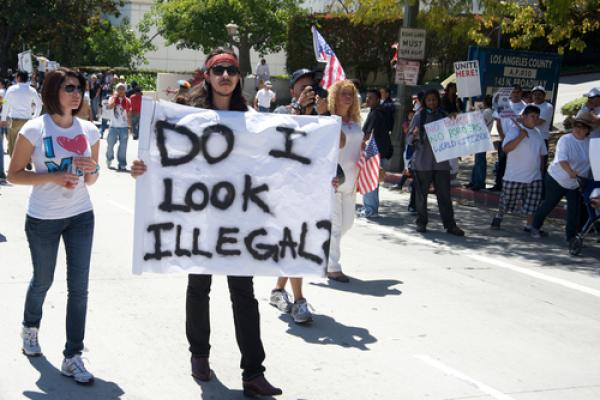
When people who have immigrated to another country through methods other than the official legal system are discussed, we hear quite a few words bandied about: “illegal,” “undocumented,” and “alien” just to name a few. The terms are often used interchangeably, but are these terms interchangeable? On NPR’s, Tell Me More, Professor Kevin Johnson, Dean of the law school at the University of California at Davis says no.
“I fear that ‘illegal immigrant’—the term—is a loaded term. It is not as loaded as some of its predecessors like ‘illegal alien’ or ‘wetback,’ but it still is a loaded term,” says Johnson.
The ONE campaign’s mission to fight AIDS has grown wildly since its inception in 2004, and recently, the organization began a new initiative striving to "begin the end of AIDS" by 2015. It’s within our reach, they say, if only we would lend a hand.
In their latest promotional message, they enlist help from the folks at Funny or Die, along with bigger names like Zach Galifianakis, Sarah Silverman, and Tracy Morgan. In a video that seems like a sketch straight out of the "internet absurdity" vault, the celebrities take turns musing on the innovations that might be possible in a future age, the year 2015. After dreaming of hybrid animals roaming the planet, cars that fit into your back pocket, they close by mentioning that in the not-so-distant future, AIDS can be on its way to nonexistence, if only people would wake up.
See the video at ONE (but be forewarned, it includes some slightly unseemly language).
And CLICK HERE for more details on ONE's 2015 campagin.

It’s a hot summer evening in a Midwestern town. The grass is glimmering in the bright lights, contrasting with the brown dirt of the base cut-outs and pitcher’s mound. On the field, nine to a side, young men are dreaming of making The Show, although one suspects that in their hearts they know most of them won’t. There are no big city teams flush with cash, no mega-millionaire superstars.
The park is half-filled with fans, many of them families out for an evening together. It’s a diverse slice of America; white, African American, Latino, a few Asian. Young boys, and a few girls, sitting in the stands with their gloves on, awaiting a hoped-for foul ball souvenir. Dinner is bratwurst or a chili cheese dog, followed by peanuts or popcorn.

Thousands of people wearing red shirts gathered in downtown Columbia, Mo., July 21 to honor an Army solider killed recently in Afghanistan—and to fend off Westboro Baptist Church.
The controversial church, based in Topeka, Kan., had posted fliers around Columbia in advance of the funeral of Army Spc. Sterling Wyatt, who was killed July 11 by an improvised explosive device.
“These soldiers are dying for the homosexual and other sins of America. God is now America’s enemy, and God Himself is fighting against America," the posters read. "THANK GOD FOR IEDs.”
I had a veteran friend once tell me, “The biggest lie I have ever been told is that violence is evil, except in war.” He went on, “My government told me that. My Church told me that. My family told me that. … I came back from war and told them the truth—‘Violence is not evil, except in war… Violence is evil – period.’”
Every day it seems like we are bombarded with news stories of violence—a shooting in Colorado, a bus bombing in Bulgaria, drones gone bad and the threat of a nuclear Iran, a civil war in Syria, explosions in Afghanistan and Iraq.
The recent cover story of Time magazine was "One a Day," showing that soldier suicides are up to one per day, surpassing the number of soldiers who die in combat. The U.S. military budget is still rising—more than $20,000 a second, more than $1 million a minute, spent on war even as the country goes bankrupt.
Our world is filled with violence—like a plague, an infection, a pandemic of people killing people, and people killing themselves. In my city of brotherly love, Philadelphia, we have nearly one homicide a day—and in this land of the free we have more than 10,000 homicides per year.
This week President Barack Obama called the shooting in Colorado “evil.” And he is right.
But perhaps it is also time that we declare that violence is evil, everywhere—period. It’s obvious that killing folks in a movie theater is sick and deranged, but the question arises: is violence ever okay?