
I sat behind a couple of folks on a plane to Seattle this morning who were discussing their distress about a so-called war on Christmas.
“Memorial Day is a holiday,” said the man in a santa hat with disgust. “July 4th and Thanksgiving are holidays. Christmas is, well, Christmas!”
“Absolutely,” nodded the woman next to him. “It’s just more evidence of this war against Christmas.”
On the way off the plane, a flight attendant made the grave mistake of wishing the man happy holidays. He stopped the line of outgoing traffic behind him (including me) to correct her. She demurred, looked toward her feet and smiled sheepishly.
We Christians have a long and storied history of playing the martyr, whether there’s actually anyone persecuting us or not.

CANTERBURY, England — The British government unveiled a proposal on Tuesday that excludes the Church of England and the Church in Wales from planned legislation to allow same-sex couples to marry in churches.
Culture Secretary Maria Miller told Parliament the new plan would allow gay and lesbian couples to marry in some churches, synagogues, temples, and mosques, but definitely not in the established church, where both the outgoing and incoming archbishops of Canterbury insist that marriage remain between a man and a woman.
"We will write on the face of the bill a declaration that no religious organization, or individual minister, can be forced to marry same-sex couples or to permit this to happen on their premises," Miller told the House of Commons.
Religious groups, including Quakers, Unitarians, and some liberal Jewish groups, welcomed the news because they favor same-sex marriage. The Church of England, the Church in Wales, the Roman Catholic Church, most Muslims, and Orthodox Jews oppose the move.

At its heartwarming core, Christmas is the story of a birth: the tender relationship between a new mother and her newborn child.
Indeed, that maternal bond between the Virgin Mary and the baby Jesus has resonated so deeply across the centuries that depicting the blessed intimacy of the first Noel has become an integral part of the Christmas industry.
Yet all the familiar scenes associated with the holy family today — creches and church pageants, postage stamps, and holiday cards — are also missing an obvious element of the mother-child connection that modern Christians are apparently happy to do without: a breast-feeding infant.
Jesus certainly wasn’t a bottle baby. So what happened to Mary’s breasts? It’s a centuries-old story, but one that has a relatively brief answer: namely, the rise of the printing press in 15th-century Europe.
With the advent of movable type, historians say, came the ability to mass-market pornography, which promoted the sexualization of women’s bodies in the popular imagination. What's more, the printing press enabled the wider circulation of anatomical drawings for medical purposes, which in turn contributed to the demystification of the body. Both undermined traditional views of the body as a reflection of the divine.

“We firmly oppose organized efforts, such as those regrettably now seen in this country, to break existing unions and prevent workers for organizing.”
My brother bishops and I wrote that more than a quarter-century ago in our 1986 letter Economic Justice for All. Regrettably, it rings true still today.
The right-to-work legislation that was passed by the House and the Senate in Michigan just this month is designed to break unions. It is designed to prevent workers from organizing. And we must oppose it as firmly as we did during the 1980s.

I asked a small group of second-graders what they would like to find inside their mailboxes. That was after we read a story about a goose who opened her mailbox and found a kite. I expected to hear answers of things: video games, toys or basketballs. But the first student who raised her hand looked at me with sincere, big brown eyes and said, "I'd like to find a letter from my dad."
In my classroom, my kids say the profoundest things.
As we entered the holiday season, I thought about the answer that student gave me. I thought about what other of my 7-, 8- and 9-year-olds were saying about the holiday season.
For three years, I lived and worked in a large housing project in Louisville, Ky. I was a middle-class, white graduate student, and my background clouded how I saw the people around me. But I finally began to see clearly.

In a classic 1960 children's book, a baby bird toddles up to one critter after another asking, "Are you my mother?"
For some babies today, there's no simple answer — biologically or legally.
Advances in artificial reproductive technologies mean a baby could have three "mothers" — the genetic mother, the birth mother and the intended parent, who may be a woman or a man.
Statutes on surrogacy, adoption, divorce and inheritance vary state by state, court by court, decision by decision. For nontraditional couples, the patchwork of laws makes it even more complex. New York allows gay marriage but forbids surrogacy, for example, while Utah permits surrogacy but bans gay marriage.
Dogs driving, trailers premiering, Oscars meriting info graphics, musicians making cool songs, Terrence Malick making a new movie in less than two years, and people of the slums taking garbage and making beautiful instruments. Crazy awesome.
With discussions looming about the Obama Administration’s supposed efforts to aggressively push for comprehensive immigration reform early next year, its important now more than ever to know where the public stands.
A recent POLITICO/George Washington University poll shows that most Americans support a pathway to citizenship for the millions of undocumented immigrants in this country.
“The national poll, conducted last week, finds more Republicans — 49 percent — support a path to citizenship than oppose it — 45 percent. Democrats favor this approach 3-to-1, 74 percent to 24 percent. And independents back it by a 26-point margin, 61 percent to 35 percent.”
So what does this support mean for immigration reform? Read more here.
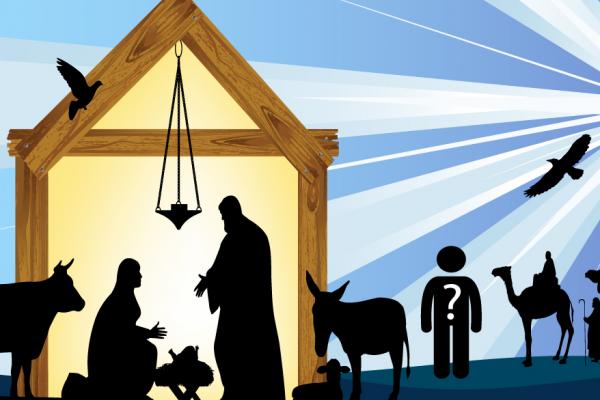
In the church where I grew up, the first Sunday in Advent was dubbed the “hanging of the greens.” On that special Sunday, we sang carols in the decorated sanctuary, all culminating in the children’s live nativity scene. The service never changed from year to year. The only variables were how many kids needed roles and which young child would get stage fright, thus leaving part of the the story without visual representation.
It always seemed like the doves were cursed. The doves rarely remained on stage for the entire performance. Over the years, I was a variety of animals — a wise man, a shepherd, and finally Joseph. I never got stage fright. I was never a dove. I can only imagine what my mother would’ve done if I had been that kid.
It took me years to realize that there was a character missing from my congregation’s telling of the story. We always left out King Herod.
This was a huge oversight, because Herod plays a major role in Matthew’s account of Jesus’ birth.