“Another world is not only possible, she is on her way. On a quiet day, I can hear her breathing.”
~ Arundhati Roy
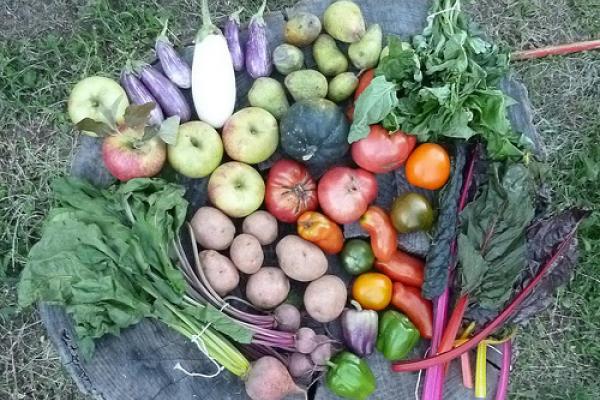
Vegetables.
Who could have imagined an economy in which gentle vegetables were subversive?
But this is our world. A world where a vegetable, whose growth is imperceptible to the naked eye, can spider a crack into the concrete of our industrial food system.
We find ourselves in a food economy that sickens us. Health is divided along race and class lines: the food economy particularly sickens those whose wages do not allow them to buy the foods that can cure us of the diseases industrial “foods” cause.
Corporations, which do not speak the language of human love and health, wrangle to profit from the stream of ill Americans falling from the industrial foods conveyor belt. But we know that type 2 diabetes, heart disease, obesity, and some cancers are fully preventable by replacing part of what we eat with fruits and vegetables.
Why, in a wealthy, fertile country are we wrecking the environment to produce foods that kill us?
The difference between sex trafficking and freelance prostitution is who has the control and who is keeping the money, said prosecutor Lindsey Roberson, an assistant district attorney in New Hanover County. If a girl or a woman is being forced or coerced by a pimp to perform sex acts without monetary gain, that’s trafficking.
The North Carolina Coalition to Combat Human Trafficking ranks the state among the top 10 states for the problem. North Carolina’s three major highways connect much of the East Coast, and the state has a large transient military and farmworker population, and international seaports in the Cape Fear region.
In May, Roberson helped start a deferred prosecution pilot program for first-time offenders with prostitution charges, partnering with a local rape crisis center.
As a Christian, Roberson is also on the board of a new faith-based effort called the Centre of Redemption, which is scheduled to open in December to help pregnant teens and teen moms who are also trafficking victims.
President Obama’s support among Catholic voters has surged since June, according to a new poll, despite a summer that included the Catholic bishops’ religious freedom campaign and the naming of Rep. Paul Ryan, a Catholic, as the GOP's vice-presidential candidate.
On June 17, Obama held a slight edge over Mitt Romney among Catholics (49-47 percent), according to the Pew Research Center. Since then, Obama has surged ahead, and now leads 54-39 percent, according to a Pew poll conducted on Sept. 16.
Among all registered voters, Obama leads Romney 51-42 percent, according to Pew.
Obama and Romney are essentially tied among white Catholics, which some pollsters call the ultimate swing group.
On Sept. 24 Romney unveiled his Catholics for Romney Coalition, which includes numerous politicians, beer magnate Pete Coors and Princeton University intellectual Robert P. George. The Obama campaign also has a Catholic coalition.

The most recent discussions of U.S. foreign policy and the Middle East, once again say more about politics during an election year, than they do about the fundamental issues we must confront if we want to see substantial change.
So let’s look at the basic issues and fundamental choices we need to make.
Today the Middle East — where about 60 percent of the population is under the age of 25 — is a region dominated by humiliation and anger.
Failure + rage + the folly of youth = an incendiary mix.
The roots of anti-American hostilities in the Middle East run deep (literally and figuratively). We can start with the fact that our oil (and its economy) lies beneath their sands. Couple that with U.S. support of repressive and backward regimes, the continual presence of foreign troops on their land and in their holy places, and the endless wars waged there, ultimately fueled by the geopolitics of energy.
Add to that incindiary cocktail the unresolved Israeli/Palestinian conflict, which continues to drive the deepest emotions of mutual frustration, fear, and retaliation throughout the Middle East and the rest of the world.
Injustices and violence caused by the oil economy have sparked a reaction from dangerous religious fundamentalists in the Islamic world. Fundamentalism — in all our faith traditions — is both volatile and hard to contain once it has been unleashed, and it becomes hard to reverse its essentially reactive and predictably downward cycle.
President Obama speaking to the Clinton Global Initiative on Tuesday:
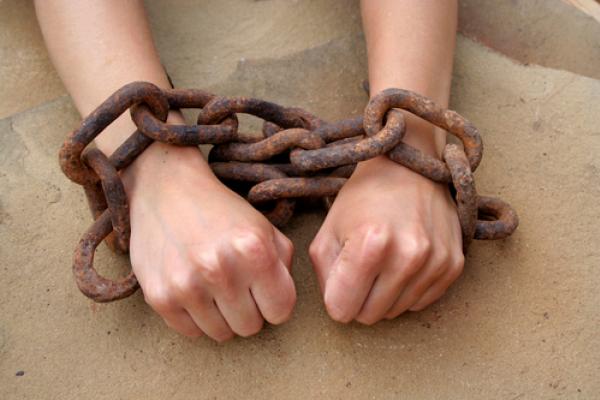
I want to discuss an issue that relates to each of these challenges. It ought to concern every person, because it is a debasement of our common humanity. It ought to concern every community, because it tears at our social fabric. It ought to concern every business, because it distorts markets. It ought to concern every nation, because it endangers public health and fuels violence and organized crime. I’m talking about the injustice, the outrage, of human trafficking, which must be called by its true name — modern slavery.
Now, I do not use that word, "slavery" lightly. It evokes obviously one of the most painful chapters in our nation’s history. But around the world, there’s no denying the awful reality. When a man, desperate for work, finds himself in a factory or on a fishing boat or in a field, working, toiling, for little or no pay, and beaten if he tries to escape — that is slavery. When a woman is locked in a sweatshop, or trapped in a home as a domestic servant, alone and abused and incapable of leaving — that’s slavery.
When a little boy is kidnapped, turned into a child soldier, forced to kill or be killed — that’s slavery. When a little girl is sold by her impoverished family — girls my daughters’ age — runs away from home, or is lured by the false promises of a better life, and then imprisoned in a brothel and tortured if she resists — that’s slavery. It is barbaric, and it is evil, and it has no place in a civilized world.

Global tensions between Christians and Muslims are high as reactions to a stridently anti-Muslim film rage on in many countries. By now, most of us have heard about the video, followed the media coverage of the protests, and mourned those, including the U.S. Ambassador to Libya, who have died from the violence.
In the midst of all this, an organization deemed a hate group by the Southern Poverty Law Center has decided to run ads in New York City subway stations that imply Muslims are “savages.” Many faith groups have spoken out to denounce the offensive ads, but the horse is already out of the barn, as the ads already have been posted and will be seen each day by countless New York City commuters.

This past Saturday, on a brilliant fall morning, my eight-year-old son came bounding downstairs for breakfast. I reached into the refrigerator, grabbed a cold Diet Mountain Dew from in between glass-bottled organic milk and tomato juice, and served it to him with farm-fresh eggs, feeling the part of a drug dealer.
We had a long day ahead, and I wanted to see what happened.
I smiled to myself, imagining some upcoming event, the mothers’ conversation all about peanut-free this and local that, when I’d pipe above the crowd to say, Hey sweetheart, how about your Mountain Dew?
The arrival of Diet Mountain Dew in my house is only the first in a cascade of little experiments we are now undertaking as a result of neuropsychological testing in August indicating that my son has a form of attention deficit hyperactivity disorder. Our house has never lacked order or discipline, and yet now we are thinking about how to structure everything more explicitly.
Diet Mountain Dew, with its massive amounts of caffeine, is our initial effort in our goal of avoiding, for now, giving him any stimulant medications: Did you know that caffeine actually calms down a hyperactive person, allowing them to focus? Maybe that’s why I’ve drunk eight cups of coffee every day since around 1985.
I tried the coffee with my son first, hoping I could cultivate a new bond with him over a shared habit. He detested the stuff. You could always give him Red Bull, one of my brothers said. I couldn’t bring myself to do that, hence the Diet Mountain Dew.
Last spring, I heard a terrific talk from Shane Claiborne at the Festival of Faith & Writing. Claiborne, a prominent voice in progressive Christian circles, lives in Philadelphia’s inner city, where he and the other inhabitants of the Simple Way community practice a “new monasticism.”
They value hospitality and communal living, seek to build relationships with those living in their neighborhood, and are concerned with issues around poverty and wealth, power and violence. From the descriptions I’ve read, the Simple Way practices similar values to the Church of the Saviour in Washington, D.C., where I worshiped for most of my 20s. The Church of the Saviour had the unusual distinction of taking both Jesus and social justice seriously. It was a community in which I was comfortable speaking like an evangelical, while voting and approaching social issues like an Episcopalian.
Listening to Claiborne speak back in April about justice and love and how our stories illuminate God’s kingdom, I felt at home. Here was the kind of guy I used to worship with in my earnest urban-dwelling days. His message, his words, and his stories felt intimate, familiar, and inspiring.
That is, except for this one story...