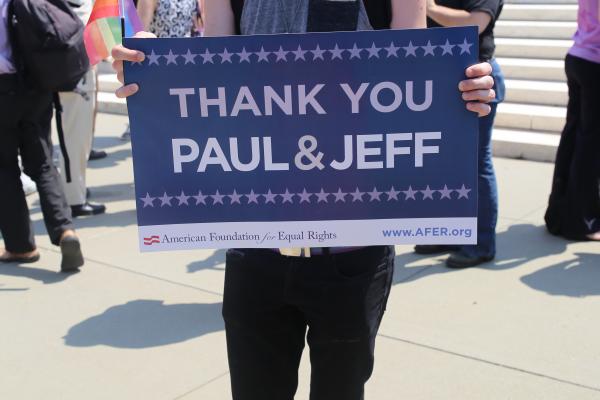
Sometimes a court opinion is more than just a court opinion.
Justice Anthony Kennedy’s 26-page decision Wednesday striking down a federal ban on same-sex marriages offers a window into Americans’ rapidly shifting views of same-sex relationships — a shift that increasingly relies on matters of law and fairness, not moral or religious views.
At the same time, Justice Antonin Scalia’s biting 26-page dissent in United States v. Windsor reflects a set of cultural, religious, and social arguments that are losing ground in the court of public opinion and now, in the highest court of the land.
Famous author C.S. Lewis was recognized for his fictional representation of God/Jesus in the celebrated novel, Chronicles of Narnia. As his theological explanation of Christianity continues to play out, nearly 50 years after his death, Lewis’ legacy of “Narnia” remains resourceful for people in a time of need. The New York Times reports:
But the text for which Lewis is best known is his “Chronicles of Narnia.” And what “Narnia” offers is not theological simplicity, but complexity. The God represented in these books is not quite real (it’s fiction) and yet more real than the books pretend (that’s not a lion, it’s God). That complexity may help people to hang on to faith in a secular society, when they need a God who is in some ways insulated from human doubt about religion.
Read more here.
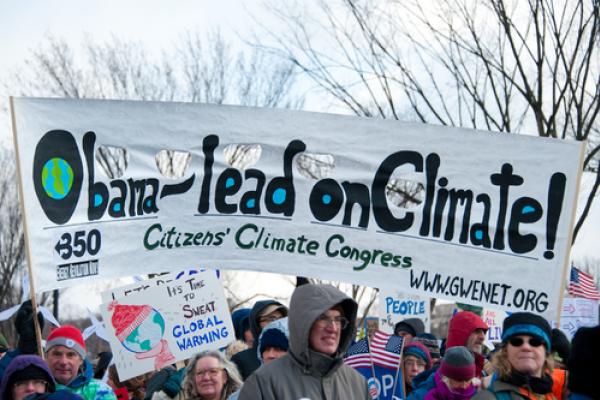
Yesterday was a momentous day for the creation care movement: after years of inaction from Congress, President Obama announced a major, comprehensive plan of action on climate change. President Obama’s new “Climate Action Plan,” which he laid out in a speech at Georgetown University Tuesday, addresses the country’s largest source of climate pollution — carbon dioxide from power plants — as well as boosting energy efficiency standards, renewable energy production on public lands, and resilience for cities, towns and roads.
President Barack Obama revealed his approval of the Keystone XL pipeline project during his climate change speech on Tuesday. With the effort to reduce carbon pollution, Obama has agreed to move forward with the process providing that the Keystone XL pipeline doesn’t release an increasing amount of greenhouse gasses into the environment. The Hill reports:
“Our national interest will be served only if this project doesn't significantly exacerbate the problem of carbon pollution,” Obama said in speech laying out his second-term climate agenda, including greenhouse gas emissions for power plants.
“The net effects of the pipeline's impact on our climate will be absolutely critical to determining whether this project can go forward.”
Read more here.
On Tuesday, the Supreme Court struck down part of the Voting Rights Act that was enacted in 1965 to root out racial discrimination in voting. The specific section of the Act that was stricken — Section 4 — set forth a formula for determining which jurisdictions need federal clearance before making even minor changes to voting procedures. The impact of striking Section 4 is that the most important part of the Act, Section 5, is now rendered useless. Section 5 provides that states, cities, and counties with a history of racial discrimination in voting must “pre-clear” changes to voting procedures with the Department of Justice or a special court in Washington, D.C. Without the formula in Section 4 to determine which states, cities, and counties the preclearance should apply to, the preemptive protection provided by Section 5 no longer exists, and any future challenges to changes in voting procedure must happen after such changes are already in effect.
The majority of the Court felt that racial minorities do not continue to face discriminatory voting practices, and that the preclearance requirement was based on 40-year-old facts that had no logical bearing on present day. Chief Justice Roberts, Jr., wrote:
“Our country has changed. While any racial discrimination in voting is too much, Congress must ensure that the legislation it passes to remedy that problem speaks to current conditions.”
The practical application of Tuesday's decision is that states will be able to enact potentially discriminatory laws that previously had been blocked. This was made immediately apparent in Texas, which announced after the ruling that voter identification laws would go into effect immediately.
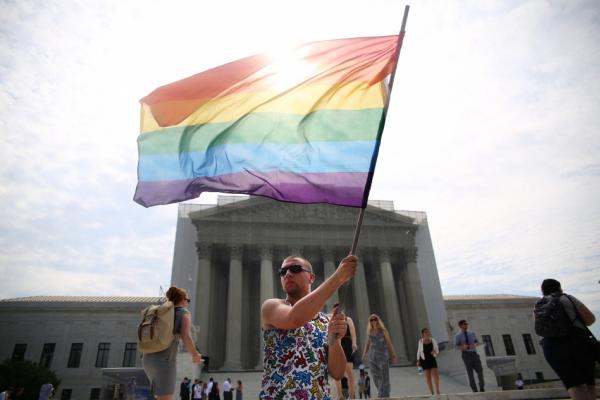
The Supreme Court this morning struck down the Defense of Marriage Act, 5-4, which prohibits the federal government from recognizing same-sex marriages performed in states.
From the opinion:
"DOMA violates basic due process and equal protection principles applicable to the Federal Government. The Constitution’s guarantee of equality 'must at the very least mean that a bare congressional desire to harm a politically unpopular group cannot' justify disparate treatment of that group."
Read the full opinion here.
Following the court's announcement, President Barack Obama Tweeted his support.
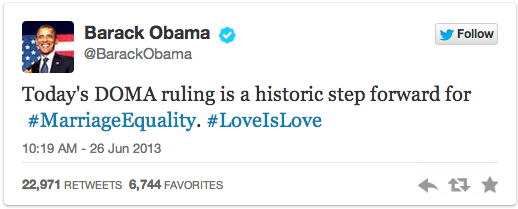
The Washington Post reports:
“The federal statute is invalid,” wrote Anthony Kennedy in his majority opinion, “for no legitimate purpose overcomes the purpose and effect to disparage and to injure those whom the State, by its marriage laws, sought to protect in personhood and dignity.”
Read more here.
Also on Wednesday, in another 5-4 decision, the Court ruled that the appeal to the lower court's decision overturning California's Proposiion 8 — the state ballot measure that ruled that only marriage between a man and a woman would be recognized — had no standing, in effect, allowing same-sex marriage to continue on the state.
Read the opinion here.

Whenever I hear someone lament that kids these days need to read their Bibles, I tell them that the Bible should be rated R for violence, nudity, rape, drug deals, and even genocide – and that’s just in the first book! Of course, as a youth pastor, I’ve found that the best way to get kids interested in the Bible is to tell them that if someone made it into a movie, it would be rated R.
The Bible and movies tell stories. Gareth points out the importance of stories in his article “It’s the Movies’ Fault/It’s not the Movies’ Fault” in which he brilliantly states that, “we could benefit from recognizing that the relationship between storytelling and the formation of human identity is crucial.” Indeed, the stories we tell are crucial to the formation of human identity, but the Bible and movies tell stories that are permeated with violence. So, the question becomes, how do we make sense of those violent stories in terms of human identity?