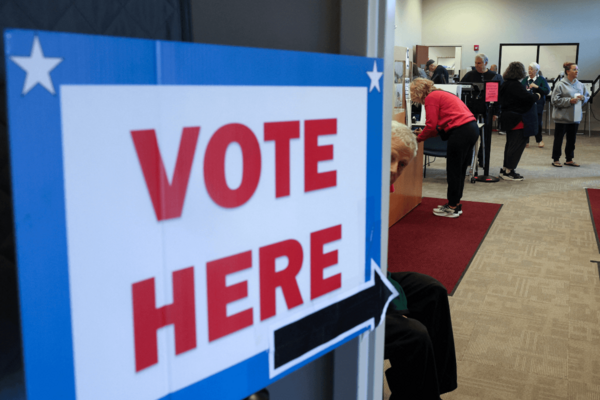
I was part of voting in Tuesday night’s blue wave. I voted for Abdul El-Sayed, whose senatorial race had been called before I went to bed, and I woke up to the news that my current member of congress, an eight-term incumbent Republican, had been unseated.
Across the board, races that were toss-ups or leaned toward Democrats swung bluer than the wildest polling predictions. Texas, Kansas, and South Carolina are all sending Democrats to the Senate for the first time in decades.
Political progressives have good reason to celebrate, sure, but the stunning change of power this election cycle is likely a sign that the curse of incumbency is here to stay.
The tendency for incumbents to lose is a global trend, and we don’t need to think back far in our own history either. The 2018 midterms were also hailed as a historic “blue wave,” just like the 2010 races handed a remarkable slate of wins to Republicans.
For cycle after cycle now, politicians have styled themselves as saviors coming in from outside with fresh ideas or a return to common sense. Subsequently, many have had a collapse in public opinion as meteoric as their rise. Why do we sour so quickly on our political leaders? All these narratives of disappointment are so enticing: broken promises, broken systems, regular people wronged by a faraway other. As a result, we’ve grown to expect our politicians to play a messianic role, both in and beyond our political lives.
Hoping for some kind of greater salvation from political leaders is a deeply rooted human trait. In 1 Samuel 8, we find the story of the ancient Israelites asking God’s prophet, Samuel, to appoint a king to lead them. He warns them of the dangers that come with having a king, but the people insist, and King Saul is eventually anointed.
Now, a system of democratic elections and a divinely appointed monarchy are starkly different ways to organize a government, but at least one element remains similar: the people’s confidence that all we need for security and prosperity are the right leaders in the right seats.
Especially for those of us whose preferred party won, it’s all too easy to turn these midterms into strategic lessons for the future, puzzling over each campaign or candidate and what helped them mobilize enough voters to win. But that’s the wrong way to look at whatever wins there have been for progressives on Election Day; winning elections isn’t enough for larger societal change.
For as long as I’ve had a political consciousness, the overarching theme in American politics has been disappointment. Enough people were fed up with “the system” ten years ago to propel the ultimate norm-breaker, Donald Trump, to office in 2016. When Joe Biden beat Trump in 2020, it was people voting against Trump, not for Biden, that gave Democrats back the presidency. Rejection is a powerful force, but 2024 showed us that it’s a sword that cuts both ways.
I think it’s a mistake to assume that the result of these midterms will be a reliable predictor of the country’s future. Getting caught in the hype of a progressive wave mentality quickly slides into a worse problem: the belief that voting is the ultimate way that an individual can participate in American democracy.
If there’s a silver lining to the disaster of the Trump years, it might be that significant parts of the American public have realized that building a democracy worth living in means more than walking into a polling booth every couple of years. Brazen state violence and increasing attempts to erode civil liberties have reminded many people that peace and freedom are worth defending.
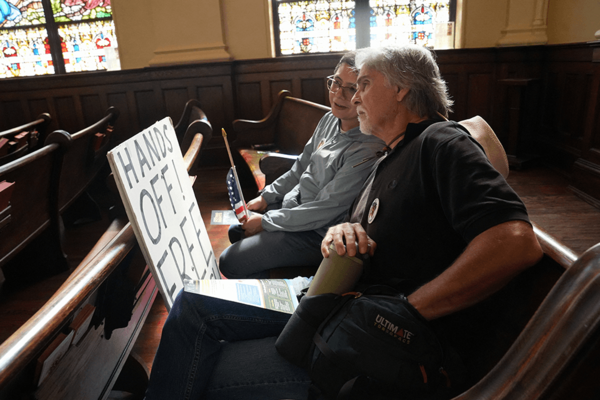
I have been deeply heartened by the role Christians and their churches have played in standing up in defense of their neighbors. Churches I’ve attended in the past year have created support networks for undocumented people in their communities, increased their commitments to providing services for the homeless, and made bold steps to help global partnerships as our government turns increasingly isolationist.
A full blossoming of these support networks might look a lot like the prescriptions for the year of jubilee from Leviticus 25, where the Israelites are commanded to return land to its ancestral holders, let the land rest, and release Israelites who had sold themselves into servitude.
That’s the kind of upside-down kingdom Jesus says he came to inaugurate when he begins his public ministry in Luke 4. He reads from the scroll of Isaiah, quoting the prophet’s vision of jubilee and telling everyone gathered there that this is the moment the messianic promise comes true. Through the following years, Jesus modeled this radical gospel of inviting, restoring, and healing for all, with a special care for those everyone else was content to abandon.
READ MORE: What I’m Praying For After the Midterms
I believe that’s the work that faith in Jesus’ return should inspire Christians to do wholeheartedly. There’s certainly a place for politics to be a vehicle for biblical justice and peace: The way we choose to organize our society dictates who is a stranger and who is welcome, who goes hungry and who is fed, who is sick and who is cared for, who is forgotten in prison and who is remembered (Matthew 25:35-36). We should all think through the implications of our vote for the most vulnerable whenever we step into the ballot box.
But even while we desperately try to do the right thing, we must recognize that we can only do so much to restore our broken world. No matter how good a system we create or how much individual good we promote, we will always live in a world affected by the evil of sin, at least until Christ’s return.
In a 2020 interview with Sojourners, the late theologian Walter Brueggemann said it was “a great temptation for liberals” to think otherwise. The danger of believing that voting the right way will save the world is exemplified in the swings of our national politics, where the broken promises of the establishment perpetually give way to the excitement of populist outsiders who then become part of the very system they promised to abolish. The tricky thing is: This is still true even if the hope is placed in good politicians with good policies. We can pray and act, for a kinder immigration policy, more accessible healthcare, and more compassionate, collaborative international relationships. If we try to make those things our ultimate hope, however, we’ll eventually come away burnt out and disappointed. We can’t create a lasting eschatology in a world where all things eventually pass away.
Brueggemann cautioned Christians to deliberately maintain a “two-track system of hope.” In our politics and every other domain, we are called to be the hands and feet of Jesus to our neighbors in this world. We’re also called to believe in a God who, as Brueggemann put it, “is indeed willing that the world, in all of its parts, shall come to well-being.”
That’s a tough balance to strike. For some people, insistence that God alone will ultimately set things right serves as an excuse to be passive. Others are filled with a zeal to better this world that can tempt them to forget that there will be another world after this one.
This would seem like the perfect place to call for a middle way, but the real paradox of this Christian kind of twin hope is something different than moderation.
The cure for our enduring fear and our politics of grievance is best found in renewing our full commitment to both our practical and eschatological hope. They should feed and intensify each other. Our actions in the political sphere are just one way we can start to glimpse the world as it really ought to be. The right policies can bring about justice and peace, and seeing tangible instances of those things in the here and now sharpens our picture of what God’s redemption of the world will be like.
At the same time, living as people assured that “God’s promise of well-being will outflank all the stuff to the contrary,” as Brueggemann said, allows us to be bolder in the political change we advocate for. Knowing where our ultimate salvation lies is a powerful license to put others’ interests before our own and to risk abundant hope in a world where scarcity is the human inclination.
The cure for our enduring fear and our politics of grievance is best found in renewing our full commitment to both our practical and eschatological hope. They should feed and intensify each other.

Did this article have an impact on you? Tell us how! Whether you’re moved to take action, have a question, or want to share a comment (good or bad), we value your feedback!