The headlines coming out of the Public Religion Research Institute’s 2026 American Values Survey seem simple: White evangelicals are less likely to view empathy as a foundational moral concept and more likely to say it can be a danger. But Sojourners analysis and an outside expert say PRRI’s question design and its own framing of results violate cardinal rules of survey research.
As a reporter and news editor, I’ve used PRRI’s data to help me better understand religious views on a host of issues. The organization is a serious fixture within public opinion polling and has partnered with the American Academy of Religion, the Brookings Institution, The Atlantic, and others. Each year it releases an American Values Survey; the newest survey was released on Oct. 20, which is where the empathy data came from.
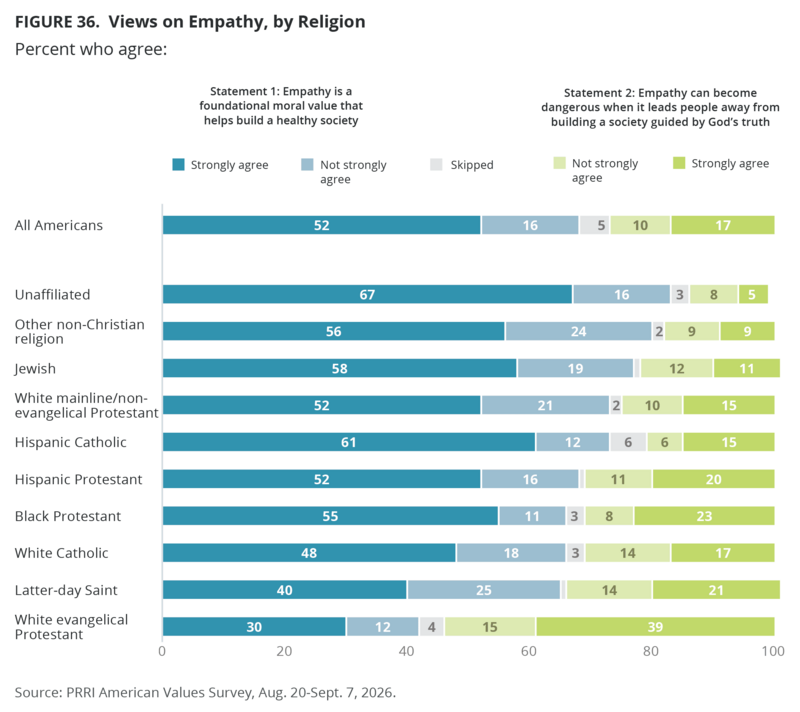
In their press release for the study, PRRI said that the majority of Americans “agree that ‘empathy is a foundational moral value that helps build a healthy society,” and that “Notably, a majority of white evangelical Protestants (54%) believe the opposite: that ‘empathy can become dangerous when it leads people away from building a society guided by God’s truth.’”
As a Christian, I’m certainly paying attention to the arguments about empathy—particularly those in faith circles. As evangelical leaders like Southern Baptist Theological Seminary president R. Albert Mohler Jr. and conservative commentator Allie Beth Stuckey have criticized the value of empathy, PRRI’s poll is meant to help understand the impact of those arguments. But as I began covering the survey, I started to have some questions.
Respondents could choose either “empathy is a foundational moral value that helps build a healthy society” or that “empathy can become dangerous when it leads people away from building a society guided by God’s truth.” They were asked which statement came closest to their views and were asked to rate on a scale of “strongly,” or “not strongly.” But why did PRRI’s survey frame these two options about empathy as polar opposites?
These statements are not mutually exclusive, but there was no option to agree with both, nor an option to state outright that you disagreed with one of the statements (the question could be skipped). Couldn’t someone believe both?
When I asked Melissa Deckman, PRRI’s CEO, about this polarity, she explained that if the questions were asked one-by-one, the result might be that lots of people agreed with both statements.
“Left on its own device, one statement alone is a little bit loaded. Because people think, ‘Oh, a healthy society is something you want,’” Deckman said. “‘Building a society guided by God’s truth’ is something that maybe a lot of Americans of faith want.”
To me, that’s exactly the problem. But despite my experience covering polling as a journalist, I wanted to get an expert’s assessment. I called Jon Krosnick, a social psychologist at Stanford and co-chair of the Stanford Institute for Excellence in Survey Research.
Krosnick hadn’t heard of PRRI before I reached out, but he started our call by praising their use of the Ipsos KnowledgePanel to poll a random sample of respondents. Unlike ‘opt-in polling,’ a popular but less reliable polling method which finds respondents via online advertising, Ipsos uses an “address-based sampling” to ensure an accurate representation of the U.S. population.
“Lots of smiley faces and brownie points to them,” for using a random sample, Krosnick said.
But he saw a lot of issues with the question on empathy. First, if respondents are answering, “which of the following comes closest to your views, even if neither is exactly right” it doesn’t actually measure agreement or disagreement with the statements presented.
“You could actually disagree with both of them, but you could disagree with them at different degrees and so you lean toward one rather than the other,” he said.
261029-PRRIFig.png
A bigger issue was that each option for respondents contained multiple clauses.
“One of the cardinal rules of survey research is don’t ask multi-barreled questions which are asking about multiple things at the same time,” Krosnick said. “The simple, classic example is, ‘Do you like riding on buses and trains?’ Somebody could say, ‘Well, I like trains, but I don’t like buses at all.’”
It becomes even more of a problem when multi-barreled statements are set against each other.
“If somebody thinks, ‘Well, anything that guides people away from God’s truth is not good, but I don’t think empathy can ever be dangerous,’ then it’s not clear how they would react to the second statement,” Krosnick said.
There’s also the possibility that someone would agree with both statements.
“That’s a real problem, which leads me to be uncertain what exactly to conclude from any of the answers to this question,” Krosnick said. “Especially if somebody believes, ‘Well, I don’t think actually empathy would ever lead people away from building a society guided by God’s truth.’ If they disagree with the fundamental premise of one of the statements, they’re unable to answer it sensibly.”
When I first read the survey, I wondered why PRRI didn’t make both statements absolute—empathy “is dangerous,” rather than “can become dangerous.” Then, I learned this is exactly how PRRI framed it the first time they polled empathy in last year’s American Values Survey, asking respondents to choose between “Empathy is a moral value that is the foundation of a healthy society” and “Empathy is a dangerous emotion that undermines our ability to set up a society that is guided by God’s truth.”
I knew that another one of those cardinal rules of survey research is to keep question wording as stable as possible, so I wondered why PRRI would change it. Deckman acknowledged it's not an apples-to-apples comparison, but she said changing the wording better approximated the arguments of evangelical leaders like Joe Rigney (author of The Sin of Empathy) and Allie Beth Stuckey (author of Toxic Empathy). As my colleague Tyler Huckabee has written, both authors are careful not to be absolute in their opposition to empathy.
READ MORE: No, Empathy Is Not a Sin
The wording change also reshaped the narrative PRRI told. In last year’s polling, white evangelicals weren’t the most likely to choose the statement negative toward empathy—Hispanic protestants were. PRRI’s press release for the 2025 survey did not include any note of their empathy results, let alone the phrasing of a “disturbing ‘empathy gap’” that was included this year. PRRI’s highlighted “gap,” which commentators—including PRRI president Robert P. Jones—now use to criticize evangelicals, relies on a question that changed.
Even with Deckman’s acknowledgment and the topline of the American Values Survey footnoting the wording change, PRRI has at times presented the results as if it is apples-to-apples. In a Brookings Institution presentation announcing the survey, Jones said that arguments about empathy have “really gained traction among white evangelical protestants.” News coverage from Religion News Service, which PRRI has partnered with, reported that “evangelicals increasingly see empathy as a danger that can lead society away from God.”
Neither of these things can be said from the actual polling PRRI has done.
What can be said is that it’s much easier to select “empathy can become dangerous” than to select “empathy is dangerous.” We know this because when the phrasing of the question changed, the share of people who associated empathy with danger rose in almost every single religious group that PRRI polled—Jews, Catholics, Black protestants, even the unaffiliated. No group decreased; only Hispanic Protestant numbers stayed the same.
Deckman said PRRI put the statements as direct opposites to measure whether arguments against empathy—like those from Elon Musk, Rigney, or Stuckey—are spreading into different communities. But Krosnick pointed out that steady question polling, asked multiple times, would be the only way to measure that.
“Gaining traction to me sounds like change over time,” Krosnick said. “You cannot answer that with one survey question.” Whatever each group feels about empathy, he said, could have been their views before Musk’s argument against empathy or before Rigney and Stuckey’s books.
Krosnick brought up another cardinal rule he felt this survey violated: “Choose words that are familiar to people, that have as few syllables as possible, that are easy to understand.”
A phrase like ‘foundational moral value,” was too jargony, he said. When I told Krosnick that PRRI’s wording was in hopes of measuring the way arguments against empathy have spread, he said that was even more reason not to use such loaded terms. If researchers want to know whether people are accepting the core arguments of Musk and others, they could express those ideas in “simple, understandable language.”
“[You don’t] have to use the word empathy just because somebody else used empathy in the title of a book or in a podcast.”
If one is interested in understanding how arguments about empathy land among the public, Krosnick said a stronger format would be to define but not use the word “empathy,” to change the question from a single, complex question into a series of simple questions, and to not ask an “agree” or “disagree” question because of what researchers call “acquiescence response bias.”
A poll following Krosnick’s advice might ask: “How important is being sensitive to the experience of others to a healthy society?” and “How important is being sensitive to the experience of others to morality?” and so on.
The empathy question isn’t the only place PRRI has broken cardinal rules of changing question wording, asking multi-barreled questions, and then framing those results imprecisely. In March 2025, PRRI asked respondents to choose whether they view President Donald Trump as a “dangerous dictator whose power should be limited before he destroys American democracy” or a “strong leader who should be given the power he needs to restore America’s greatness.”
Of course there are options between these two that many Americans might choose. And as Krosnick noted, there’s a lot of multi-barreling in each statement. But in September 2025, and in subsequent polls, PRRI added the word “potentially,” to the first question, asking not if Trump “is” a dictator but instead if he is “a potentially dangerous dictator.” They didn’t note the word change in subsequent topline results nor in their press releases. And when reporting these findings, PRRI sometimes cut the word “potentially.” The headline for the 2026 American Values Survey press release was “Six in Ten Americans See Trump as a Dangerous Dictator.”
When I asked Deckman if she saw a difference between saying someone “is potentially” something and saying someone “is” something, she said she didn’t: “Otherwise, we wouldn’t have allowed that sort of headline to go out.”
When I later inquired about the wording change, Deckman responded by email to acknowledge that PRRI should have noted the addition of “potentially” in its topline results.
“We are also now adding language in our topline reports that indicate the change in question wording since March 2025 to correct that oversight in the subsequent surveys” Deckman wrote.
I appreciate that PRRI has corrected these and other errors I raised to them but considering the way their erroneous framing influences journalists and commentators, I wish they would be transparent and note when they made a mistake.
Public polling is a vital and important way to keep up with public opinion. When done well, it helps cut against personal biases and anecdotal feelings. But when done poorly it only reinforces those biases and anecdotes. It becomes ammunition in culture war battles and, coincidentally, hardens us against empathy.
I appreciate that PRRI has corrected these and other errors I raised to them but considering the way their erroneous framing influences journalists and commentators, I wish they would be transparent and note when they made a mistake.

Did this article have an impact on you? Tell us how! Whether you’re moved to take action, have a question, or want to share a comment (good or bad), we value your feedback!