Earlier this week, the Evangelical Press Association voted to change its name, dropping “evangelical” to become the “Christian Communicators Network.” The move follows a 2020 name change from Evangelicals for Social Action, founded by Ron Sider, to Christians for Social Action.
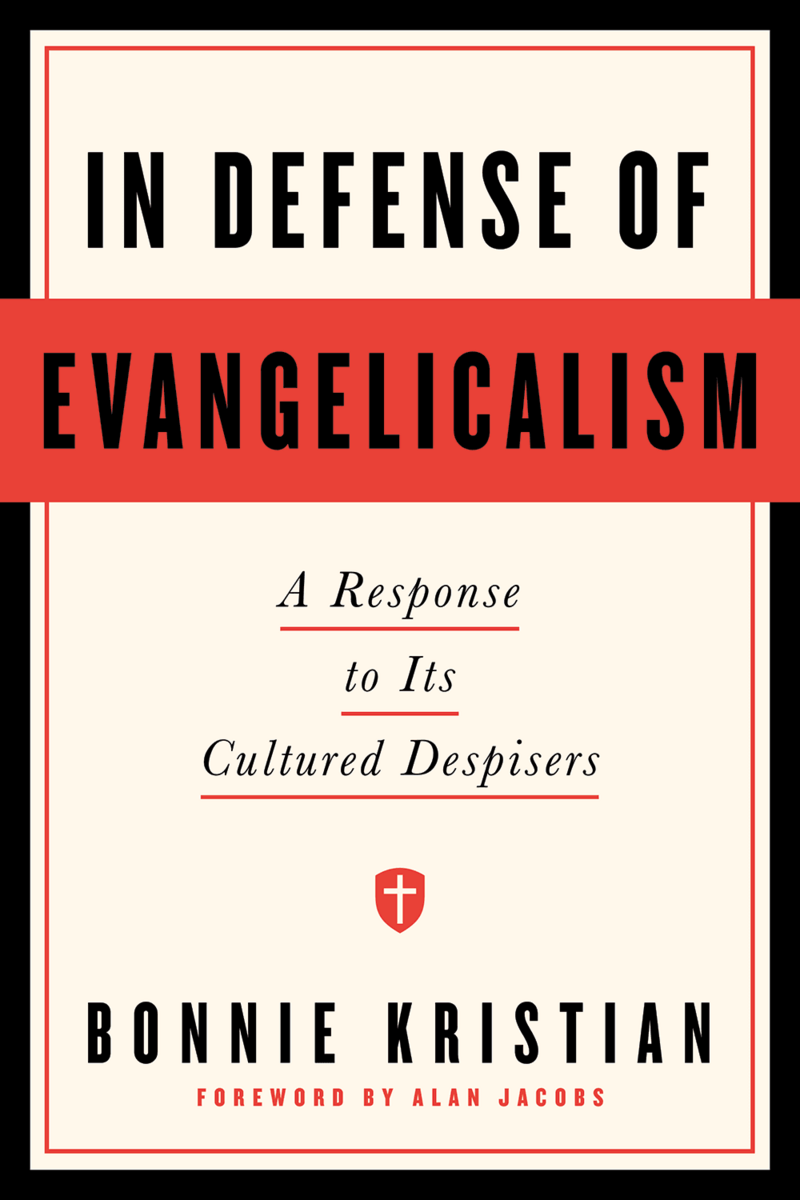
Both groups cited the current American political climate as baggage that had attached to the term in ways that made “evangelical” no longer useful. And public polling finds that evangelicals are the religious group viewed most unfavorably by Americans. It can seem like no one wants evangelicals to be “evangelicals.” Bonnie Kristian, author of In Defense of Evangelicalism: A Response to Its Cultured Despisers, hopes to intercede. Kristian, having written for and served as an editor at Christianity Today, has had a close look at evangelicals and their critics.
In her book, Kristian reads and responds to the work of several journalists and scholars whose work can be critical of evangelicals—Tim Alberta, Kristin Kobes Du Mez, Jemar Tisby, Anthea Butler, Samuel L. Perry, and others. A tightly argued book, she contends that evangelicalism is not worthy of the ire it receives from culture nor is it as harmful (to individuals, communities, or democracy) as scholars say.
Kristian believes many criticisms mistake the margins of evangelicalism for the center. At the center, she says, are regular Christians who seek to love God and neighbor and want to live their convictions alongside those neighbors.
In our conversation, we discussed who belongs in evangelicalism, how those boundaries are enforced, whether evangelicals support authoritarians, and more.
This interview has been edited for length and clarity.
Mitchell Atencio, Sojourners: In the introduction to your book, you have this anecdote about telling your mom you’re writing this book and she asks what an evangelical is. You say “We’re evangelicals. You’re an evangelical.” When did you first understand yourself as evangelical?
Bonnie Kristian: I really started actively thinking about it, especially in political context, in the last decade. I am hyper aware as a journalist who has written about evangelicalism, both for Christianity Today and in secular newsrooms, of where the public discourse is about evangelicals. I came to this project with some trepidation about that. Even now, if someone were to ask me in my personal life, “Are you an evangelical?” I would want to know, “Well, what do you mean by that?” Because what we say is not necessarily what someone else is going to hear.
If I’m looking at this group of people and thinking in the context of the wider church, it seems to me that the place I fit best is evangelicalism, and that’s a fair description to apply to me.
In your introduction you also say, “the best question is rarely whether someone is or isn’t evangelical. Instead, we should consider whether someone is more or less evangelical.” More or less compared to what?
Evangelicalism is not a formal membership organization. More than one person has joked, “I’d like to leave evangelicalism, but I don’t know where to send the letter.” That’s quite different from the Roman Catholic Church.
It’s useful to think about evangelicalism as something that has a knowable center and quite fuzzy boundaries. That’s not no boundaries. Evangelicals are creedally orthodox Protestants—you cannot meaningfully speak about an “evangelical atheist.”
In terms of what that center is, what we would say is someone who is “more evangelical,” we can talk meaningfully about what is typical of evangelicalism in a given time and place. I’m particularly speaking about American evangelicalism now and asking “What is the norm? What do most of them do and like and think?”
To give an example, looking at those Bebbington emphases, they have to be practiced in community. I am not willing to say that someone who does not go to a local church and has no real-life community is not an evangelical, but I would say they are very much less.
In talking about “more or less” rather than “is or isn’t,” part of my goal is to keep me honest. I don’t want to be just defending the nice, polite, college-educated evangelicals who have politics like me. I don’t want to be able to draw convenient lines. And part of it is holding some of the voices that I’m engaging with to a higher account. There are times when they are leveling things that should not be leveled. They’re treating things that are of very disparate influence, import, and popularity as if they were equal among the average, median evangelical, and they are not.
“More than one person has joked, ‘I’d like to leave evangelicalism, but I don’t know where to send the letter.’”—Bonnie Kristian
Do you think evangelicals could adopt your “more/less” framework when deciding who belongs in evangelical institutions?
It really depends on the institution and their purposes. If you’re thinking about the Council for Christian Colleges and Universities, evangelicals tend to be pretty conservative and traditional on sexual ethics. If you’re trying to do an organization that maybe doesn’t represent every evangelical but represents a particular grouping of Christian colleges that are going to tend to have similar beliefs and therefore student life policies around sex, then many of those membership institutions are going to want you to draw a line one way or another.
It’s important to think about the decline of institutional life in America as a whole and the fragmentation of institutional life—and this is not unique to evangelicalism. Looking to institutions is still helpful to understand what evangelicalism is; looking at denominational affiliation can be really helpful to get a more nuanced count of American evangelicalism than just self-identification. But it’s a less useful tool than it used to be because of how fragmented we are, how much institutional decline there is, and the rise of nondenominationalism.
I ask because of the conclusion to your book, where you write “Effective critique will be made from evangelicalism’s own commitments and by its own people. We need less revulsion and ridicule from without, more reformation from within.” And I wasn’t sure how you square that “within/without” distinction with your more/less framework. How do those align?
The historian George Marsden has that famous quip “an evangelical is anyone who likes Billy Graham.” Billy Graham, at the height of his powers and his fame, if he comes out with a critique and says, “we need this reform,” he is speaking to a mass of people who care about what he thinks in a way that no one can do now. There’s no way to update the Marsden quip with something comparable.
That fragmentation means that the internal drive for critique and reform is not going to tend to be one big thing. We don’t have the pope; we don’t have bishops. It’s going to have to be people within these smaller—formal and informal—networks and institutions.
Something that you and I have seen professionally, and I’ve seen personally, is that when critiques are made from within, those critics soon find themselves on the outside of evangelicalism. Jemar Tisby, whose work you critique, was pretty well enmeshed in evangelicalism when he published The Color of Compromise. He wrote for The Gospel Coalition; he was speaking at evangelical colleges. After the book came out, there was a heavy backlash from evangelicals.
There wasn’t any analysis in your book of the reaction to Tisby’s work. What did you make of the reaction to the The Color of Compromise?
I know that there was a controversy around him speaking at Grove City College, which is up the road from me. Frequently when I’m there to speak at a class or something, someone will make a comment about what a fiasco that was and how bad it was. I don’t feel like I know the full account of what happened there. I’ve looked into it—I don’t know that I have a good sense of the reaction.
I do know that Tisby’s next book [Notes from an Evangelical Reject] seems to be an expression of his sense of being rejected by evangelicalism. I’m eager to read that.
To your broader question about how evangelicals receive critique—it’s a mixed bag. You absolutely see that classic evangelical thing of, “We’ve always got to be repenting.” That ever reforming mindset, very eager to receive that critique and say, “Where did we go wrong? What can we do better? Please tell us about our sins so that we can repent of them.”
There are absolutely also evangelicals who react defensively, who are unwilling to hear that critique. I’ve seen it online about Du Mez; I’ve read these things about Tisby—some really cruel reactions. That’s undeniable. What I would say about that latter group, maybe not the truly cruel people, but the defensive people who are not able to receive the critique, is part of my interest in writing In Defense of Evangelicalism is to say many, not all, of the critiques of evangelicalism in recent years have been disproportionate or inaccurate or otherwise off the mark. And there have been so many of them. It has been relentless. That’s one reason, but not the only, it is difficult for some evangelicals to hear needed critiques, because of the volume of critiques that they know ring false.
I came across this quote from Bill Pannell, a prominent Black evangelical who lived from 1929 to 2024, and he said that over his lifetime “the evangelical movement became more and more American and less and less Christian.” Do you agree?
I loathe to contradict Bill Pannell. His book is so wonderful. I would say yes and no.
Yes, in the sense that American evangelicalism could use a heftier dose of, and more clarity around, Anabaptist influences. We often tend to have muddled thinking around engagement with politics and with the American state and American history and our identity and the loyalty that is demanded of us.
Also, as the historian Thomas Kidd says, evangelical was a term of journalists and academics. For many people in the pews, even if they know that the term applies to them, they’re thinking primarily of some other identifier—Baptist or Lutheran or just “Christian” or fundamentalist. Evangelical is the favored term in the political discourse, so it takes on those political overtones and is discussed in those political contexts. It’s a vicious cycle of how we talk about evangelical as a political identity.
I was involved with children’s ministry at my first church as an adult. One night they had a guest speaker, and he did some kind of illustration for the children with the American flag—the red was the blood of Jesus, etc. I remember being like, “Oh no, what are we doing here?” I went to one of the older leaders and said “Do you notice the message we just told these children? What if a child from another country was here?” He clearly hadn’t thought about it before. But as soon as I said it to him, he went up immediately after and said to the children, “We thank the guest speaker so much for coming and sharing with us. But we do want to be really clear that Jesus is for all people and for all countries. Being a Christian is not the same as being an American.”
He made this good distinction in the moment, with an immediate willingness to do that. That brings me to the way in which I would say no.
One example of why I might say no is from back around 2008-2009. A poll came out that found white evangelicals most likely to say torture could be justified. Now, there was still a minority who said absolutely not, but we were the most likely. But another poll found that if you reframe the question and you specifically put it in golden rule terms, that support dropped precipitously.
[The second poll found that when Southern, white evangelicals were asked if they agree that “the U.S. government should not use methods against our enemies that we would not want used on American soldiers,” the percentage who said torture was rarely or never justified rose 14%.]
There is a real messiness here in how we relate to politics and the state, and sometimes a failure to bring to bear our convictions in that arena. When evangelicals are in our political brains, like many Americans, we tend to think very simplistically, in tribal terms, and sometimes very cruelly. But when we are explicitly reminded of our faith, there is a meaningful difference. And it is a difference that evangelicalism is making for the better.
“When evangelicals are in our political brains, like many Americans, we tend to think very simplistically, in tribal terms, and sometimes very cruelly. But when we are explicitly reminded of our faith, there is a meaningful difference.”—Bonnie Kristian
Let’s talk about where evangelical convictions come into conflict with others. You have a chapter on Sun Lee, an evangelical owner of a Korean Spa who has sued to protect his right to refuse serving transgender women who still have a penis. You write, “In public life in the private sector—in civil society and the open market—evangelicals should be able to live and work according to our convictions.” I know you’re a libertarian, so I do want to ask genuinely, do you believe there should be any limits on that?
Yes. When we’re talking about those kinds of protections around basic human needs—everyone needs to be able to eat; everyone needs to have a safe place to sleep—I think that’s appropriate. Generally speaking, many laws where the state is requiring a positive action of a private actor, we do offer religious liberty exemptions and sometimes a certain amount of scaling—what the government requires of a business of 3,000 is going to be different than what they require of a business of three. That kind of thing is very appropriate here as well.
There’s a big difference between going to a spa and going to the grocery store. Getting your entire nude body scrubbed by a Korean immigrant woman is not the same thing as buying a loaf of bread. So, while civil rights law does often have us weighing competing rights and interests, in this case, it seems to me that the scale is quite uneven.
I understand why you and other evangelicals worry about the possibility of pluralism and civic compromise on these laws. But I wonder whether pluralism and compromise are serious desires of evangelicals or just what feels politically accessible at this moment. You write about it being deranged that a trans woman would want to attend a woman’s spa without having—
I talked about it being deranged that the state required Lee to admit it. What a private individual wants is a totally different matter. What I am speaking to is the law.
And when you write, “For the scrub techs, it would border on sexual assault”?
I mean, again, the state is the one who would compel them. It’s the compulsion that requires it to happen, and that makes it a forcible encounter. The way in which it is assault is that it would be compelled by the state on an unwilling tech.
You used he/him pronouns for Haven Wilvich, the transgender nonbinary woman who originally wanted to be a patron at the spa. [Editor’s note: Kristian did not use any pronouns for Wilvich in the book, opting instead to use only Wilvich’s last name. In the section on the case, before Wilvich is mentioned, Kristian writes, “If a male identifies as a woman, even if he has a fully intact and functional penis and testicles, Washington State says Olympus Spa must admit him.” In the interview, remarks about Wilvich are printed as spoken. Sojourners refers to people by the names and pronouns they use, but we publish quotations in their original form; Kristian’s language does not reflect our style or editorial position.]
Why should people who disagree with evangelical conservative sexual ethics feel compelled to build a society that respects those individual faith beliefs when evangelicals often don’t respect trans people in particular nor want to extend that sort of pluralistic courtesy to them.
I would ask you why using someone else’s preferred pronouns in every context is the baseline of respect. I want Wilvich and any other trans person to be able to flourish in their lives. In the United States, they’re equal citizens. They have equal rights. We engage in the democratic process together. If Wilvich wants to open a spa and not admit any evangelical Christians, I don’t know if the law would allow it, but as a libertarian, go for it. I am very much interested in live and let live when it comes to adults in America who are able to consent.
I don’t accept the notion that calling Wilvich, who is a male person, he/him, is inappropriate.
You don’t think it’s disrespectful?
I don’t think it’s disrespectful, no. I’m calling Haven Wilvich by the name he’s chosen—I don’t know and haven’t even looked into any other name. And as I said, deliberately not focusing on Wilvich because that’s not the point; the point is the law. Does the law compel Sun Lee and his family to violate their understanding of what God requires of them for something that is not analogous to buying bread or staying safely in a hotel? You do not need a spa scrub by a woman to survive.
261014-IDECover.png
Let’s talk a little bit about President Donald Trump and evangelicals. Do you think of Donald Trump as an authoritarian? As somebody who’s violated the bounds of democracy and acceptable governance?
Definitely he has authoritarian instincts. He’s obviously incredibly self-aggrandizing, interested in his own authority and glory. I don’t think he respects the Constitution. Has he violated the bounds of acceptable governance? I would say yes. Has he violated the bounds of democracy? I think that’s debatable. I understand what you’re saying; I agree to a large extent. But, in many ways, our democratic institutions have held. That’s not to say they shouldn’t be shored up or that there’s nothing to worry about. But I do feel comfortable saying American democracy is intact. Not “perfect.” I’m probably doing too much of nuance for a thing on that.
My question is to understand whether you think you were defending evangelicals supporting a bad president or somebody who is outside the pale of what is acceptable within democracy.
I don’t know if I would say outside the pale of what’s acceptable in a democracy. That’s a tricky one. Because democracy, you know, as a bare form of governance, is about majoritarian rule and the will of the people. And he did get elected twice.
Is it in the deeper spirit of democracy of equality and care for all people? I think no.
I asked the Pew Research Center about evangelical job approval of Trump. In January of 2026, 55% of evangelical Protestants approved of the way that Trump was handling his job as president. In July, most recent when I asked, it was still 51%. In comparison, 34% of U.S. adults overall approved.
If half of evangelicals still approve of the job Trump is doing as president, and Trump is an authoritarian, doesn’t that mean evangelicals support authoritarianism?
I would be interested to see the “approve, very strongly” versus “approve, not so strongly” breakdown. That might be meaningful or it might not. To an extent, the answer is yes, that does mean support. It’s also support in comparison to what? They’re not answering that question in a vacuum. They’re answering it in comparison to what are the other meaningful options for control of the federal government? And that’s the Democratic Party, which, as I explain in the book, is not tolerable to most evangelicals because of the abortion politics. Obviously there are other issues that matter as well, but that is a very consistent baseline. There is an approval there that I do not share, and that is meaningful. I would not necessarily treat it as like a full-throated, context free approval.
When being asked, “Do you approve of how he’s handling the job of president?” You’re not being asked in comparison.
No, but people are thinking about it that way. You don’t think they’re thinking about it in comparison to who else could be in charge and what the viable political alternative is?
I suppose if someone asks me if I approve how the president is doing, whoever the president is, I either just say yes or no. I think evangelicals would be capable of just answering the question.
I don’t know. I don’t think that the question is quite that simple. When I think about our recent presidents, not just Trump, but also Biden and Obama, or Bush, there are things that I approve of and there are things that I don’t approve of. They’re asked to give an up-down answer and maybe they should all say, “I don’t know,” but they’re asked, do you approve or do you disapprove? I would hope that they would answer “no, I don’t approve.” But I think people are thinking in context and they are thinking about a multiplicity of issues, not just overall.
Let’s end on the “cultured despisers” in the book. The figures who you critique—Kristin Kobes Du Mez, Jemar Tisby, Tim Alberta—how many of them have you been able to talk to about your criticisms?
I’ve mostly talked with Du Mez, and that’s been in public. Did I reach out to them ahead of time? No, I engaged with their published works that they presented to the public. If I had run into a question where I didn’t know what a person really thinks about an issue, and I wish to speak to their views on this issue, I would have reached out to them, but I didn’t have those questions.
When I’m speaking about “cultured despisers,” I’m not necessarily speaking specifically about the voices that I engage. I’m speaking about a broad environment of discourse.
I took care to say that some of these people are approaching the subject of evangelicalism quite differently than others. Some of them are speaking with much more proximity and with much more interest in reform. Some of them are speaking with much more distance and much more disdain. I tried to take care to distinguish that about each writer and make quite clear if that label is more or less accurate to an individual person.
As far as those three that you named, I’ve engaged with Du Mez. I would love to hear from Tisby or Alberta or any of them, if they’ve read the book, what they think of it. Alberta in particular, I greatly respect as a fellow journalist and would be delighted to dialogue with him.
When I was preparing for this, I read your review of Charlie Kirk’s posthumous book, which you say you’re thankful for compared to what else evangelical young men could be reading. In your book, you often tell readers to ask, “compared to what?” Because you want critics to consider what’s actually accessible to the evangelicals they criticize. But when I look at that question, my “compared to what” brings to mind not just other types of Christians, but those in evangelicalism like Ron Sider or Jim Wallis or even Tisby and Du Mez. Even where I may disagree, I’d far prefer evangelicals read and listen to those people than Charlie Kirk. Do you?
We can we can talk in the abstract about whether the young men who like Charlie Kirk should read Du Mez instead. In a lot of cases, I don’t think that that was ever realistically going to be on their reading list. In the absence of Kirk, where they’re going to go is somewhere much grosser and darker and explicitly racist and antisemitic. Someone like Nick Fuentes, a Holocaust denier.
It is all very well and good to say, wouldn’t it be nice if they did something better? But in practice, if where their algorithms are taking them is much worse, then I don’t think it’s actually that controversial to say I would rather they read Charlie Kirk’s probably AI-generated book about the Sabbath and getting off your phone. I would prefer they do that.
Would I also love them to read something better than that and read about church history and the evils and the goods in church history and get the full nuanced picture of everything that has happened in the 2000 years since Christ? Yes, I would like them to do that.

Did this article have an impact on you? Tell us how! Whether you’re moved to take action, have a question, or want to share a comment (good or bad), we value your feedback!