There's an early moment in the new Little House on the Prairie series that I keep thinking about. As the Ingalls family makes their way by covered wagon to the Kansas prairieland, they encounter a Black physician named Dr. George Tann. Tann (Jocko Sims) is a real historical doctor who helped the Ingalls family overcome malaria in the original book; here, he is the sole witness as the Ingalls family recklessly crosses a river and almost drowns in the process. And as he helps patch up their injuries, he remarks, “It is a myth that men can make it out here alone. It’s a pretty story, nothing more. Find help, any way you can.” It’s a nice first-episode thesis statement for this version of Little House, and an ironic one, given that the original book series was a formative piece of American mythology about, among other things, the virtue of self-reliance.
The original Little House books were written from the intimate perspective of a young girl who has little understanding of the complex cultural and political wars being waged around her. Still, critics over the years have noted both the damaging tropes (toward Native Americans especially) present in Laura Ingalls Wilder’s writing and the way that she constructs a folksy retelling of her childhood that overly romanticizes her father’s many shoddy and misguided decisions as part of the bootstraps pioneer spirit. In her later years, Wilder staunchly opposed the New Deal and anything resembling government handouts—and her daughter Rose, instrumental in the completion of the series, would go on to become a prominent founder of the libertarian movement. By contrast, this version of Little House is less concerned with independence and more with interdependence; it is simultaneously an affectionate retelling of its source material and a thoughtful deconstruction of the rosy ideals that masked messier truths.
Conversations about literary adaptation and the stories we tell about our past have been hovering prominently in the zeitgeist. In the last few months, vitriol has spread about various adaptational choices in The Odyssey, particularly Christopher Nolan’s decision to cast people of color in a few roles. At the core of the debate is disagreement about how we understand and depict history and the ways we bring it into the present day. In the political realm, the Trump administration has been doing everything in its power to sand down the edges of America’s past and construct a modern myth of triumph and white exceptionalism: including but not limited to defunding and censoring museums and national park exhibits that highlight slavery, civil rights, Indigenous cultures, or LGBTQ+ history.
In the midst of these debates, the new Little House on the Prairie show has received similar aggression in right-wing spheres: Following Netflix’s announcement of the new show, Megyn Kelly issued a threat to “make it [her] singular mission to absolutely ruin your project” if the streamer “wokeified” the material. But the show has also flown under the radar after an initial backlash that soon lost steam.
Despite Kelly’s threats of woke Little House armageddon, this take is one of the more faithful adaptations to the original books that has ever been produced—as sweet-spirited and family-oriented as the novels and the 1974 TV series ever were. Alice Halsey, who plays Laura, is everlastingly charming—and Warren Christie is a standout as the indelible family friend Mr. Edwards. In a world of cheap-looking streamer shows, this is one that also looks and feels grand and beautiful to watch—the musical score by Dan Romer is gorgeous, the cinematography calls to mind the intimacy and scenic landscapes of last year’s Train Dreams, and the whole thing is underscored by a constant motif of family fiddle-playing and hymn-singing, which was one of my most-treasured memories from listening to the audiobooks growing up. The show is warm and often heartening to watch, celebrating many of the things that the original books esteemed: hard work and determination, simple pleasures, and gratitude for a beautiful world, even amid its many hardships.
Make no mistake, however: this new Little House show is a radically reimagined adaptation. For as much of the past as it celebrates unreservedly, it’s obvious that showrunner Rebecca Sonnenshine is interested in honestly wrestling with some of the core tensions of the source material and incorporating marginalized perspectives (including Black and Indigenous voices) that were largely sidelined or even harmfully characterized in the original text. This is a Little House show with multiple episodes directed by Indigenous filmmakers, and a historically consulted narrative and cast that fleshes out the perspective and family lives of the Osage people, on whose Kansas land the Ingalls family is settling.
As part of this expansion, Sonnenshine introduces the neighboring Osage family of the Mitchells: William, White Sun, and their daughter Good Eagle, who becomes Laura’s best friend and helps teach her to read. And through the relationship that emerges between the Ingalls and the Mitchells, we begin to understand the complex tensions within the Osage and white settlers; even William and White Sun disagree about what to make of the Ingalls family and the increasing possibility of their own family’s departure to Indian Territory elsewhere.
READ MORE: Nolan’s Odyssey Confronts Civilization’s Original Sin
Notably, the Mitchell family seems more devoted to their Christian faith than the Ingalls. A wooden cross hangs in their well-furnished home. And in at least one key moment, White Sun prays to Wah’Kon-Tah—the Osage name for the supreme God—to protect Laura on a dangerous journey and “that the enemy nor a creature will harm her.” Not unlike the depiction of the Osage people at a later stage of their history in 2023’s Killers of the Flower Moon, this take resists tired “cowboys and Indians” tropes and homogeneity, instead highlighting the ways that Indigenous people even in this period were far more diverse than is usually portrayed in settler-focused narratives.
This Little House also leans into the tragic ironies and undercurrents of the story that previous adaptations largely shied away from. Childhood readers of the original books may not remember it, but the original Little House on the Prairie novel ends on something of a sudden downturn; after only around a year spent building their ‘little house’ in the Kansas countryside, Charles Ingalls decides it’s time for his family to pack up their wagon and move elsewhere when he finds out that U.S. soldiers will be sent to forcibly remove white settlers from Osage territory.
It’s an off-putting and anticlimactic ending for a story that has become such an iconic picture of what work, family, and home mean in (white) American life. And it explains why some of the more prominent adaptations of Little House—such as the 1974 Michael Landon series—have historically decided to pick the story up after the Ingalls family leaves Kansas, moving instead to Walnut Grove, Minn. It’s a tidier picture with more roots to put down and fewer thorns around the edges of the frame.
Still, the fact that the idyllic Ingalls family was, in fact, squatting on Indigenous land at the expense of the people who actually lived there is a significant and inconvenient detail that many fans and subsequent storytellers have often skirted until now.
Where the updated take on Little House finds its voice is not by recasting the Ingalls family—or the original books—as comically evil or intentionally malicious. Instead, Sonnenshine is more interested in the inherently tragic ironies and complex intercultural relationships of such a tale—and the way that the hope, optimism, and faith of the American story have sometimes (naively or deliberately) danced around the cost of it all.
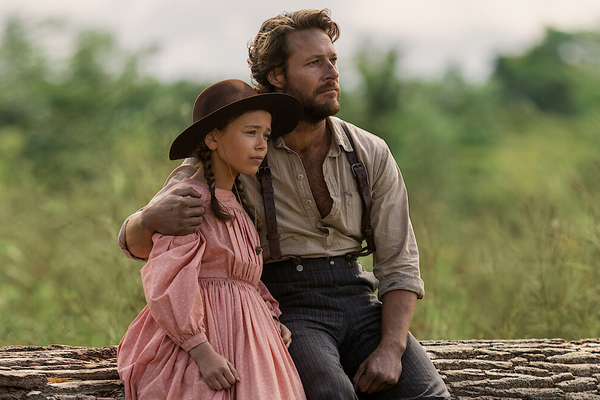
Charles Ingalls (or Pa, as his children know him, played by Luke Bracey in the show) is a chipper, starry-eyed dreamer. He’s excited about the promise of free land out West—he heard about it through flyers that made their way up north—and the possibility of a place for his family to truly call their own. When the family dog, Jack, is lost during the river crossing that kicks off the show, Charles tells Laura that “hope is everything,” encouraging her to have faith that Jack will eventually find his way back to them. It sounds ludicrous until, miraculously, Jack does make it home.
Charles’s optimism—and plucky young Laura’s childlike trust in him—is core to the heart of the series. “This will be our new forever,” Laura says of the family’s new home in Kansas, and Charles agrees with her. And Charles isn’t the only optimist; we’re soon introduced to Independence town founder and railroad executive Eli James, the man who turns out to be responsible for the flyers advertising free land out west. But Eli James has built his town on a lie; as soon as the family arrives in town, Charles begins to hear conflicting reports about whether the land is, in fact, free to begin with. Some say that a “fair” deal with the Osage will be finalized very soon, and their people will move on. Others, like newfound family friend Mr. Edwards, tell Charles that the prospect of a deal is all pretense: “They’re speculating,” he says, “hoping that the government is gonna step in and force the Osages out … There’s nothing free about this land at all.” As the story continues, it becomes increasingly evident that there’s no way this ends cleanly—and yet, the brash Eli James tells Charles, “have faith!”
Watching this show in our current moment, the word “settler” hit me differently than it did when I was a child reading the books. These days, the “settlers” that appear in my news feed most often tend to be those in the occupied West Bank, often violently encroaching on land that Palestinians have owned and lived on for generations. And for many, these settlers’ strategy remains the same as the one in Independence: Trust (or “have faith”) that the Israeli government will not defend Palestinian dignity, and the land they’ve violently taken will eventually be granted to them legally. Suddenly, the fact that the primary characters in Little House are themselves “settlers” feels less charming and aspirational than it did in my youth.
Still, like many in post-Civil War economic straits who were vulnerable to unregulated false advertising about “free land,” the Ingalls in the Little House show are only beginning to understand the consequences and implications of stolen land built on a romantic ideal.
It’s a strange experience: the rude awakening to your own complicity in a creeping atrocity. I was reminded of an account from Polish Holocaust survivor Genya Kowalski in the book The Holocaust and the Nakba: A New Grammar of Trauma and History edited by Bashir Bashir and Amos Goldberg. In an interview in the book, Kowalski recounts the shock she experienced when she arrived in the newly established state of Israel in 1949 only to realize that she would be displacing an existing Palestinian family in their home:
“We opened the gate, opened the door and went in and we couldn't believe our eyes… We were in shock. The house was beautiful, but we didn't even enter the house because in the yard there was a round table set with plates, and as soon as we saw this… we were frightened. And besides the fear, we could not look, it hurt us... it reminded us how we had to leave the house and everything behind when the Germans arrived and threw us into the ghetto. And here it was just the same situation, and it was not in us to stay. I did not want to do the same thing that the Germans did.”
What do we do when our fathers’ naivety fails us? What do we do when we begin to realize that our hope is built on the backs of others’ heartbreak—and our faith is in a future that does not belong to us? These are some of the questions at the heart of this version of Little House—and maybe even at the heart of American society. In all our efforts to sanitize history and sand down its many edges, we seek to avoid the realization that our figurative ‘fathers’ may have been wrong or done wrong.
For their part, Laura and the Ingalls family (particularly their mother Caroline, who has an arc of understanding for the Osage) feel more empathy and conflictedness about these questions than their literary counterparts felt in the books. By giving them these moral qualms about their own actions, does the show itself sand down the historical edges of who the Ingalls may have truly been? Perhaps—though I think it’s also arguable that Sonnenshine is using these quintessential American characters more as fictional (and safely familiar) vessels to cause us to properly wrestle with such questions ourselves.
In all the show’s wrestling, one thing is clear: The answer does not lie in hopes and dreams of isolated “independence” from others and their struggles. Laura says as much when she participates in a speech contest for her emerging town. In a spontaneous monologue, she muses, “Independence is actually a funny name for a town like this. The prairie is so big, and we’re so small. The truth is, none of us can make it alone out here. We need each other. Independence isn’t about self-reliance, or liberty, or freedom, or any of those things. It’s a place to come together.”
Like Dr. Tann’s line near the start of the show about “finding help any way you can,” it’s yet another reminder that this Little House is actively constructing a more communal and interdependent vision of history and America—or, if not constructing one, perhaps acknowledging that community among diverse groups of peoples has always been what our society depends on in the first place. And perhaps as we retell our history—and our most beloved stories for a new generation—it’s reimagining them (and wrestling through them) with a diversity of others around us that makes all the difference. With Osage consultants, historians, and language experts involved in this take on Little House throughout, Sonnenshine and Netflix certainly seem to have given that their best effort.
In the end, tragically, neither the Ingalls nor the Osage end up getting to live freely on the Kansas prairie. In Sonnenshine’s version, the Osage make a fateful deal with the U.S. government—an adaptation of the real-life 1868 Drum Creek Treaty—to sell their land and relocate to Indian Territory in present-day Oklahoma. It’s an episode rife with the difficult pragmatism and communal grief that Indigenous people were faced with as they realized that westward expansion was not going to stop. The Ingalls family, however, is also forced to leave because they can’t afford the high cost that the government will now charge them for the acres of land they’ve claimed. Mr. Edwards was right: There was “nothing free” about any of it.
Charles Ingalls is finally confronted with the reality that the hope he had for his family was built on a fiction—one which benefited some, but not others. “I wanted to believe that everything was being handled fairly, that everyone was getting what they wanted,” he tells William Mitchell after the Osage deal has gone through, “because I could only think of my own family, the life I wanted them to have. I willed myself not to see the truth, and for that I’m sorry.” Later, he tells Laura, “When I imagine the future, when I dream about us, I always see the best possible outcome.” Laura replies, “You have hope.” Charles responds mournfully, “Sometimes that’s not enough.” Finally, Laura reminds him of his words to her at the start of the series: “Hope is everything.”
Laura is right, in some sense, that hope is a necessity worth holding onto. But Charles is right, too, that it’s not always enough—at least not when it’s pointed at temporal plots of “free” land, crops that can burn, horses that can run away, and houses that won’t last. Certainly not when any of those things depend on stealing or believing helpful lies to acquire them. For as much as they mourn the loss of their ancestral land, the Osage in the show seem to realize this more than anyone: Their truest hopes lie in people and in a deeper spiritual reality.
In the penultimate episode, when Laura finds that her friend Good Eagle and the Mitchell family will have to leave Kansas, she is distraught. In her sadness, Good Eagle’s mother, White Sun, comforts her with a story: “Our wa-zha-zhe ancestors came to earth from the upper world and the stars. When they landed, they travelled looking for a home. Even when they found one, things would happen that led them to move to a new one. There was always more to see, to learn, to feel. We carry those memories in us. That’s why we tell stories, to remember that moving and changing brings us closer to understanding Wah’Kon-Tah…The Great Mystery.”
White Sun expresses the thematic center of a series that is truly about two families—one white, one Osage—who are making their way through a chaotic world and looking for somewhere to call home. In a sense, both are sojourners.
But even sojourners still hope for a place to rest—a place to be “settled,” not in the possessive colonialist sense, but in a spiritual one. This truth finds more explicitly Christian resonance in another sequence: As they have done throughout the show, the Ingalls family gathers again around the fire to play the fiddle and sing hymns together. The first hymn that they sing, with the help of Mr. Edwards, is “In the Sweet By and By.”
“There’s a land that is fairer than day, and by faith we can see it afar,” sings Edwards. “For the Father waits over the way to prepare us a dwell—”
Mr. Edwards is too overcome with emotion to finish the hymn: “a dwelling place there.”
Perhaps the better land to build a home on, and the truest hope, is this one. It’s a land that no one can claim to own. But every tribe and tongue can call that place home.
Even sojourners still hope for a place to rest—a place to be “settled,” not in the possessive colonialist sense, but in a spiritual one.

Georgia Coley is a documentary filmmaker and culture writer living in Nashville. She writes about the intersection of trans experience and theology at her Substack, Georgia In Her Mind.
Did this article have an impact on you? Tell us how! Whether you’re moved to take action, have a question, or want to share a comment (good or bad), we value your feedback!