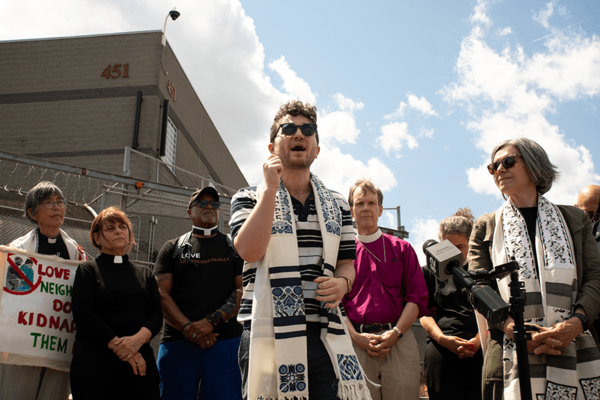
Walking into the Immigration and Customs Enforcement Delaney Hall detention facility in New Jersey, Rev. Robin Tanner quickly noticed that the windows were blocked off. Tanner, a Unitarian Universalist minister in Summit, N.J., pointed out one issue for people inside: “For many people in their faith tradition, [prayer] is a daily act,” she said. Muslims are instructed to face the city of Mecca during their five daily prayers, and a Muslim detainee wouldn’t have any way to know which direction to pray.
But for months, Amadou, a pseudonym for a father and truck driver from Burkina Faso whose name Sojourners is withholding for his safety, struggled to convince guards to let him pray with other detainees at all. In Islam, Friday prayers, or salat al-Jumu’ah, are not only obligatory for every nondisabled man but are required to be performed in congregation. Amadou was detained 16 months ago and transferred to New Jersey last year. In Delaney Hall, it took four months for Amadou and other Muslim detainees to gain access to occasional gatherings for Friday prayer, finally prevailing in time for Ramadan.
ICE has a stated duty to provide spiritual care for those in its custody. According to ICE manuals, detainees must be provided with “regular opportunities to participate in practices of their religious faiths, limited only by a documented threat to the safety of persons involved in such activity itself or disruption of order in the facility.” As ICE continues to fail even its own guidance, a host of faith leaders have emerged to chip away at the agency’s spiritual blockade of those in its custody.
In five of ICE’s detention centers, the agency contracts with Jesuit Refugee Services to provide religious services to detainees. In the other 200-plus facilities, like Delaney Hall, a patchwork of volunteers, prison staff, and individual contractors is left to fill the gaps.
By accounts from clergy who regularly visit, there is one chaplain hired to serve Delaney Hall’s fluctuating population of around 900 people. The GEO Group mentions a chaplain’s office on its webpage for Delaney Hall but did not answer questions from Sojourners.
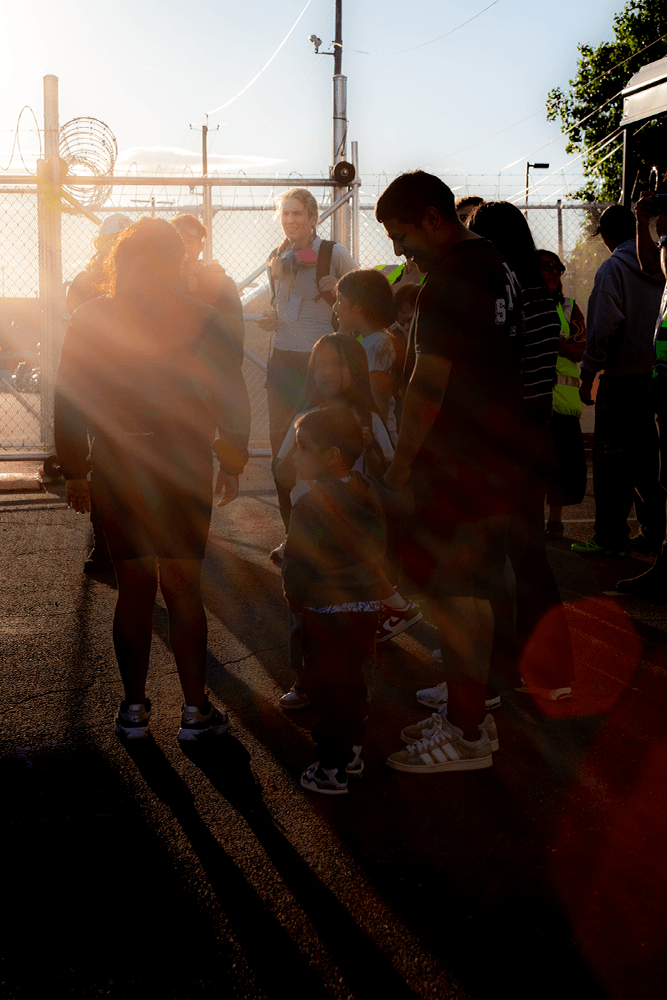
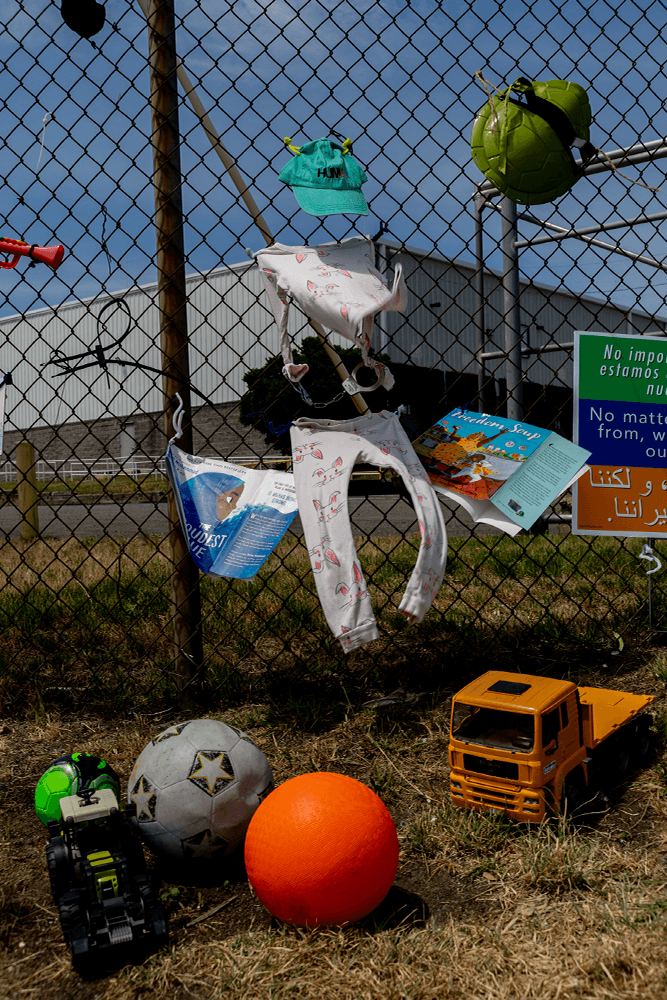
Cantor Meredith Greenberg of Temple Ner Tamid, in Bloomfield, NJ., said this reflects “a culture that just has almost no value for spiritual health … though we’re a deeply religious country.” Greenberg and her colleague, Rabbi James Feder, have led regular prayer services outside the detention center. There, volunteers, clergy, and visiting families are frequently gathered under a white tent stocked with snacks, children’s toys, diapers, and free clothing—all the work of a web of volunteer groups.
Religious practice is vital for detainees
“The isolation will drive you crazy,” Amadou told Sojourners. “You have to believe in God if you want to make it.”
A personal religious practice is “one of the steadying forces for many people,” Tanner said. Tanner has witnessed clergy being denied entry after detainees in distress request someone to pray with them and, at times, ICE canceled all visitation. Consequently, cutting off access to pastoral care is “just that much more horrific, because it’s just stripping folks of every possible source of comfort and strength,” she said.
Despite ICE’s policy promising “equitable opportunities to participate in the practices of their respective faiths,” advocates say non-Christian detainees face uneven access to such opportunities. Tanner relayed an instance of a community leader from a local mosque attempting to fulfill a detainee’s request for a copy of the Qur’an. “They wouldn’t allow him to bring the Qur’an in, but they were allowing Bibles in,” she recalled. On July 14, Rep. Nellie Pou (D-N.J.) sent a letter to DHS Secretary Markwayne Mullin demanding that ICE honor detainees’ constitutional right to freedom of religion, and requesting data on ICE’s accommodations for Muslims in detention. The letter was co-signed by 27 other Congress members.
Imam Saffet Catovic, an interfaith activist, has witnessed the toll of this inequity. Meals provided by The GEO Group, the corporation contracted to operate Delaney Hall, lack nutritional value, sometimes come only once a day, and often include contaminated, expired, or moldy food. But Muslim detainees following a halal diet are further deprived and are inconsistently given food that meets those guidelines or can only purchase it at high prices from the commissary. He frequently hears from family members coming to visit that their detained family members had noticeably lost weight—“they got so skinny.”
Sally Pillay, a board member for the advocacy group First Friends, said two Jewish detainees in Delaney Hall (both of whom have since been released) reported that there was no designated space for Jewish prayer or access to kosher meals, both required by ICE’s standards.
260805-Delaney1.png
260805-Delaney2.png
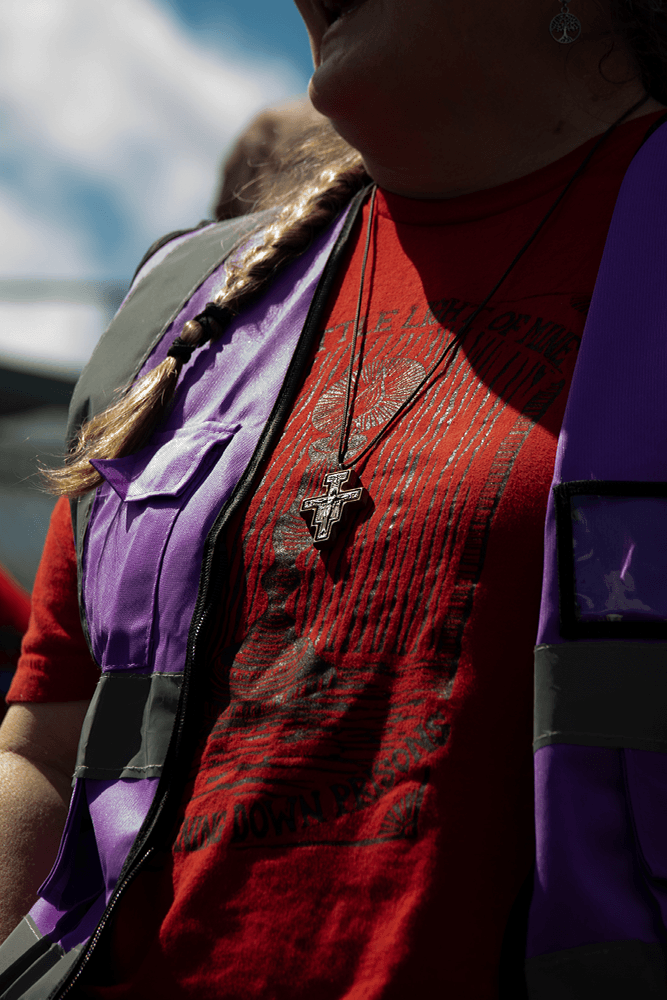
On Aug. 3, officials announced the death of Edwin Jovanny Lopez-Cornejo, a 41-year-old man detained in Delaney Hall. His family and bystanders inside Delaney Hall allege he died after ICE refused to administer medications for diabetes, seizures, and high blood pressure. They called the handling of his death a cover-up. At a press conference, his mother María Cornejo said ICE hadn’t contacted her regarding her son’s death—saying she was instead notified by hospital staff. Lopez-Cornejo’s 12-year-old daughter told the crowd, “We were both dead, but the only difference is that his heart stopped beating and I'm going to grow up without a father.”
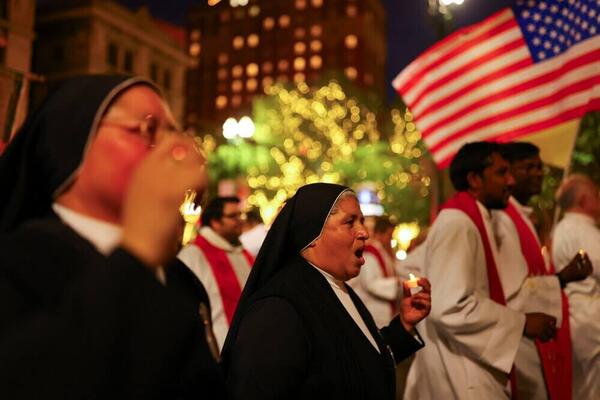
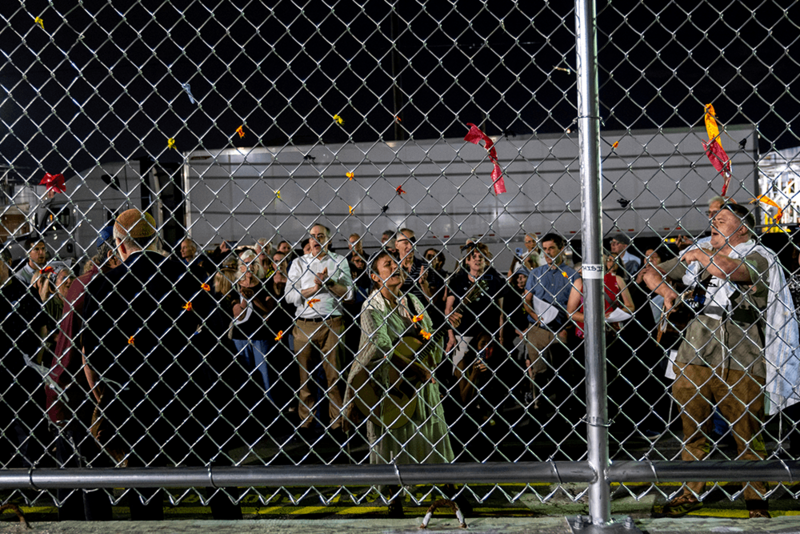
At a vigil organized by multiple immigrant advocacy groups, including Faith in NJ, minister Archange Antoine prayed for detainees and their supporters in front of Delaney Hall. “I pray that they hear our voices from inside, to know that we have not left them,” he said, pressing both hands against the chain-link fence.
Lopez-Cornejo is the second person detained at Delaney Hall to die in the last eight months. DHS, responding to Sojourners, said, “Comprehensive medical care is provided from the moment individuals arrive and throughout their stay,” and said that Enforcement and Removal Operations notified DHS, ICE’s Office of Inspector General, and Office of Professional Responsibility. The statement also said that ICE notified the consulate of El Salvador in New Jersey as well as Lopez-Cornejo’s next-of-kin.
In a statement prior to Lopez-Cornejo’s death, DHS denied any “subprime conditions” in Delaney Hall, and wrote in an email that “all detainees are provided with proper meals,” as well as religious accommodations. The GEO Group did not respond to requests for comment.
‘Surreal’ choice between family and faith visits
Catovic often attempts to visit detainees who request to meet with him and recently has encountered Delaney Hall staff who divide those waiting to visit into two lines: family and clergy. He said on these days, detainees can only receive a visit from either family or a religious leader.
This leads to a “surreal” situation where clergy and family members, who have often traveled from out of state to visit, are “set against [one another]” in choosing who will enter, and detainees are forced to forgo contact with the other. Since May and early June when detainees led hunger and labor strikes, visitation has been sharply restricted, limited to immediate family members—making it even harder for religious leaders to reach detainees.
Standing in the lines, faith leaders find themselves offering support to the families, praying with them while standing in sometimes biting cold or blistering heat.
“The refrain that is often repeated over and over again is, ‘We didn’t do anything. We were working hard. He was taking care of his family,’” Catovic said. “There are moments like a child crying, ‘When can my father come home?’ And you wish you could answer the question. But we say, ‘Let’s pray together on this.’”
Catovic said no Muslim chaplain or imam has been officially approved to act as such for Delaney Hall’s Muslim population. He has sometimes been allowed to visit specific detainees, but on an inconsistent basis. As far as Tanner knows, “GEO Group is not hiring certified chaplains,” who are trained to provide pastoral care in institutional settings to people of all (or no) religious backgrounds. Without this expertise, people in detention are subject to the whims of facility guards and staff who may have limited knowledge of a detainee’s faith.
260805-Delaney3.png
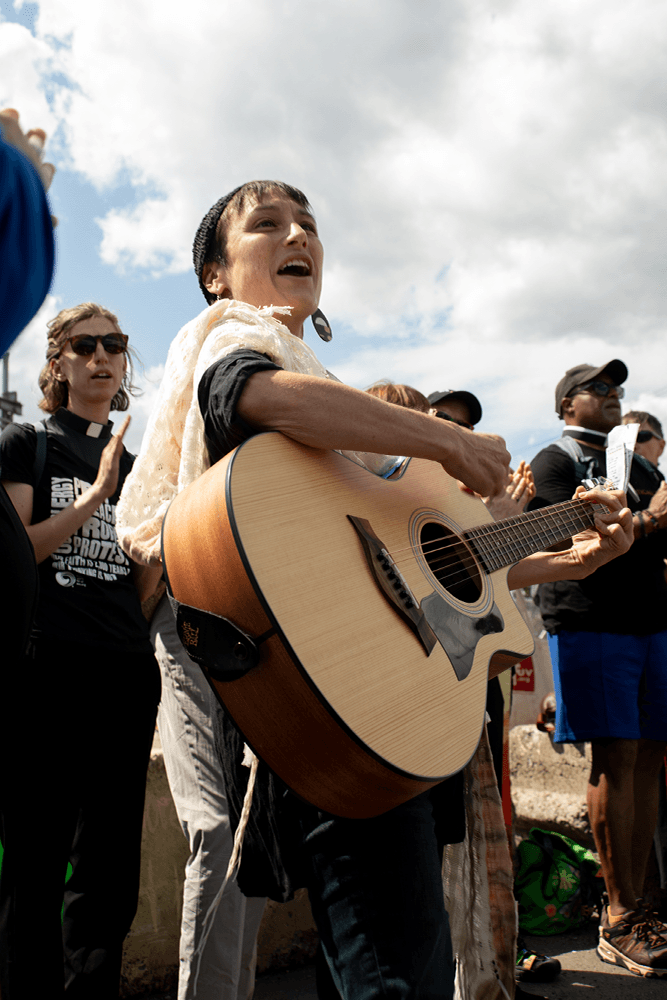
In February, a federal judge ordered ICE to allow faith leaders to provide pastoral care at the Broadview detention center outside Chicago. In March, another federal judge in Minnesota ordered the same for Minnesota’s Bishop Henry Whipple Federal Building, after clergy were repeatedly denied entry to minister to those inside.
Plaintiffs in both cases argued the government violated First Amendment rights to free exercise of religion, as well as protections under the Religious Freedom Restoration Act. The Minnesota lawsuit described an incident where a pastor intending to perform the imposition of ashes on Ash Wednesday was refused entry to the holding facility, on the grounds that “the detainees could become agitated.”
The First Amendment is meant to guarantee the right to freely exercise one’s religious beliefs or lack thereof. But “interestingly, there’s stronger free exercise of religion protections under statute Supreme Court case law,” said ACLU Law Fellow Katie Considine. She referred to RFRA and the Religious Land Use and Institutionalized Persons Act, a federal law specifically applicable to people housed in federal institutions like jails, prisons, and detention centers.
Considine said both statutes require “that the government cannot substantially burden a person’s religious exercise unless the government can demonstrate that that burden furthers a compelling governmental interest and is the least restrictive means of doing so.” Even private contractors running government facilities—such as The GEO Group—are considered to be acting on behalf of the government and are thus subject to the same obligations.
Profound isolation
During Ramadan this year, Muslim advocacy organizations collaborated with ordained and lay Catholic volunteers to bring hundreds of prayer rugs, Qur’ans, hijabs, and other religious items into Delaney Hall so people like Amadou could observe Ramadan. Given the ever-changing restrictions surrounding visitation, it was a hard-won success.
Rev. Katrina Forman, lead minister at Union Congregational Church in Montclair, N.J., said she hopes Christians might come to understand how ICE, especially under the Trump administration, reflects on their faith.
“What is being done … I sort of feel like it’s being done in our name as Christians, because of who’s in the Trump administration architecting this stuff explicitly talking about it in that language,” she said. “That, to me, is heretical.”
A 2025 report from the United States Conference of Catholic Bishops, co-sponsored by other Christian organizations, including the international nonprofit World Relief, found that 1 in 12 Christians in the U.S. are at risk of deportation, or live with someone who is. According to the report, “80 percent of all of those at risk of deportation are Christians.”
When Forman learned how close Delaney Hall was to her church, “it was mind-boggling,” she said, realizing that the ten miles in between could be walked in a day. On Good Friday this year, Forman organized a pilgrimage from her church to the detention center.
As the demonstration culminated outside Delaney Hall, a participant from another local church got a call from his father detained inside. The congregant and his mother relayed the sound of the prayer service happening outside. At the close of the vigil, the crowd, gathered on the grass and pavement, recited the Lord’s Prayer in unison with a group of detainees inside.
“It’s not abstract to welcome the stranger,” Forman said of what she hopes her congregants take from this. “Our allegiance ought to be to God more than to the nation-state [and] wherever people are seeking liberation and in this day and age, that often involves migration. I think that there is something sacred about that.”
260805-Delaney4.png
260805-Delaney6.png
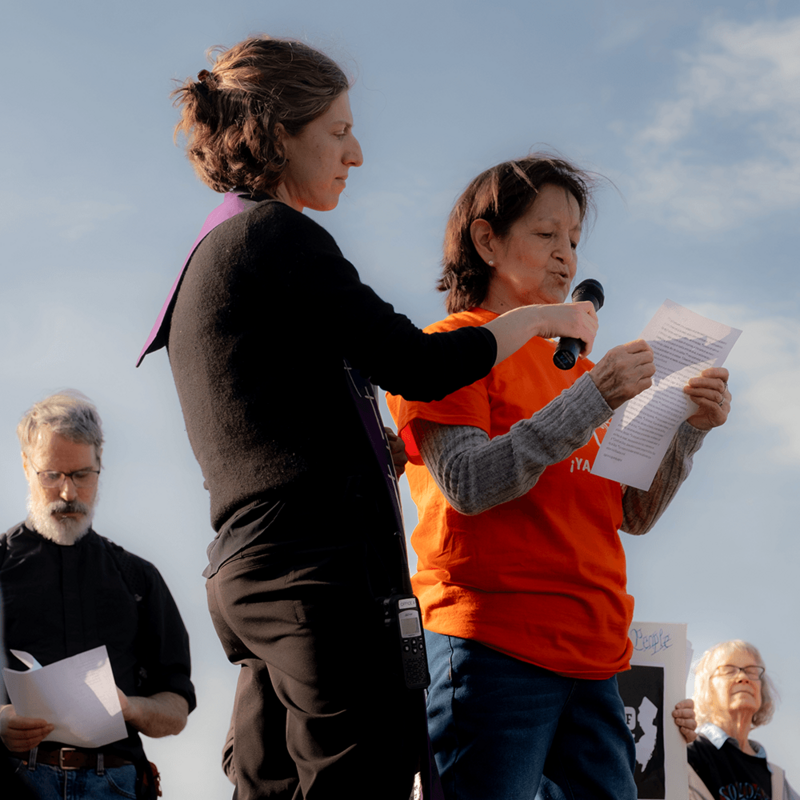
Visiting people in Delaney Hall reminds Rabbi Anne Laurent, a former hospital chaplain, of the profound isolation she witnessed in patients.
“That’s the purpose, right? It’s to remove you from the rest of the community. And I think for human beings, that is probably the greatest [punishment], to be away from your community,” she said. “What you’re doing when you go and visit is reminding them that the community still can care about them [and] reminding them that they exist.”
When Laurent first went to see Delaney Hall for herself, she was “really surprised” to find that she was the only Jew, as far as she could tell, among the volunteers who maintain a constant presence outside the facility “If people are getting deported from somewhere, then Jews should be there.” It wasn’t hard to convince clergy at Temple Ner Tamid to join. Feder, assistant rabbi at Ner Tamid, said the Torah makes clear how Jews are supposed to treat migrants.
“In Torah—which is a very terse document that doesn’t have anything superfluous—36 times we are reminded to care for the strangers because we were strangers,” he said. “For something to be repeated once is a big deal. For an idea to be repeated 36 times means that is something that we cannot ignore.”
Rabbi Abigail Treu, who has also led prayer services outside Delaney Hall and whose synagogue has raised money for grocery gift cards, concurred.
“Immigration is just such a part of the Jewish story,” Treu said. But she navigates her engagement there carefully, as the head of a “politically mixed, purple congregation” in South Orange, N.J. “It’s really rooted in the Jewish value of loving the stranger ... I’m not a political leader. So it’s not a comment on the political efficacy of a particular administration.”
Leveraging community resources
Since Greenberg, the cantor at Ner Tamid, first visited the detention center last September, she and Feder have joined the multifaith coalition of clergy and volunteers working to support loved ones of those inside, including attending to more mundane needs. Volunteers help families cover rent; buy groceries; and connect with lawyers, social workers, and interpreters, drawing from their own resources and their broader communities.
“[We’re] trying to leverage some of the resources and wealth that exist in this community,” Forman said, “towards people who have a breadwinner who’s been detained and all of a sudden … they’re struggling to pay rent and pay the bills.”
The process of identifying needs, searching for resources, and delivering them to families is ongoing. “It’s very difficult to help a community when you don’t have the very first idea of how they live, what their needs are,” Laurent said. “There was one episode early last month when we were trying to pay rent for somebody, and because everyone is undocumented, nobody could give an actual real name.”
Unable to verify the recipient, they struggled to digitally transfer the funds. “I have a hundred stories like that, of things that just don’t work out because ... one group doesn’t realize where the other comes from.”
But amid the overwhelming circumstances of detention, things that seem small can make all the difference. Laurent recalled meeting a woman from the Dominican Republic who came to see her husband the day before he was deported to his home country, Colombia. “She was never, ever going to be able to see him again … He was sick enough that there was no way he was still going to be alive in 10 years,” when he would be able to reenter the U.S.
“I brought her back to the tent afterwards,” Laurent said. “She sat down with someone else from Peru who was also coming to visit her husband. She shared, and she was seen. All we gave her was a couple of grocery cards and a cup of coffee and something sweet to eat. And it was just amazing how incredibly grateful she felt.”
Still, she and other volunteers wish they could do more for those inside and outside the detention center. Laurent used the word “helplessness,” and Catovic said it is “heartbreaking to be within eyesight of the facility but not being able to change it.”
Multifaith responsibility
For those who have dedicated months or years to this work, it is humbling and deeply fulfilling. “I have moments of real transcendence,” Greenberg said. “Fifteen to 20 minutes of prayer at Delaney Hall is a deep spiritual experience, but it’s because of the willingness to be in the discomfort and the joy of community, of a kind of fearlessness.”
Confinement within Delaney Hall is stifling, and many struggle with doubt, fear, and guilt. Sometimes, chaplains find themselves reassuring people that it isn’t their fault.
“You’re told that things happen for a reason, so when bad things happen to you, the reason is probably that you committed some sin,” Laurent said. “Having a chaplain come and say, ‘No, you didn’t,’ can reintegrate you again in that community.”
Over an Ash Wednesday supper in February, Rev. Alex Gaitan of the Catholic Archdiocese of Newark’s immigration ministry described similar conversations. People often confide that they are afraid their detention is punishment for some sin. He urges them to take to heart that it is not.
Walking with people, as faith leaders often put it, is a natural instinct for many engaged in this work. “It could be me,” Laurent said. “Why am I on that side of the table and they're not?”
260805-Delaney5.png
Greenberg said that despite the pain chaplains encounter in their work, “An essential part of being really awake in the world is [being] awake to [the fact] that there is suffering, terrible injustice happening at all times.”
This awareness, Greenberg and others argue, brings transformation in social and economic systems, approaches to justice, and what it means to be faithful.
“Within this country [Christianity] is by and large a religion of empire,” Forman said. “So I do feel like the responsibility to some extent is if we don’t want it to be that, to make it something else.”
Forman recalled her time as a union organizer. She hopes the faith-based movement can learn from the tactics she learned there, for example, by “identifying, where’s the power for this administration coming from? Who are the companies and the corporations that are upholding it? Where are their contracts being held? Who’s on their board of directors?”
When she’s at Delaney Hall, Laurent thinks of her grandfather, a member of the French resistance. She feels Americans today are in the same position.
“Some [Jewish people] have chosen to … ally with power. And I don't think that's the right solution,” she said. “I can’t know what is going on and not do anything about it and still call myself a Jew.”
Catovic, after recounting detainees’ struggle to obtain edible, halal food, recalled a saying of a companion of the Prophet Muhammad: “Since when did you have a right to imprison or enslave a person whose mother has born him free?”
“In the Christian tradition, they are children of God,” Catovic said. “In the Jewish tradition they're made in the image of God. In the Islamic tradition, they're infused with the divine spirit. … And part of that spirit is to be free.”
Editor’s note: This story was updated on Aug. 5 to correct that “Amadou” is a pseudonym, not the first name of a man detained at Delaney Hall.

Sam Hsiaomei Lee is a photographer and journalist based in New York City, exploring topics of religion, politics, and culture, as well as questions of human rights and social justice.
Did this article have an impact on you? Tell us how! Whether you’re moved to take action, have a question, or want to share a comment (good or bad), we value your feedback!