Editor’s note: This story includes reference to suicide. If you or someone you know needs help, the national suicide and crisis lifeline in the U.S. is available by calling or texting 988. There is also an online chat at 988lifeline.org
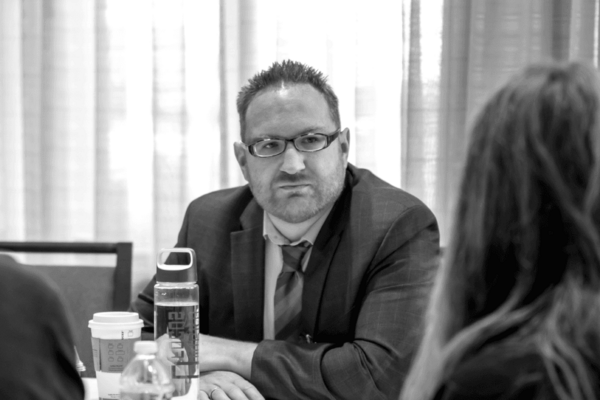
Ryan “R.L.” Stollar, a theologian and advocate whose work focused on children, abuse survivors, and homeschooling, died by suicide this week, leaving behind a legacy of tenacious and occasionally combustive activism. He was 41.
Stollar co-founded the blog “Homeschoolers Anonymous,” which garnered scores of media attention in the 2010s as more homeschool alumni began sharing stories of their experiences. He later helped found the organizations Homeschool Alumni Reaching Out and the Coalition for Responsible Home Education, both dedicated to resources and advocacy around safer homeschooling in the U.S. In 2023, Stollar published The Kingdom of Children: A Liberation Theology with Eerdmans.
“We [adults] need to give children the freedom to be their own theologians — to discover and love who God is and what God values on their own terms,” Stollar wrote.
Religion News Service named Stollar a faith leader to follow in 2025, calling him “one of a handful of theologians whose observations about the rights of children are making inroads in churches, seminaries and parenting groups.” In the last few years, Stollar also worked as an election specialist for the County of Santa Clara Registrar of Voters, according to his LinkedIn.
Stollar’s death was first reported on social media after a suicide note was posted to Stollar’s website. As of July 9, that blog post was no longer available. The Santa Clara County’s Office of the Medical Examiner confirmed Stollar’s death in an email to Sojourners.
K-12 homeschooler to “dreaded homeschool ‘apostate’”
Stollar was homeschooled in a conservative, Christian community from kindergarten through high school. Stollar described himself as being raised in what homeschool parents dubbed “Generation Joshua,” a metaphor to describe their children as the generation that would lead a Christian revival in the U.S.
While Stollar was laudatory of the flexible pedagogy and encouragement toward creativity that homeschooling supported, he was also open about surviving sexual abuse as a child and the toll that an isolated, conservative, Christian subculture had on his mental health.
Stollar initiated three homeschooling projects in quick succession in the early 2010s. He began Homeschoolers Anonymous in 2013, alongside Nicholas Ducote and other bloggers across the U.S. He also co-founded the Coalition for Responsible Home Education, a nonprofit that advocates for homeschool policy, that same year. Another nonprofit, Homeschool Alumni Reaching Out, began in 2014 with Stollar as a board member.
He wrote playfully and honestly about his journey to becoming one of the “dreaded homeschool ‘apostates,” regularly for the blog, talking about how figures like Dietrich Bonhoeffer and Fr. Gustavo Gutiérrez taught him new ways to think of faith.
One of Homeschoolers Anonymous’s partner bloggers was Julie Anne Smith, who also blogs at Spiritual Sounding Board. In a post remembering Stollar, Smith wrote that she read a blog post of his in 2012 and was touched by his transparency. A homeschool mom herself, Smith connected with him, and they became friends for years.
“We shared a lot of information and knowledge back and forth. We referred people to each other. I have no doubt that it was Ryan who helped my blog to be so successful,” she wrote. “He modeled how to use social media.”
Stollar’s education work became foundational for other academics and authors studying the Christian Right, from Bradley Onishi to Chrissy Stroop and Kristin Kobes Du Mez, who cited his work in Jesus and John Wayne. Stroop wrote in an email that Stollar was always kind and encouraging, fighting hard for the rights of children. Du Mez complimented Stollar’s work uplifting those who experienced a “darker side of evangelicalism.”
“I wanted to acknowledge the important work being done by survivors on blogs for so many years—work that gave me a new understanding of the dynamics inside high-control evangelical families and institutions, a perspective almost entirely ignored by scholars of the movement up to that point,” Du Mez wrote to Sojourners in an email.
Complex work, mixed impact
Other advocates for homeschooled children said that Stollar’s work forming spaces and institutions to uplift the stories of homeschool alumni—especially stories of abuse and neglect—was foundational.
Samantha Field, a homeschool advocate, told Sojourners in an email that the Homeschoolers Anonymous blog, which Stollar edited, was “a beacon to many of us who were first beginning to put the pieces together and understanding the patterns that had shaped all our lives.”
At the same time, Field and other advocates said that Stollar could be prickly, adversarial, and sometimes harm the movement he served.
In 2017, Homeschool Alumni Reaching Out accused Stollar of stealing funds from the organization while serving as HARO’s executive director and board member. They chose not to pursue legal action against Stollar but did remove him from his roles.
Stollar did not deny taking the funds improperly but characterized it by saying he “unintentionally spent hundreds of dollars of my wife’s and HARO’s” during a manic episode. He also objected to the board’s depiction of how the missing funds were discovered and his removal as executive director and board member.
That rupture did not fully heal. Ducote, reflecting on Stollar's death, wrote on Threads that Stollar had threatened HARO with defamation lawsuits even after his departure, causing the organization to drain its limited funds on lawyer fees. HARO’s website now says it is an archive and no longer active.
Field, who met Stollar online in the time when HARO, Homeschoolers Anonymous, and Coalition for Responsible Home Education began, also served CRHE for 11 years, first as a policy advocate and then as a government relations director until 2024.
“CRHE was occasionally hampered by people assuming he was still in leadership and we were therefore untrustworthy, tainted by association,” Field wrote. “Even though he did attempt to make amends, there was no putting back together what he'd broken.”
Jessica Dulaney, another homeschool advocate, first met Stollar through her work with CRHE in 2018.
“I considered Stollar to be something of a colleague, someone working towards the same overarching goal,” she wrote in an email to Sojourners.
Over time, Dulaney wrote that she came to see how Stollar could antagonize those who disagreed with him, even other survivors and allies who disagreed with him. She wrote that in the last few years, CRHE chose to stop engaging with Stollar publicly, a decision she supported.
“Stollar often failed the very cause he strove to advance,” Dulaney wrote. “Stollar made important contributions to our movement, but the harm he caused shouldn’t be dismissed, either.”
All of those critical of Stollar's conduct made room for grief and sadness alongside their frustration. CRHE did not reply to Sojourners’ request for an interview or comment, but in an unsigned public statement, they praised his work and expressed sadness at his death while acknowledging the “complexities” of his work.
“His willingness to leverage his own experiences brought people together and challenged others. Championing change is complex, especially in how it impacts those in our orbits … we want the many communities that Ryan impacted to know that they are not alone, and there is hope.”
Shock, grief, and anger
Stollar’s death became public through a suicide note published on his website that included personal details about his family. Sojourners is not reporting further on the contents of the note to protect his family’s privacy and follow journalistic ethical norms, which caution against reporting on the contents of a suicide note.
However, homeschool advocates said their community is wrestling with the impact of the note’s publicity and details. Dulaney and Field expressed their fear and frustration that Stollar made personal information public in his blog post.
“While I understand the reality of suicidal ideations, having struggled with the same despair Ryan wrote about three days ago on his personal Facebook page, and that he was clearly not in a healthy frame of mind … it’s disappointing that so many who idolized him are forced to grapple with all his flaws at the same time they are dealing with shock and grief,” Field wrote. “The Ryan I knew would have eventually taken this post down and apologized, but now he can’t and we all have to deal with the aftermath.”
Dulaney hoped to tell all inspired by Stollar’s tenacity for child safety and education would continue the positive elements of his work.
“Continue to create resources to help people who’ve been harmed by abusive, neglectful homeschooling,” she wrote. “Continue to tell your stories. Continue to take care of yourselves and each other. This movement is changing, but the goal remains the same.”
In a 2013 blog post writing about his journey leaving the conservative Christian culture he was in, Stollar wrote about the variety he was seeing among other homeschool alumni.
“Some of us were in the Home School Legal Defense Association. Some of us did speech and debate, while others did Teen Pact or Teen Mania. Some of us did Creation Science seminars; others did not. Some of us grew up in Quiverfull homes, or homes dedicated to Josh Harris’ model of courtship, or even betrothal homes. Some of us were allowed to date. We all have different experiences. Some of us are atheists now, or agnostics, or Buddhists, or still Christians. Some of us are liberal; others are conservative,” he wrote.
“But there is a pattern emerging. And that pattern has a story that needs to be told.”
“Continue to create resources to help people who’ve been harmed by abusive, neglectful homeschooling. Continue to tell your stories. Continue to take care of yourselves and each other. This movement is changing, but the goal remains the same.”—Jessica Dulaney

Did this article have an impact on you? Tell us how! Whether you’re moved to take action, have a question, or want to share a comment (good or bad), we value your feedback!