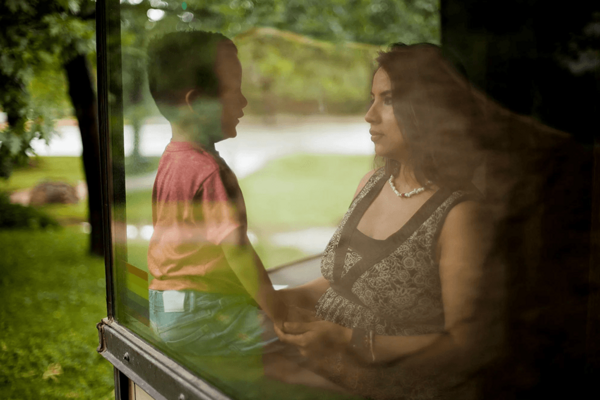
Theo Rigby’s new documentary Si Pudiera Quedarme/If I Could Stay follows sanctuary activists Jeanette Vizguerra and Ingrid Encalada Latorre as they resist deportation to stay with their families and communities. At its heart is a story of courage. Standing in front of a classroom in Denver, Vizguerra explains it like this: “Like all people I am afraid, but I also feel the moral duty to raise my voice as a person, mother, and woman. Because the problems I am facing are happening to thousands of others on the street. And someone has to be the person putting their finger on that problem.”
Sanctuary as a tactic emerged during the Vietnam War, when houses of worship shielded draft resisters from arrest. The 1980s saw the advent of the Sanctuary Movement, which focused on critiquing the Reagan administration and giving Central American asylum seekers platforms to speak about the violence happening in their countries of origin. After the success of that movement, Sanctuary saw a revival in the 2010s. The “New Sanctuary Movement” critiqued our unjust immigration system by housing undocumented immigrants and giving them a platform to share their experiences and build power.
The film focuses on the sanctuary experiences of Vizguerra and Latorre over the span of eight years. By centering their stories, the film is unlike most media around sanctuary, which tends to lionize the white activists giving sanctuary, as opposed to those receiving it. This story is laser-focused on their experience in ways that shed light on the opportunities and difficulties of enacting this practice.
Most importantly, we see Latorre and Vizguerra as the activists they really are. Vizguerra is perhaps the highest-profile activist in the New Sanctuary Movement. We watch her fight for herself, others facing detention, and coordinate resettlement efforts for dozens of families. She even spends nine months in Immigration and Customs Enforcement detention during the film, eventually winning a reprieve in December 2025. Likewise, Latorre wins a pardon from the governor for her felony conviction for using false paperwork and launches advocacy efforts to help undocumented people understand the risks of doing the same. That focus on the leadership of these undocumented women against significant obstacles stands out as a triumph of storytelling.
Some of the most haunting and important perspectives in the film show the impact of the COVID-19 pandemic on Vizguerra and Latorre as they wander empty churches, fundraise via Zoom, and confront isolation in ways that I’ve never considered. We all felt isolated during that time, but very few of us also had the threat of deportation looming.
I’m a scholar of the Sanctuary Movement and the pastor of a sanctuary church with a family in residence; Si Pudiera Quedarme/If I Could Stay is the most honest appraisal of the inherent tensions of sanctuary I’ve seen. In a particularly striking scene, the minister of the church makes an announcement before the congregation that Latorre is pregnant and defends her autonomy and ability to make decisions. Upon learning of the pregnancy, many in the congregation respond with joy, while others attempt to control her body in ways that highlight two different competing streams of sanctuary advocacy: charity and solidarity.
Vizguerra marks the tension this way: “Sanctuary is not a favor. It is an act of social justice, of making the world a better place. But always in every congregation, there will be two or three people who have that mentality that tries to make our lives impossible … Above all they still have that mentality of superiority, of ‘We whites are more intelligent and we must decide.’”
Those who see offering sanctuary as an act of charity understand the congregation as a benevolent host deserving of some level of control over the lives of the recipient of sanctuary. Those who see sanctuary as solidarity, on the other hand, understand sanctuary as an act of radical justice meant to challenge not only the world but our own preconceived hierarchies. One congregant in the film articulates this more radical vision by describing those living in sanctuary in this way: “They’re only claiming what is theirs.” A church was never sanctuary activists’ to give, but in the relationship that forms, there is an opportunity to share in common life with another as a witness to something more. This is the moral center of the film: Congregants likely have more to learn and gain from the relationship than those in sanctuary.
Watching a film that is partially set before President Donald Trump’s second term almost feels like a time warp. On the first day of Trump’s second term, Department of Homeland Security Secretary Benjamine Huffman issued a directive rescinding the “sensitive locations” policy that protected houses of worship, hospitals, and schools from immigration enforcement. The creation of that policy was one of the cornerstone victories of the first Sanctuary Movement.
In a phone interview, I asked the director, Theo Rigby, why he thought it was important to tell this story now, when sanctuary has actually taken a step back from the headlines. “The beautiful thing about sanctuary is it is ever changing,” Rigby said. He pointed to the ways we have seen faith communities confronting ICE since 2025—accompanying people on their ICE check-ins, raising money for deportation defense—as new manifestations of the Sanctuary Movement. “The exciting part and the part that’s infinite is that faith communities are grappling with how to live out sanctuary right now,” he said. Sanctuary is about asking the question, “How can faith communities truly show up for people in need?”
Sanctuary as a practice, with the loss of those sensitive locations’ protections, isn’t as safe as it used to be, but that does not mean that sanctuary isn’t being lived out by faith communities. Instead, we’re seeing the values that sanctuary has always cultivated come to bear on our present moment. The Sanctuary Movement has always been malleable, and that fact makes it a continuing moral force in advocacy for our immigrant neighbors.
What we need now more than anything is these stories. With so much attention on the clergy who are fighting ICE, we need to be grounded in the fact that this fight has been going on much longer than the past year, and it has been led by those who have suffered the most—undocumented people. This isn’t just an interesting perspective shift, it is a moral shift, and one that is well worth considering as we find new ways to fight the dehumanization of this administration.
“We need to be grounded in the fact that this fight has been going on much longer than the past year, and it has been led by those who have suffered the most—undocumented people.”
Did this article have an impact on you? Tell us how! Whether you’re moved to take action, have a question, or want to share a comment (good or bad), we value your feedback!