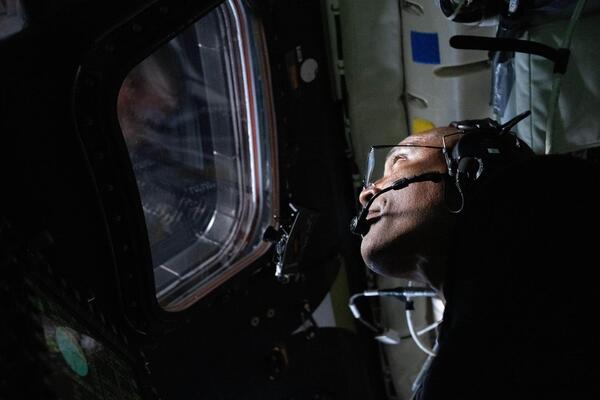
As of this writing, Phil Lord and Christopher Miller’s sci-fi epic, Project Hail Mary, is the third-highest-grossing film this year. For a book adaptation that explores heady sci-fi concepts, that’s no small feat, and it’s clearly struck a chord with viewers. Before NASA’s Artemis II expedition launched, the crew watched a screening of the film.
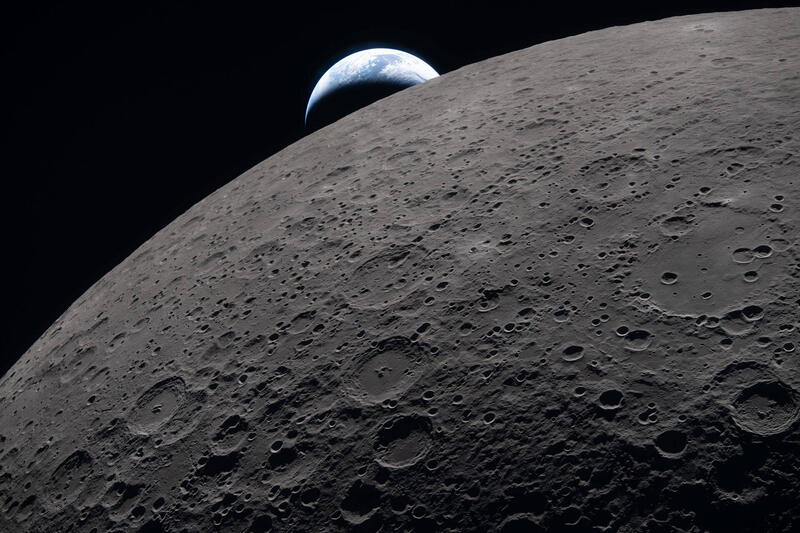
Space films and space expeditions can both inspire a particular type of awe. I think of the striking photos by the Artemis crew during their expedition, particularly the one where we see Earth partially hidden.
Space films and space expeditions can both inspire a particular type of awe.
I’m used to seeing photos of the Earth in its fullness, whether online or in textbooks, but there was something unintentionally playful about the photo taken by the Artemis crew. It seems as though the camera caught the Earth peeking out as if to observe the photographer before going into hiding again.
NASA Artemis II (1).jpg
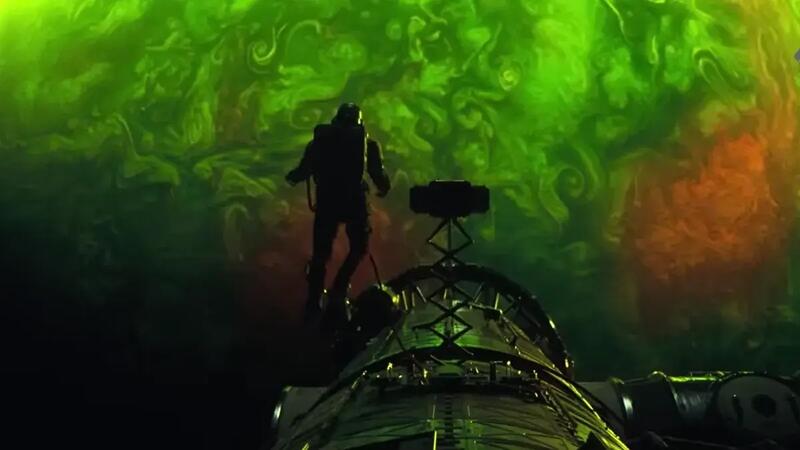
That same week, millions flocked to movie theaters to see Ryan Gosling and a sentient alien rock dangle from the side of a spacecraft while in the orbit of the planet, Tau Ceti e, as they attempt to capture an organism that can help save their respective suns. As Gosling’s character, Grace, and the alien, Rocky (James Ortiz), brave the elements to retrieve the samples, it’s framed almost as if they’re stepping into an ocean of paint and light. The effect is equal parts marvelous and terrifying, a sentiment that was undoubtedly felt among the Artemis II crew as well during their flyby.
Project Hail Mary - green.jpeg
Screenwriter Drew Goddard, who adapted Project Hail Mary from author Andy Weir’s 2021 novel of the same name, believes that people are drawn to space movies for the ways that the exploration of the unknown cosmos may cause them to reflect internally on the unexplored terrains within their own inner lives.
Speaking to Sojourners about what keeps drawing him back to the stars in his own work (his other credits include the sci-fi film Cloverfield as well as The Martian, another Andy Weir adaptation), he shared, “I think that at its core, the exploration of space is the exploration of the unknown. I don’t just mean the physical unknown, i.e., ‘What’s beyond that star?’ It’s an exploration of what lies beyond ourselves. If you look at all of storytelling, such as the early cave shadows on walls, people have been trying to make sense of their world.” He continued further, “We’re just trying to make sense of the world, and I think space gives you this gorgeous canvas to tell those stories … After all, there’s so much you don’t know. What attracts me to it is that it just immediately puts you in this place of looking inward, even though the canvas is looking outward,” Goddard shared.
In 1980, philosopher Frank White first used the term “Overview Effect” to describe the overwhelming cognitive and emotional sensations astronauts experience when, for the first time, they see the entirety of planet Earth from a spaceship above it. From that vantage point, the man-made borders of Earth disappear, and the unity of earthly inhabitants feels obvious—even urgent. This sentiment came across in Artemis II astronaut Christina Koch’s own reflections. “When we saw tiny Earth, people asked our crew what impressions we had and honestly what struck me wasn’t necessarily just Earth. It was all the blackness around it. Earth was just this lifeboat hanging undisturbingly in the universe” she said. “I haven’t learned everything that this journey has yet to teach me, but there’s one new thing I know, and that is: planet Earth, you are a crew.”
It’s clear why White describes the Overview Effect as “a message to humanity.” Most of us will never go to space, but the best space films can inspire that same type of awe. They can give us a bird’s-eye view of our planet and our own humanity.
Below, I’ve compiled a list of projects that reflect White’s sentiments and the Overview Effect phenomenon. You’ll find titles that speak to the disruptive power of transcendence, ones that showcase how time in space might just remind us about the shared humanity we hold, even with those most different from us.
Project Hail Mary (2026)
Long before the aforementioned Tau Ceti e sequence, there’s another quieter moment in Project Hail Mary that inspires awe. In a poignant scene, Grace makes contact with Rocky’s ship. Unable to communicate with Rocky, Grace deduces that the creature is asking him to remove his helmet and that it’s safe for him to breathe. For the logic-minded Grace, who understands the world through quantifiable terms, he’s hesitant to trust what Rocky might be saying. Begrudgingly but in hope, he takes the space helmet off to find that Rocky is telling the truth. His first exhale is one of infectious elation, a portrait of faith being made sight. In the expanse of space, it’s a touching and transcendent moment that reaffirms the powerful beauty of connection, this time between two entirely different species.
READ: ‘Project Hail Mary’ Knows Empathy Isn’t a Sin
Ad Astra (2019)
James Gray’s somber sci-fi epic focuses on Major Roy McBride (Brad Pitt), who goes on a mission to Neptune in order to locate his missing father, H. Clifford (Tommy Lee Jones). Its most awe-inspiring moment might just be when Roy takes a commercial flight to the moon. Roy notices how humans have colonized the moon and populated it with fast food chains, hotels, and everything in between. Elsewhere, we witness renegade pirates trying to claim whichever plot of the moon hasn’t had property built upon it. This recreation of Manifest Destiny is haunting to witness, and “inspires awe” but in a more sinister way: Human avarice knows no boundaries and finds a way to infect even the planets themselves. We’re no better on Earth than we are on the moon, and while Gray laments this, McBride’s journey through the film offers some hope: maybe our capacity to change and better ourselves is transferable, too.
Star Trek: First Contact (1996)
Most Star Trek films could probably make it on this list, but I’ve chosen Star Trek: First Contact for the way it manages to instill a sense of wonder even while providing all the bells and whistles of sci-fi spectacle. It focuses on the crew of the USS Enterprise-E, who have to travel back in time to defeat their enemies, the Borg, from changing the past in such a way that it would enable them to conquer Earth. One of the film’s climactic space battles takes place in the vacuum of space on the ship’s deflector dish. Even while the Enterprise crew and the Borg fire lasers at each other with the conflict morphing into a physical brawl, cinematographer Matthew F. Leonetti never fails to frame the battle with a sense of wonder. He weaves in wide shots that make all parties look like the very stars they’re fighting in. Such perspectives imbue these fight scenes with a surprising amount of dramatic lament: How tragic it is to wage war when in the scope of the cosmos, our conflicts are quite small.
READ: The Beautifully Christian Vision of ‘Star Trek’
Sunshine (2007)
Director Danny Boyle’s Sunshine focuses on an international crew that is traveling toward the sun in the hopes of reviving the dying star. Of course, their mission is far from straightforward, but what’s of note is the way Boyle frames the sun, positioning it amongst the crew as a type of deity that can’t be understood or reasoned with. Boyle rarely depicts the sun the same way twice, showing it as a static body in one shot and a vivacious, unpredictable force in another. This dynamism reminds us that, for all of humanity’s cleverness and ingenuity, for all of the ways we try to tame the universe and subdue creation, it’s always more alive and unpredictable and slippery than our tightest shackles. We might do better to instead be in awe of creation and consider ourselves a part of it, as the crew of Sunshine learn, rather than try to think of ourselves as outside of it.
Prometheus (2012)
Spoilers for Prometheus follow. Ridley Scott’s ambitious, messy prequel to the Alien franchise presents a cynical take on the origin of humanity. It tells the story of a crew that travels to a distant world, believing they’ve been invited there by humanity’s forerunners (and potential creators). What they uncover are not generous gods but calculated scientists, who view humanity as a first draft of better creatures they hoped to create. This revelation—that human beings are just the first draft of something to be perfected—is a sobering gut punch to the crew who hoped to be told that humanity was special and set apart. As the crew wrestle with this reality, it compels the most open-minded of them to band together as they seek to find a way off the planet they’ve landed on. They may be united in their shared insignificance, but in that very realization they find their strength.
High Life (2018)
High Life might just be the bleakest entry on this list, but Claire Denis sets those morose themes in front of a beautiful cosmic backdrop—a jarring backdrop to nest its cruelty. Robert Pattinson stars as Monte, a convict aboard a spaceship who takes care of a girl named Willow (Scarlett Lindsey). They’re subjected to dehumanizing experiments by Dibs (Juliette Binoche), who is fixated on trying to create a child through artificial insemination while in space. Because Monte and the other convicts are serving out death sentences, they’re viewed as expendable guinea pigs for Dibs’ experiments. Denis’ camera rebukes the narratives that are placed upon the space convicts, taking time to showcase them in all of their humanity, their imperfections, messiness, and goodness. The ample screen time given to them acts as a way to affirm their humanity even if the forces around them seek to deny it. The film is a harrowing yet powerful depiction of resilience in the corners of the universe where you would be hard pressed to find any.

Zachary Lee is a former online editorial assistant at Sojourners and part of the inaugural Sojourners Journalism Cohort. You can find him on Letterboxd @zlee729.
Did this article have an impact on you? Tell us how! Whether you’re moved to take action, have a question, or want to share a comment (good or bad), we value your feedback!