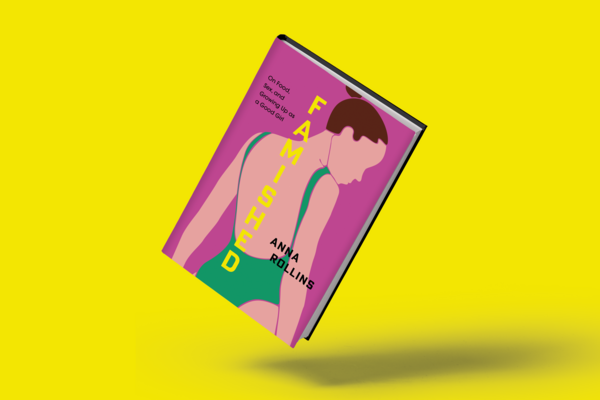
IN THE EARLY 2000s, Christian women were flooded with commentary about female bodies, both from secular and religious camps. A societal fixation on weight filled tabloid and magazine covers in grocery stores. Pastors preached against premarital sex by comparing teenage bodies to dirty water.
“So many sermon illustrations compared my body to food waiting to be consumed by men,” writes Anna Rollins in her new memoir, Famished. Rollins, who grew up in a white Appalachian fundamentalist Christian community, situates cultures of diet and sexual purity on the same continuum.
Famished details her journey into disordered eating and recovery. At age 10, Rollins measured her body daily. At 12, she threw away her school lunches. She would determine much later that controlling her eating was an attempt to control her emotions.
“I began to understand that my own fixation on my body—my fears of its hungers and needs and capabilities—was not simply personal or even cultural,” she explains. “This narrative dated back as far as Genesis: when Eve ate and offered forbidden food and was subsequently cursed with pain in childbirth.” For as long as people have told stories about women, they’ve situated the female body as a site of necessary pain and abnegation.
For Rollins, purity culture, like her disordered eating, was a complex form of bodily self-denial.
Rollins discusses the years she spent unable to have sex without pain or discomfort. This wasn’t the fairy-tale ending a Christian woman hoped for after waiting until marriage to have sex. “The solution to the difficulties of desire was simple: Refrain. Say no to all of it.” Her body size decreased yet claimed more space in the eyes of her peers. She received far more praise for her diminutive form than she did for her achievements as an English professor or a mother.
For Rollins, purity culture, like her disordered eating, was a complex form of bodily self-denial.
Famished is a relatable read for people who grew up with disordered eating, especially those who struggled while actively involved in church. A 13-year-old might not connect the dots between evangelical sexual purity and an aspiration of thinness, but Rollins does. Her book also sheds light on how time spent online can easily fuel an isolated absorption of diet mentality and pursuit of excessive exercise. And Rollins shares about learning that contemporary ideals of thinness have historic roots in anti-Black racism.
The author’s “quiet deconstruction” as a Christian is inseparable from her relationship with food. “Without the power to speak up and challenge religious authority, I communicated my rejection of this world by trying to disappear my body,” she writes.
Zooming out, the author wrestles with body perception at the societal level. Unsatisfied with body positivity or body neutrality, she leans into “body reflexivity.” Rollins credits philosophy professor Kate Manne with this “idea that my body is for me. It does not exist for the purpose or pleasure of anyone outside myself. My body is not for my husband. Or the church. Or my children. My body is mine.”
Rollins finds that just as food doesn’t fit into a binary of good or bad, religion isn’t all good or all bad either. No one cause was solely to blame for Rollins’ disorder. But now, she says her secrets out loud as a woman who is no longer afraid of having an appetite.
Did this article have an impact on you? Tell us how! Whether you’re moved to take action, have a question, or want to share a comment (good or bad), we value your feedback!