A New Book Smashes Idols of Economic Growth

This excerpt from Enough is Enough: Degrowth, Capitalism, and Liberation Theology makes the case for faithful resistance to wanting more and more.

MAYBE YOU’VE NOTICED the pattern: Since 1995, the United Nations has called world leaders together every year to participate in a Conference of Parties, or COP, on climate change. Politicians and negotiators are tasked with discussing progress and commitments—or lack thereof. So far so good, right? But year after year, governments fail to show up with enough ambition to meet even their own targets—targets that already fall short of what social movements and scientists demand. Faced with an existential threat to human and other life on earth, our leaders meet annually and agree to back away from their promises, pushing the planet further into a situation of more flash floods and drawn-out droughts, more wildfire smoke and rising shorelines, a world less fit for life in all its variety.

In 2025, COP30 marked 10 years since the signing of the Paris Agreement, where 196 countries committed to limit global warming to 1.5°C higher than preindustrial temperatures. In the summer leading up to COP30, a document began to circulate: “The science is clear: we must limit global warming to 1.5°C to avoid catastrophic effects. We must never abandon this goal,” the document says. “It is the Global South and future generations who are already suffering the consequences. We reject false solutions such as ‘green’ capitalism, technocracy, the commodification of nature, and extractivism, which perpetuate exploitation and injustice.” Instead, the authors call for transformational, structural change, the kind of courage that never makes it to COP meetings.

The document reads like an impassioned call from a revolutionary climate movement, criticizing even the green economy for emerging “not as a break with capitalism, but as an incremental modernisation of capitalism, expanding its capacity for self-regulation while perpetuating systemic contradictions.” Yet the document did not come from the Extinction Rebellion, a socialist group, a left-wing think tank, or a handful of anarchists. It came from the Catholic bishops of Latin America, Africa, and Asia, who issued it together as “the message of the Catholic Church in the Global South.”

Radical change is needed

WHAT THE BISHOPS wrote was not merely a prophetic denunciation; they provide concrete proposals and suggestions. Among them is a truly radical one. “It is not enough to talk about an energy transition,” they explain. “We propose a model aligned with planetary boundaries and with goals for degrowth. A model that reduces demand and excessive consumption and promotes solidarity-based, circular, and restorative economies.” The bishops explain a degrowth alternative would mean adopting what Pope Francis called a “happy sobriety” in our lives, “a new lifestyle marked by joyful simplicity,” rejecting the glitter of consumerism and ensuring that everyone has access to what they need to live a dignified life. A change of this scale would involve personal commitments, but it could not be reduced to individuals making lifestyle changes. It would rather require “a personal, community, cultural and value transformation that cuts across political and economic structures.” In their appeal for degrowth, more than tinkering with policies or parading out insufficient action on climate change, the bishops propose a revolutionary conversion of all of society, one that would require dethroning growth as the ruling ideology of global and national economies.

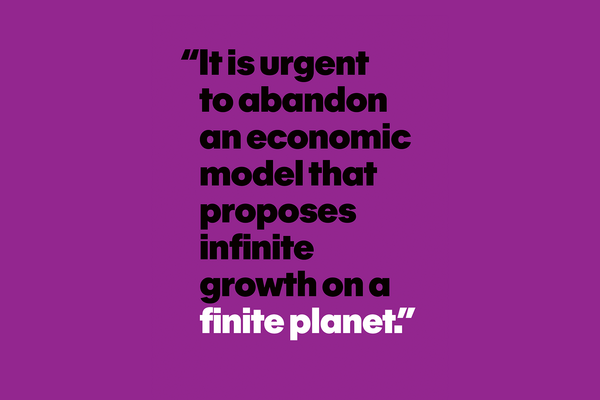
“It is urgent to abandon an economic model that proposes infinite growth on a finite planet.”

By calling for degrowth, the bishops have thrown their weight behind an ongoing conversation among researchers, activists, artists, social movements, and many others. At the heart of degrowth is a simple observation, one put well by the bishops themselves: “It is urgent to abandon an economic model that proposes infinite growth on a finite planet and, to this end, exploits people and resources without limit.” Growth as an abstract economic goal has licensed the wholesale destruction of both people and the planet, sacrificing communities, watersheds, mountaintops, rainforests, and many, many lives to the logic of accumulation. Degrowth is a practical and strategic discussion about how to do something different.

The bishops make a series of commitments and a specific invitation for “a historic coalition between actors from the Global North and South to face the crises in solidarity.” Such a coalition, they propose, ought to work on many different fronts, among them “a change in the economic model in favour of the common good and future generations.”

While the invitation is addressed to both the North and South, those of us in the North will likely have a harder time responding to it, since it’s our way of life, based on consumerism and burning massive amounts of fossil fuels, that most fundamentally needs to change. Achieving change at the scale we need will require a lot more than buying less, consuming with discernment, and reducing waste, although we should make those changes where we can. It will require a change in our economic system itself, a task that requires the kind of wide, global coalition-building the bishops have invited, and one in which the Global North bears a unique responsibility. For that very reason, it’s also that much more important that we take up the invitation of the bishops, echoed by many others in the Global South, to work to build a new economy, one based not on growth but on solidarity, ecological sustainability, and true justice.

Enough is enough

BUT WHAT DOES “degrowth” mean? Degrowth tries to reckon with the consequences of capitalism, a world careening toward its self-destruction, threatening to turn the verdant, life-giving world of creation into a puff of wildfire smoke, acidified oceans, and inhospitable deserts. It asks difficult questions along the themes of the bishops, affirming that for a better world to be possible, people in the Global North will indeed have to find out how to reduce our demand for products that require the destruction of whole ecosystems and communities. We’ll have to pay our fair share in reparations for the harm that our so-called development has caused. And we’ll need to attune ourselves to other ways of knowing and being to decolonize our societies and ourselves. Degrowth is a discourse of responsibility, but it’s also a discourse of hope, of reckoning with the past and present while working toward a future where there is enough, rather than too much or too little, for everyone.

Christians have begun to think about degrowth, but we’re late to the conversation. For some, an invitation from the Catholic bishops of three continents will be persuasive enough to get going. But you don’t have to take it from them: The world we have created, organized for capitalist growth, is destroying the world that God created, organized for the flourishing of life. Reading headlines about increasingly destructive weather events, the loss of so much of creation’s diversity, or the ubiquitous stories of workers being abused and mistreated for profit should be enough to prompt a simple observation: This is not what God intended after shaping creation and calling it good. For Christians, degrowth is a way of recovering our own faith from an economic system that demands devotion to the god of growth, reaffirming that we are to be people of Good News, of redemption, liberation, and healing.

Degrowth is a discourse of responsibility, but it’s also a discourse of hope.

How we lost our way

BY ENGAGING ECONOMIC theories, liberation theologians show how the idol of growth shapes the underdevelopment of the Global South, where the majority of human beings live. The global economy has changed, mutated, and gotten generally weirder and more speculative since the liberation theologians began their explorations of it, but the fundamental features of unequal exchange, value drain from the Global South to the Global North, and the externalization of negative effects from production are still the same.

Yet in the Global North, even many progressive Christians, pastors, and theologians have lost the skill or interest to investigate the problem of capitalist growth from an anti-imperialist perspective, attuned to the Global South. As the Argentine queer liberation theologian Marcella Althaus-Reid observes, many theologians turned to cultural concerns, which she says were more acceptable than class analysis. Cultural Liberation Theology was relaunched, leaving the political and economic analysis aside.

Althaus-Reid’s point is not that theologians should quit analyzing the many vectors of oppression and cultural issues of interest to Christians, but that theologians largely traded in economic analysis for other forms of analysis, rather than adding them into a more systemic critique of oppression. As people and the planet continue to be sacrificed to the idol of growth, producing more poverty, waste, and ecological destruction, Christians in the Global North will need to relearn and deepen our political and economic analysis.

Rediscovering the prophetic critique of growth in liberation theology will also necessarily mean becoming willing to go beyond the standard talking points of not only politicians and businesses, but also international development itself. Engaging at the global level, many well-intentioned and justice-seeking Christians borrow the language and goals of bodies like the United Nations, where terms like sustainable development try to describe a more equitable arrangement of the world economy. Brazilian liberation theologian Leonardo Boff, however, asks rhetorically:

“Can the term sustainability be applied to the kind of modern development and growth whose logic is based on plundering Earth and exploiting the labor force? Sustainable development is an oxymoron. This is especially true of capitalism, which is based on private appropriation of nature and its resources; it is especially against nature. ... The term used should not be development at all but rather growth, which is sought for its own sake within a single quantitative and linear model.”

For Boff, as for other liberation theologians, development is a euphemism for growth, and growth for growth’s sake is fueled by exploitation. Unless we confront growth as a fundamental problem, we will be repeating the same structures with different language. Growth remains the idol that the international order continues to feed, built on a long history of colonialism, unequal economic relationships, and extraction. “Indeed,” Boff observes, “for four centuries all societies in the world have been held hostage to a myth, the myth of progress and of uninterrupted and unlimited growth.”

As Boff explains, even socialist countries have found themselves prioritizing growth at the expense of people and the planet, albeit for reasons other than the formula of capital growth, often in competition with capitalist countries. Liberation theologians push us beyond the rhetorical strategies that shy away from fundamentally calling into question the idol of growth, which can manifest in many models. It is capitalism, however, that has become the dominant global economic framework, and capitalism that requires a perpetual, unsatisfiable growth, making capital growth the most significant impediment to ending inexcusable inequalities in wealth and access to basic things like health care, education, and food.

To make our prophetic critique something more significant than a simple counter-rhetoric, we need to take the time to examine the ways growth structures our economies and find the creativity and courage to go beyond the solutions put forward to maintain the hegemony of growth. The ambition of liberation theologians, as they routinely explain, is not development, nor growth, however allegedly sustainable, but liberation.

The world we have created, organized for capitalist growth, is destroying the world that God created.

Reclaiming prophetic tools

THERE ARE WARNINGS about growth, and limits on it, already in the Bible, especially in the concept of the Jubilee. Appearing in Leviticus 25:8-38 and Deuteronomy 15:1-11, the Jubilee year was supposed to occur every 50 years, a time to free slaves, allow the land to rest, and cancel debts. Land was also returned to its original owners, further preventing (in theory) the rise of a class of landed economic elites, dispossessing people from subsistence and a place to live. The Jubilee year was an affirmation that economic growth is not the primary driver of economic activity, and that the common good ought to relativize the drive for growth. The prophet Isaiah later expands the idea of Jubilee, saying the Lord has sent him “to bring good news to the oppressed, to bind up the brokenhearted, to proclaim liberty to the captives and release to the prisoners, to proclaim the year of the Lord’s favor” (Isaiah 61:1-2a). Jesus begins his public ministry in a synagogue by quoting a version of this same passage (Luke 4:21).

Over the course of modernity, Christians in positions of power deliberately buried these warnings and limits, instead promoting capitalism and economic growth. As the German philosopher Walter Benjamin put it, “the Christianity of the Reformation period did not favor the growth of capitalism; instead it transformed itself into capitalism.” Benjamin isn’t picking on Protestants here, but saying all Christians in the West contributed to this diabolical transubstantiation over the course of the Reformation.

To be clear, the medieval world before the Reformation was no shining utopia of justice and equality either. However, Catholics and Protestants seemed to agree that unlocking economic growth through colonialism, the emergence of modern states, and the rise of the merchant class and eventual bourgeoisie was ultimately consistent with their expression of faith. In doing so, Christians created a significant set of tools for building a capitalist system that has also brought a staggering amount of violence into the world, giving theological justifications for the necessity of colonialism, the commodification of human beings in the slave trade, the abuse of nature and workers in industrialization, and the ongoing maintenance of a global economic order pushing us to ecological destruction.

While Christianity facilitated the emergence of capitalism, it never did so without internal opposition. Christians on the underside of capitalism speaking up for themselves and the lives of oppressed people have always found conflict with other Christians privileging the imperative of economic growth at all costs. Degrowth prompts us to rediscover the prophetic critiques of growth and the communitarian commitments, the other tools within Christianity, that could destabilize the idol of economic growth.

This excerpt is adapted from Enough is Enough: Degrowth, Capitalism, and Liberation Theology, copyright © 2026 Fortress Press. Reproduced by permission.

This appears in the March 2026 issue of Sojourners