IN 2017, SYLVESTER JACKSON joined a forgiveness therapy group simply to get out of his cell in a maximum-security prison—he might not have participated otherwise.
This happenstance involvement profoundly impacted the course of his life. Now living in Milwaukee, Wis., he leads community members whose lives have been impacted by the criminal justice system through the same course.
Jackson understood forgiveness as a spiritual concept from growing up in the church, but it didn’t click until he was able “to connect the dots between the spiritual and the scientific part,” he told Sojourners. For him, forgiveness applied to the hurt he had caused others but also to the hurt he experienced from others’ wrongdoing. You forgive, he said, “without trying to diminish [the wrong]. You’re not forgiving that person because of them. You’re forgiving them because of you.”
“I didn’t know the impact that anger could have on your physical, mental, and spiritual well-being. It takes a lot to hate people,” said Jackson. What did he learn? “The greatest enemy of hate is forgiveness. It has that much power.”
When he got out of prison, Jackson reached out to the psychologist who led his therapy to let him know what an impact it made.
Understanding why
IN 1994, ROBERT ENRIGHT, a psychology professor at the University of Wisconsin, founded the International Forgiveness Institute, leading the scientific study of forgiveness. His books The Forgiving Life and Forgiveness Therapy lay out his groundbreaking work in the therapeutic field. In 2016, Enright’s lab began offering forgiveness therapy to men incarcerated at Columbia Correctional Institution in Portage, Wis., Jackson told Sojourners. That's where Enright and Jackson met. In 2018, Lifan Yu, one of Enright’s graduate students, continued that research with a new cohort of men there.
Building on Enright’s work, Yu’s therapy sessions did not focus on the crimes inmates committed but instead examined how their personal history of abuse led them to harbor anger and had negatively impacted their mental health.
“Why did they choose to harm others?” Yu wondered. “Prisoners themselves are victims before they committed a crime,” she said. “They bear that for their whole lives. ... That’s the reason they chose to hurt others.”
Similar to Jackson’s experience with Enright, Yu brought together a group of 12 men to read Enright’s book 8 Keys to Forgiveness alongside 12 others in a control group that used the Carey Guides, a collection of cognitive behavioral tools and worksheets for prison personnel to create positive change with inmates and used widely throughout the prison system.
“Everyone in the group had stories to tell about how they had been used, abused, and/or misused by those they trusted and/or looked up to. We became close like a family and knew the group was a safe place to deal with anger and resentment,” wrote one participant in an anonymous letter given to Yu at the end of the study.
Before the group met, individuals responded to surveys measuring anger, depression, and anxiety, as well as orientation toward forgiveness and more. All the selected men had significantly impaired mental health. After completing the six-month therapy, Yu sent the survey again. The experimental group saw significant improvement while the control group remained the same. The research team then decided to offer the program to the control group. The results again indicated growth.
Yu followed up with both groups six months after they completed the therapy: Both retained growth, indicating the long-term effectiveness of forgiveness therapy.
The letter to Yu from the anonymous participant continued: “I was able to see how the way I was raised had a very negative and profound impact on me. ... I forgave others from my past for the wrongs they inflicted on me. I don’t feel the pain anymore.
“I have been in many groups, programs, and counseling sessions but was never able to understand why I kept hurting people. This was the only program that ever asked me, ‘What happened to you to make you the way you are?’”
Breaking cycles of harm
THERAPIES IN PRISON often focus on correcting behaviors to prevent repeat offenses, rather than aiming for improving mental health overall, said Yu. That approach fails to make a connection between the crimes committed and the personal abuse history of the perpetrator.
Sylvester Jackson’s story is an example. He was sexually abused from age 7 to 13. At age 14, he sexually abused another person for the first time. “I didn’t have no outlet for those things. I grew to the point that I wasn’t going to be the one being hurt; I was going to be the one doing the hurt,” he said.
“The greatest enemy of hate is forgiveness. It has that much power.” -Sylvester jackson
“My first experience with hate started with my father and seeing how he disregarded us, and then I find out he was on the other side of the city taking care of other people’s kids,” Jackson said.
Eventually, Jackson was living on the streets of Chicago and became involved with a gang. At age 27, Jackson served his first prison sentence in Texas for stolen checks. When Jackson got out, he rediscovered his faith and did well for several years but again sank into mental illness after his mother died in 2002. During this time, Jackson sexually assaulted his youngest daughter. “She came into my life unfortunately when I was in a spiral,” he said. “I passed the abuse on that I had, and that led me to prison.”
In 2007, Jackson was imprisoned in Wisconsin, where he remained for 10 years. There he encountered Enright and forgiveness therapy. Jackson prayed for help. “I tried suicide, and I thought, ‘OK [God], if you aren’t going to kill me, then help me live. If you are who you say you are, I need you to show me yourself,’” he said. Jackson asked for God to restore his mind. Forgiveness therapy was part of the answer to that prayer.
Jackson’s story illustrates a prevalent reality: Yu and her colleagues found higher rates of adverse, traumatic experiences in medium- and maximum-security prison populations than in the general public. Yu and her team began exploring whether therapy programs in prison can assist in psychological healing and contribute to lower recidivism rates. The forgiveness therapy study confirmed the connection between the types of abuse individuals experienced and the types of crimes they committed.
The research of Yu and others showed that among 103 men surveyed in the initial phase of the study, 90% reported a childhood abuse—almost all reported more than one abuse—and 82% said the abuse still negatively influenced them. Of the 33 men who reported sexual abuse, 67% of them were convicted for sexual assault. Of the 70 men who reported physical abuse and familial neglect, 80% were incarcerated for violent crimes, such as armed robbery, homicide, or felony murder.
Surprisingly, Yu also found that 46% of the men had never shared their past abuse and trauma with anyone else, and most had never had anyone recognize their hurt or help them heal. “In essence, they were re-traumatized by holding in their pain,” said Yu.
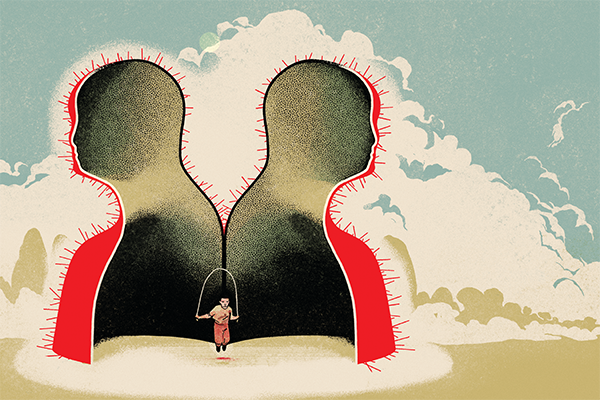
dec feature randall 2.png
What leads to a changed life?
AARON GRIFFITH, A Duke Divinity School historian who wrote God’s Law and Order: The Politics of Punishment in Evangelical America, said, “Most people who actually go into prison ministry or chaplaincy or work ... realize pretty quickly that those who come in [to prison] come with harms that have been done to them.”
But it can be hard for Christians with a strong “law and order” belief system and a bent toward saving individual souls to understand the cycles of harm many prisoners experience. “There’s a resistance to see [them as caught] in cycles of abuse or harm or violence,” said Griffith. “For evangelical Christians, that resistance comes because they can be narrowly focused on conversion. They are looking for the seamless narrative: ‘I’m a sinner, and now I’m going to be saved.’”
While evangelical Christians shaped prison policy substantially in the mid-20th century, Griffith wrote, many Christians of various traditions have also been strong advocates for restorative justice practices within and alongside the incarceration system. Restorative justice advocates see it as a way to address the root causes of crime, including individuals’ deeper wounds and injustice within the carceral system. Forgiveness therapy is not quite restorative justice, Griffith noted, and perhaps that is an advantage.
“Are prisoners bad people? Or people who have done a bad thing?”
A restorative justice approach centers the victim first and works with all involved in the crime to determine what would advance repair for damage caused. Forgiveness therapy, on the other hand, does not require the participation of the victim. Focusing on forgiveness alone, however, may not attend enough to what the offender owes the victim and what repairing the harm might look like. One benefit of restorative justice, therefore, is that it’s careful not to force forgiveness, but to address the needs of all parties, starting with the victim, so that transformation can occur.
In any case, therapeutic approaches that measure emotions or virtues, wrote Abilene Christian University associate professor Brad East, can never quite grasp the bigger realities of forgiveness. “Even in the best circumstances—two friends, a wrong done, followed by acknowledgement, repentance, forgiveness, and restoration—the experience is never perfect, never complete. All human forgiveness this side of death is partial, piecemeal, a marathon measured daily in inches lost or won,” he wrote in “The Theological Terrain of Forgiveness,” in Comment magazine.
Forgiveness therapy in prison will reach a very small percentage of the nearly 2 million people locked up in the U.S. in 2025—and that is not likely to change. While prison psychologists and chaplains are aware of the enormous need, Griffith says “our criminal justice system is not set up to actually deal with this.”
Theologies of sin and redemption
IN 1976, ACCORDING to Griffith, evangelicals ramped up their promotion of a more punitive carceral system. The National Association of Evangelicals took the position that God does not offer forgiveness of sins without first a penalty being paid, equating crime with sin. From then until now, writes Griffith, “more law and order, not the spiritual redemption of criminals, became the primary evangelical answer to lawlessness.”
Psychologist Blake Riek, a professor at Calvin University, said that there are basically two theologies at play when it comes to crime. One end of the spectrum says all humans are sinful, while the other reminds us of the dignity of all people.
Each theology can cause people to believe different things about themselves and others. “Are prisoners bad people? Or people who have done a bad thing?” Riek asked. “It really makes a difference in the ways people view themselves [and others].”
Shame and guilt are both moral emotions that result when we deviate from our internalized standards. Riek’s own research found that when a person dwells on thoughts that they are inherently bad, it leads to shame, and people get stuck there. Shame does not lead to seeking forgiveness. Feeling guilty, however, increases the likelihood that a person will seek forgiveness. A large study published in 2007 found that feelings of guilt at the beginning of a prison term correlated with lower rates of recidivism, and feelings of shame correlated with higher rates. “Guilt—because it focuses on the action—is, in a sense, fixable,” said Riek.
One benefit to Enright and Yu’s approach is that it doesn’t rely on shame to produce changed behavior and instead offers dignity to incarcerated individuals. The anonymous letter to Yu suggested the need for such interventions to come much earlier in the trauma process. “I truly believe if I would have done the forgiveness program the first time I went to rehab or even prison, I would not be in prison now,” the inmate wrote.
Sylvester Jackson could not keep to himself the transformation he experienced through forgiveness therapy. “I felt that it freed me from such anguish, it can help someone else,” he said. “There are so many people today walking around being controlled by people who are long gone who abused them, and they don’t know how to let them go.”
Jackson launched Believers for Change, a nonprofit run by his wife Lavansa Jackson, to support formerly incarcerated people as they reenter society. The Jacksons offer the same forgiveness program that changed Sylvester’s life, followed by a restorative justice process to heal families that have been torn apart by personal harms and the prison system.
“Hurt people hurt people,” Sylvester Jackson said. “But healed people can also heal people.”

Rebecca Randall, an independent reporter and editor, is a Black and Korean U.S. domestic adoptee. She writes on the environment, religion, and adoption. Her first mother is an adoptee from South Korea.

Did this article have an impact on you? Tell us how! Whether you’re moved to take action, have a question, or want to share a comment (good or bad), we value your feedback!