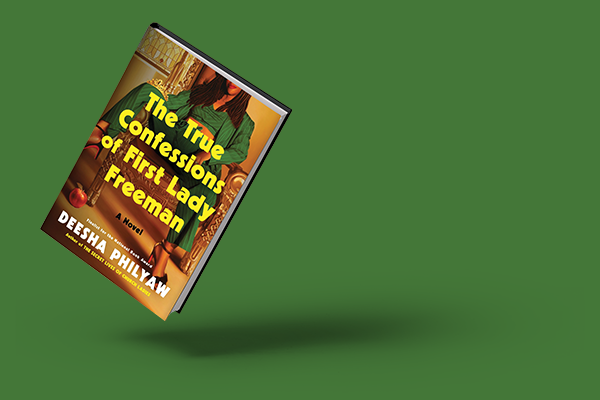
“TO THE SO-CALLED whores and their daughters! May we inherit the earth and enjoy an endless fount of wine to forget our troubles,” says First Lady Scharisse Freeman as she concludes a subversive monologue reimagining Proverbs 31, the biblical passage often invoked as a model of ideal Christian womanhood. With this opening scene, Deesha Philyaw sets the tone for her riveting, satirical novel, The True Confessions of First Lady Freeman. The story then goes back in time to show the events that led to the rousing speech. We follow Freeman, the wife of a megachurch pastor who is 15 years her senior, as she prepares for the First Lady USA pageant and deals with the fallout from a scandal that threatens her marriage, her family, and their megachurch.
True Confessions explores the complicated lives of Black church women and the struggle to live authentically amid the pressures to be perfect—to be “Proverbs 31 women.” Philyaw first voiced the experiences of Black women shaped by the church in her award-winning short story collection, The Secret Lives of Church Ladies. In Secret Lives, Philyaw centers Black girls and women who contend with their faith as they navigate sex, pleasure, and sexuality.
Those themes deepen in True Confessions, which also confronts sexual violence in Black churches. The novel’s central conflict emerges when a past occurrence of sexual violence is brought to the attention of Freeman; her husband, David; and his mentee, Jeddah (who is also a megachurch pastor). The pastors’ response not only leaves Freeman vulnerable but forces her to bear the brunt of the fallout. She must decide whether to let them control the narrative or take back her story.
In the opening monologue, Freeman also exclaims: “When faced with the choice between doing what’s right and protecting other men doing evil at the expense of women, David and Jeddah will choose men like themselves every time. Because women—Bathsheba, Moms Mabley, my mama, me—we’re all just collateral damage in men’s war for self-preservation and dominance.” True Confessions emphasizes that the real problem in the church is not the absence of Proverbs 31 women but the presence of harmful theologies around sex and sexuality and the failures of church leaders to protect Black women and girls.
Through the self-discovery journey of Freeman, who earlier described herself as “the ultimate Proverbs 31 woman,” Philyaw poses the questions: Who would Black women be if we let go of the desire to be accepted by church spaces that weren’t created with our well-being in mind? Who would we be if we let go of church spaces that tell us that who we are, where we’re from, and the people we love are not welcome?
In an interview with Elle, Philyaw shared that her mother and grandmother sent her to church as a child but never attended themselves. She later realized that it was because, as single mothers, they felt unwelcome. True Confessions is for people like Philyaw, her mother, and her grandmother. It’s for Black Christian women who know the Bible and aren’t afraid to call out the church for misusing it. It’s for Black Christian women taking control of their sexuality. It’s for Black Christian women freeing ourselves so that the next generations can experience a freedom we only dreamed of.

Deirdre Jonese Austin is a minister, writer, scholar, and womanist whose work focuses on religion, race, gender, and sexuality.
Did this article have an impact on you? Tell us how! Whether you’re moved to take action, have a question, or want to share a comment (good or bad), we value your feedback!