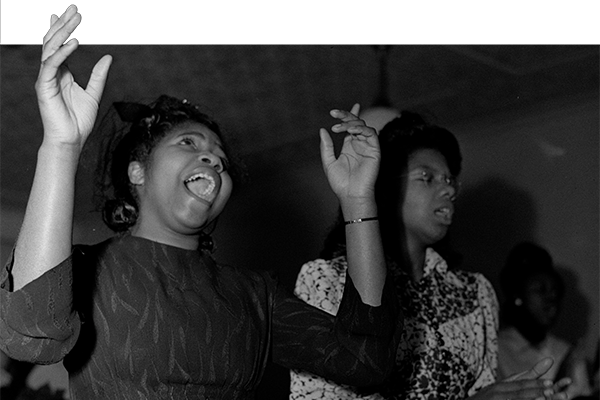
THE PREACHER PAUSES mid-sermon. Somewhere in the middle of the sanctuary a voice rises: Amen. Another voice answers. Then another. Soon a chorus builds. Amen. Amen! Preach. The sound rolls through the sanctuary like a wave gathering strength. Hands clap rhythmically. Feet begin to tap against the old wooden floor. The preacher smiles and leans into the pulpit. The congregation has begun to preach with him.
For many who worship in the Black Church, this moment is instantly recognizable. The cadence of amens, the rising energy of the room, the collective response of the congregation. These are not interruptions to the sermon. They are part of the sermon itself. Worship becomes something shared, something embodied. Faith is not only spoken. It reverberates in the body. It pounds the ears.
Outsiders often hear these moments as emotional outbursts, but they are something much deeper. The shout, the clap, the rising chorus of amens are forms of prayer—ways the body joins the soul in responding to the presence of God when ordinary speech cannot carry the weight of the moment.
This tradition did not begin in modern sanctuaries. Its roots stretch back through centuries of Black worship, including the spiritual practices of enslaved Africans in America. In hidden gatherings and brush arbor meetings, enslaved believers prayed, sang, and moved together in what came to be known as the “ring shout.” The ring shout was both worship and witness—a circle of movement and song in which faith, memory, and survival met in the presence of God. In those gatherings, prayer did not stay confined to words. It moved through the body and the community.
The rhythm of feet, the sway of shoulders, the rising chorus of voices formed a shared act of faith that said to worshippers, “You are not alone.”
These gatherings preserved fragments of African spiritual traditions while shaping a distinctly Black Christian expression of faith. The rhythms of call-and-response, the collective movement of the community, and the embodied nature of worship all testified to a truth that could not easily be silenced: God was present even during suffering. In those moments, faith moved through voices and bodies together, much like the Spirit-filled gathering described at Pentecost.
In the Book of Acts, the disciples gathered in Jerusalem after the resurrection. They were together as a community; waiting, praying, and uncertain about what would come next. Suddenly, “a sound like the rush of a violent wind” (2:2) filled the house. Tongues, as of fire, appeared, and rested on each one. And the believers began speaking in languages they never learned.
Faith is not only spoken. It reverberates in the body.
To outsiders, the scene sounded chaotic. Some even accused the disciples of being drunk. But the apostle Peter stood and declared that something sacred was happening—the Spirit of God was moving among the people.
The miracle of Pentecost was not about people speaking different languages. It was that the Spirit met people where they were—in their own voices, in their own bodies, in their own gathered community. What sounded chaotic to some listeners was, in fact, the sound of faith breaking through fear.
In many ways, the shout in Black worship reflects that same spiritual impulse. When words fall short—when grief is too deep, when joy is too overwhelming, when injustice presses too heavily on the soul—the body still finds a way to pray.
Hands lift. Voices answer. Feet move. The sanctuary becomes a place where faith speaks through breath, rhythm, and movement—through clapping hands, tapping feet, and a chorus of voices rising together in prayer.
In a world where language is often strained by division, where public discourse can feel exhausted or empty, the shout reminds us that prayer is not limited to carefully arranged sentences. Sometimes the most honest response to God is a cry, a song, or a chorus of voices ascending together.
Pentecost reminds Christians that the Spirit does not only speak through formal speech. The Spirit moves through communities, through breath and sound, through bodies gathered in faith.
When the preacher pauses and the congregation answers with a chorus of amens, something ancient rises again—a reminder that the Spirit still finds ways to speak when words alone are not enough.

Stuart C. Lord is a Christian minister, educator, and civic leader based in Boulder, Colo.

Did this article have an impact on you? Tell us how! Whether you’re moved to take action, have a question, or want to share a comment (good or bad), we value your feedback!