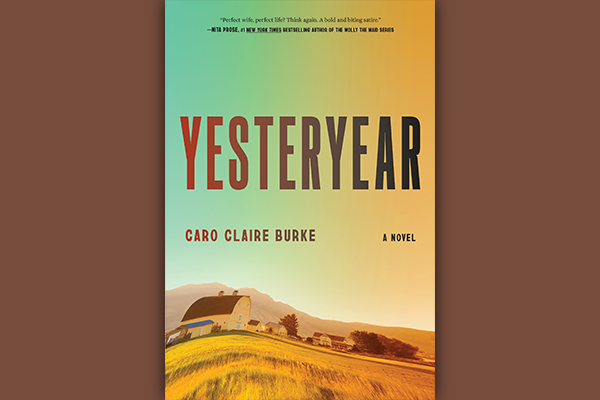
THE QUESTION OF free will is best approached sideways. Rather than asking head-on whether we have agency in our lives, we should ask ourselves a more consequential question: What happens when we deviate from the life script we’ve been handed, especially when that life script is dictated by religion?
This is the question that novelist and podcaster Caro Claire Burke explores in her debut novel, Yesteryear. The story follows the rise and fall of Natalie Heller Mills, a conservative trad wife social media influencer who suddenly finds herself transported to the 1800s. Homesteading—which had mostly been an act Natalie performed for Instagram, only possible thanks to a plethora of be-hind-the-scenes hired help—is suddenly overwhelmingly real, isolating, and cold.
Yesteryear is an exploration of womanhood in the U.S. under capitalism and religious fundamentalism. The novel was inspired by real-life Hannah Neeleman, a Mormon influencer who abandoned her dreams of being a ballerina to start a homestead, known as Ballerina Farm, with her husband. Ballerina Farm and the larger trad wife trend of returning to traditional gender roles were scrutinized in a July 2024 profile in The Times of London, which revealed that maybe Neeleman wasn’t as free or empowered as she seemed.
Tradwifery provides an excellent case study of free will. By creating the character of Natalie, Burke was able to inhabit the mind of someone like Neeleman to better understand her life choices, especially when it seems those choices are disempowering. Yesteryear, like much great fiction, is an exercise in empathy.
culturelead3may26.png
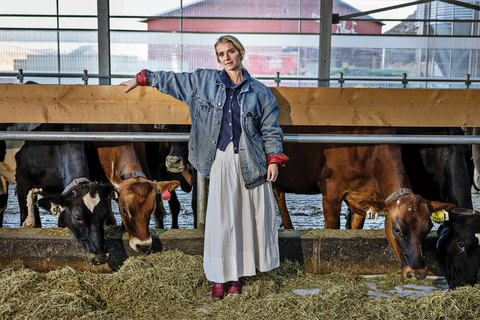
The parallels between Burke’s fictional Natalie and Neeleman are clear: Neeleman was raised Mormon; Natalie was raised in an unspecified fundamentalist religion. Neeleman was a talented dancer who studied ballet at Juilliard; Natalie is a brilliant student who got a full ride to Harvard. Neeleman married the son of the billionaire founder of Jet Blue; Natalie married the son of a conservative politician. Both women got married after a short courtship and then quickly became pregnant. Both families had no experience homesteading, and both women are the social media figureheads of the operation while their husbands control the finances. Both the real-life Neeleman and the fictional Natalie are perpetually pregnant, and their children are all homeschooled with a Christian curriculum.
Natalie is heavily shaped by the cognitive dissonance surrounding gender roles that she internalized at a young age. She watched as men were cast as the leaders of the family and society while the women silently picked up the slack wherever and whenever the men fell short. Her own father abandoned her family for another woman, and instead of telling the truth about his infidelity, Natalie’s mother, who managed just fine without a man, taught her daughters to protect his reputation, and by extension their own. “This was the world I was born into,” Natalie narrates. “A world where good Christian women moonlighted as crisis managers for their good Christian men.”
Natalie learned that the only way for women to wield power was to do so secretly while giving credit to men. She tries to enter the secular world, where she believes her merits might be recognized, but after a year at Harvard, Natalie sees that the modern woman cannot have it all. Her feminist classmates at Harvard are still bound by a new, reimagined set of 21st-century gender norms: They use fake tanner, wear specific clothes and makeup, and sleep with frat boys in order to be accepted and well-liked. They dream of having a family while also chasing career success on the capitalist hamster wheel. Natalie ends up deciding that the “stupidest” path a woman can take is the one her roommate chooses: “accepting a job in an industry designed, filled, and run by men.”
Natalie gains power where she can: by pretending that her husband makes the decisions while she secretly steers the ship.
Natalie feels betrayed by a society where women are still not judged for their intellect or talents. She sees only two paths ahead: abandon her faith tradition—which would mean abandoning God—or abandon her worldly ambitions. How do you exercise free will when faced with two bad options? Natalie ultimately decides to leave the world of secular elites and gain power where she can: by pretending that her husband makes the decisions while she secretly steers the ship.
After a quick courtship, she makes the strategic choice to marry Caleb Mills, a decision she hopes will lead to security. But soon after the first baby arrives, she realizes she had miscalculated: Caleb is an “actual, honest-to-God idiot” with no career ambitions. But leaving him isn’t a possibility. “In the world that I came from,” she says, “divorce was a German word that translated loosely to a lifetime of destitution and misery followed by an eternity in Hell. You didn’t leave your husband if he slapped you in the face, or had an affair, or set you up a weekly allowance so sparse that you snapped at your children when they spilled a glass of milk, and you certainly didn’t leave your husband if he was just some dumb rich guy.”
culturelead2may26.png
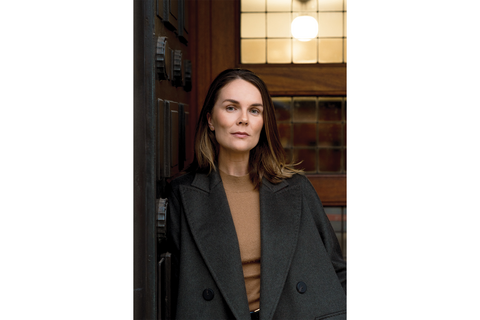
By showing us Natalie’s thought processes, Burke expertly lays out the tragedy facing some women who leave Christian fundamentalism. Women are still oppressed in the secular world, but the forces that oppress women are not as visible. The rules exist, but they aren’t explicit as they are in certain religious contexts. And when you realize that either way you will be forced to abide by a set of oppressive rules, why not choose the set of rules that are transparent and that offer a man who is duty-bound to provide for you? Why risk blowing your life apart and potentially ostracizing your family when the thing you are blowing it up for doesn’t provide any more security or happiness? In other words, better the patriarchy you know than the patriarchy you don’t.
Yesteryear is fast-paced with short chapters alternating between the past and the present. The sections chronicle Natalie’s rise to power as a trad wife influencer and also Natalie figuring out how to escape from the 1800s.
Some of the sentiments about patriarchy are heavy-handed, such as when Natalie is reflecting on reality TV and says, “America hates women. What a comfort to remember.” But the heavy-handedness makes the message more poignant. Natalie is clearly not blind to the ways that patriarchy functions. By writing Natalie as a character who has always been aware of patriarchy, Burke changes the narrative around women in fundamentalist environments, who are often viewed as unaware of the systems that oppress them. Burke is suggesting, through Natalie, that these women are fully aware of the flavor of gender-based oppression they are choosing. And if that is true, the judgment cast on the state of feminism under capitalism is much more damning: These women understand what it has to offer and still say no.


Did this article have an impact on you? Tell us how! Whether you’re moved to take action, have a question, or want to share a comment (good or bad), we value your feedback!