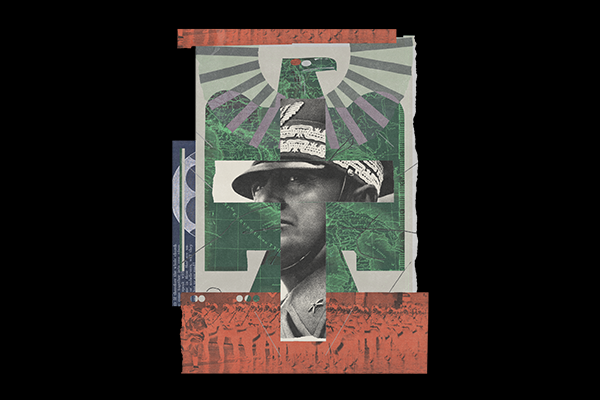
DURING ONE MEMORABLE scene in Mussolini: Son of the Century, a critically acclaimed series about the rise of Benito Mussolini currently streaming on MUBI and Apple TV, the fascist leader finds his wife, Rachele, in a church, praying for the recovery of their sick child. An avowed, outspoken atheist, Mussolini tells her to direct her pleas to the doctors treating him instead. When ignored, he looks up at the ceiling and asks God to prove God’s existence by smiting him—a request which, to Mussolini’s self-satisfaction, goes similarly unanswered. Outside, the couple is greeted by a crowd shouting “Duce,” or leader. Bathing in the public’s adoration, Mussolini spreads his arms, his pose mirroring the cross atop the church behind him.
Mussolini’s desire to rival and replace Christianity is not a fabrication or exaggeration on the part of the TV series, directed by filmmaker Joe Wright and based on a well-researched historical novel of a similar name by Italian author Antonio Scurati. Fascist leaders frequently compared their movement to the Catholic Church, describing themselves as prophets and saints while referring to their followers as believers and worshippers. In a way, the party apparatus didn’t just look or sound like religion; it was a religion, custom-made for an age when Christianity was rapidly giving way to atheism.
Although Mussolini’s 20-year reign came to a brutal end during World War II, when he and his mistress were executed in front of a similarly jubilant crowd, his legacy has survived. To this day, this early fascism serves as a blueprint for conservative and neo-fascist movements across the world, from the United States to Italy itself. Looking at what happened when Mussolini rose to power more than a century ago will help us understand what’s happening today.
‘Humanity needs a credo’
EMILIO GENTILE, A leading Italian historian at Sapienza University of Rome, has argued that fascism was more like a political religion than a political movement. Mussolini’s regime, much like those of Adolf Hitler and Joseph Stalin, constituted a “sacralization of politics” where the party doubled as a church, the leader was transformed into a deity, and ideology was treated like holy scripture.
The fascist philosopher and education minister Giovanni Gentile—no relation to the former—once said that fascism was predicated on “a religious feeling” insofar as it “takes life seriously.” Salvatore Gatto, deputy secretary of the National Fascist Party, wrote, “Fascism is a civil and political religion because it has its own concept of the state and its own method of understanding life.” He continued to explain that “throughout history the heroes of the fascist revolution, and Christian martyrs, have confirmed a burning reality: that only religion can deny and annul attachment to an earthly existence.”
Italian society had been searching for a political religion long before fascism arrived on the scene. As a member of the Italian Socialist Party, Mussolini argued that for socialism to succeed, it needed to become not a science or a philosophy, but a faith. “We want to believe in it; we must believe in it,” he once said. “Humanity needs a credo. It is faith that moves mountains because it gives the illusion that mountains move.”
Emilio Gentile traces Italy’s search for a political religion back to the Risorgimento, the messy birth of the modern Italian nation-state at the end of the 19th century. In their quest to craft a sense of national identity, some poets and intellectuals took inspiration from the Jacobins of revolutionary France, who sought to replace church and monarchy with a cult that deified the French Revolution itself. Others turned their sights to Japan, where the Meiji Restoration’s crackdown on Japanese Buddhism and Confucianism and recentralization of traditional Japanese Shintō was thought to have contributed to Tokyo’s historic victory over Moscow during the Russo-Japanese War (1904-1905).
Italy’s need for collective meaning and purpose was further exacerbated by World War I which, in Gentile’s words, brought all participating states to a place where “politics could not return to the banal forms of everyday life, but had to perpetuate the heroic impetuosity of the war and the mystical sense of a national community.” Carlo Rosselli, a politician, historian, anti-fascist activist, and contemporary of Mussolini, surmised that the sheer brutality of the war had left many of its survivors willing to “sacrifice their body and soul for a cause—whatever it was—provided that it had the capacity to transcend the wretched nature of everyday life.”
The war’s romanticization of militarism gave fascism its spiritual dimension. Molded by the “holy communion of war” and its “mettle of generous sacrifice,” as the party put it in a 1921 statement, fascism promised to march “unstoppably towards the future.” More important, perhaps, it told Italians—long humiliated by the other European powers and divided among themselves—that they were “the highest of the high.”
featurebrinhofmar262.png
Demanding unquestioning faith
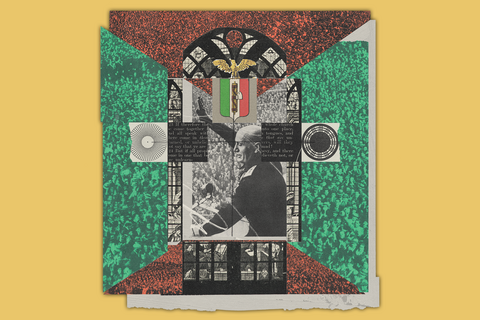
FASCISM’S RELIGIOUS DIMENSION expanded after the movement entered an alliance with the Catholic Church itself. Records from the Vatican Archives released in 2006 called into question the previously unchallenged notion that the church resisted Mussolini’s rise to absolute power. As detailed in David Kertzer’s Pulitzer Prize-winning 2014 book, The Pope and Mussolini, and elsewhere, the papacy proved a loyal, valuable ally. As the Duce moved deeper into Hitler’s orbit, clerical leaders suppressed religious criticisms of the Nazi regime while propagating antisemitic propaganda of Judeo-Bolshevik forces conspiring to destroy Christianity. Pius XI, who shared Mussolini’s distaste of democracy and communism, consented to the latter’s campaign to crush Luigi Sturzo, an anti-fascist priest and politician who described fascism as “profoundly pagan, and in contrast with Catholicism.” As threats against him intensified, Sturzo fled Italy for London in 1924.
Catholic support for Mussolini’s regime was, however, certainly not unanimous. Sturzo’s Italian People’s Party, Italy’s largest Catholic political organization, was itself divided between pro- and anti-fascists, the latter of which went into exile when the Duce came to power. So did Guido Miglioli, a leader of the country’s “White Leagues”—Catholic labor unions that used their ties to Moscow to aid partisan resistance during World War II. Catholic institutions across the world condemned both the Lateran Treaty, which solidified the papacy’s relations with the state, and the various racial laws that—similar to legislation passed in Germany—reduced Italian Jews to second class citizens, robbing them of their rights and property. When the Nazis brought the Holocaust to Italy, Catholic clergy such as Giuseppe Placido Nicolini and Rufino Niccacci in Assisi and Hugh O’Flaherty in Vatican City operated networks of safehouses that saved thousands of Jewish lives.
Party recruitment and promotions prioritized fidelity over competence.
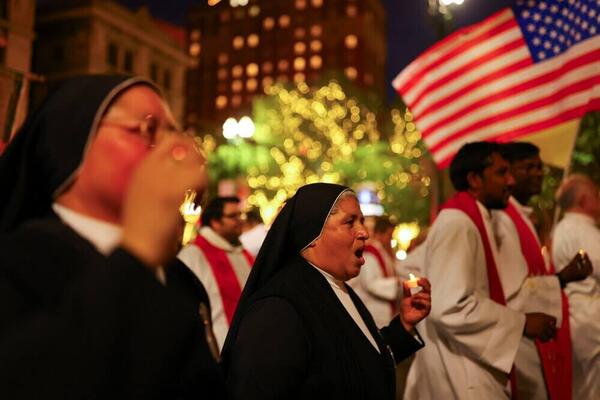
One of the most well-known figures in Catholic resistance against the fascist state was Enrichetta Alfieri. Remembered as the “The Angel of San Vittore,” she was a nun who organized schools and nurseries for inmates of the eponymous prison in Milan. When fascists took over the prison as part of a larger effort to crush dissent and destroy their ideological enemies—which by the time World War II was in full swing included Marxists, Jews, and various ethnic minority groups—Alfieri risked her life delivering secret messages between the inmates and the partisan organization fighting to dismantle Mussolini’s puppet regime in Northern Italy, the Comitato di Liberazione Nazionale Alta Italia.
But despite these notable stories of resistance, fascism was able to control its followers in ways that a conventional political movement never could. Members swore allegiance not to a set of values or ideals, but to the Fascist Party itself. Those who broke their oaths were labeled “traitors of the faith,” while those who died upholding them were turned into canonized martyrs. Loyalty was demonstrated not through argument or action, but blind faith. As party secretary Augusto Turati declared, Fascists had to “believe absolutely ... just as one believes in God.” They had to accept its principles without discussion, “even if we realize they are mistaken.” Such was the party’s insistence on obedience that recruitment and promotions prioritized fidelity over competence. Where early conceptions of fascism’s “new man” emphasized a person’s boldness and intelligence, later sources highlighted obedience and subservience.
According to Emilio Gentile, fascism’s demand for unquestioning faith was both pragmatic and dogmatic, rooted in its “conviction that both the individual and the masses were motivated by irrational and mythical thoughts.” He points to Lo Stato e la dottrina corporativa (The State and the Corporate Doctrine), a 1930 book by fascist lawyer and criminal law professor Guido Bortolotto, whose theory of governance was predicated on the assumption that most people “cannot recognize subtle distinctions” and therefore “need spiritualism, piety, religious principles and rituals.” While fascism broke down the distinction between private and public life, its vision of civil society had no desire for active participation; the model fascist citizen was expected to listen, not to speak.
Fascism’s organic rise
ALL TOO OFTEN, explorations of Italian fascism’s political religion are limited to the deification of Mussolini, who through persistent propaganda elevated himself to the status of a superhuman, guardian angel, or demigod. This limitation is to some extent justifiable, as the historical significance of the Duce’s cult of personality—arguably the first of its kind—should not be underestimated. Aside from providing a blueprint for future authoritarians, it has allowed Mussolini’s legacy to survive his own downfall.
By successfully convincing the public of his own infallibility, he was able to separate his perfect self-image from the less-than-perfect track record of the Fascist regime itself. Already during his dictatorship, unpopular policies—such as the unfruitful pursuit of economic self-sufficiency—were blamed not on Mussolini himself but on the subordinates who supposedly acted without his guidance. Today, the Duce remains a vital force in Italian politics, where nostalgic and historically inaccurate memories of his strong-armed reign have served to generate support for right-wing politicians such as Giorgia Meloni, Italy’s current prime minister, and Silvio Berlusconi, her predecessor.
Still, solely concentrating on Mussolini risks ignoring several other equally crucial factors that contributed to fascism’s sacralization. As the debates about national identity that erupted in the wake of the Risorgimento demonstrated, the country’s search for a political religion predated the Duce’s rise to power. Moreover, fascism’s transformation from a party into a church-like entity that neither originated from nor limited itself to the individual at its center. Far from being imposed from the top down, it arose organically from the collective and considerably decentralized efforts of people inside and outside the party itself.
When Mussolini spreads his arms in Mussolini: Son of the Century, his resemblance to Christ is framed as neither deliberate nor accidental. Nowadays, the Duce is often imagined in one of two ways: as a Machiavellian mastermind who successfully schemed his way into absolute power, or as an oafish opportunist swept up by powerful historical forces he pretended to control but never could. The TV show, much like Emilio Gentile’s scholarship, proposes a third interpretation, contextualizing the Duce within a larger political and intellectual ecosystem—one without which fascism’s religious character could never have come into being.
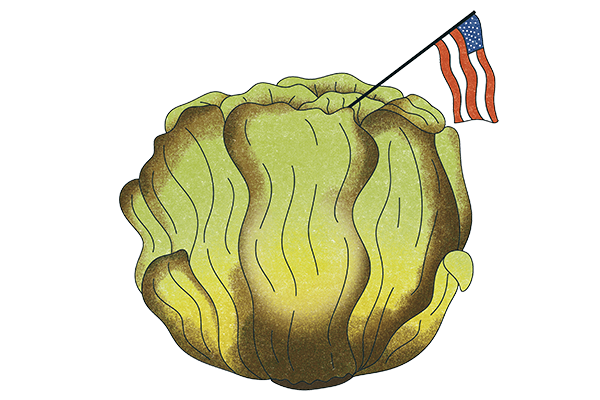
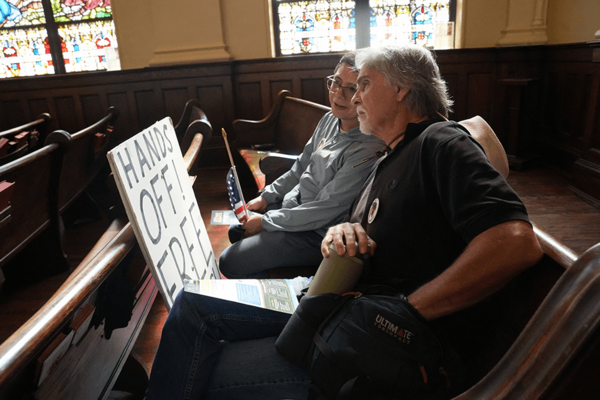
Italian fascism’s transformation into a political religion bears a close resemblance to the rise of Donald Trump’s MAGA movement in the United States. Sanford Schram, a professor of political science at Hunter College and author of The Trajectory of Trumpism, tells Sojourners that, like Italian fascism, the MAGA movement “at its core exalts its leader as chosen by God to impose authoritarian rule on behalf of the resentful group that supports him.” To this group, the movement is not a conduit of, but a substitute for, the Christian gospel—the new faith for those who, as Schram puts it, mainline religion has become “too woke.” Amanda Porterfield, a professor of religion at Florida State University, argues that the religious character of Trumpism is rooted in Christian connotations of the idea of America, “an idea inflected with a combination of Calvinist providentialism and a resentment of patronizing elites that goes back to the American Revolution.”
Fascism is resurging across the globe. People of faith would do well to contemplate the ways that leaders past and present have used religion for their own benefit under the guise of upholding them. As a close look at the history of fascism reveals, what happens on stage seldom corresponds to what takes place behind the curtain.

Tim Brinkhof is a U.S.-based Dutch journalist who writes about religion, politics, and history.
Did this article have an impact on you? Tell us how! Whether you’re moved to take action, have a question, or want to share a comment (good or bad), we value your feedback!