IN A 2025 general audience, Pope Leo XIV drew listeners’ attention to the “cry of pain rising from places devastated by war, especially Ukraine, Iran, Israel and Gaza.” He warned that “we must never get used to war.”
He was identifying a condition already visible on social media, where footage of Russian drones bombing Ukraine and ICE agents raiding neighborhoods in Chicago and Minneapolis is nestled neatly between cat videos and cooking clips as just another type of consumable digital content. These incidents of violence once represented distinct breaks with the ordinary—moments when civic trust collapsed into the mire of conflict. Now, they are part of the endless stream of videos sifted, reacted to, reframed, and absorbed by a political and media apparatus primed for soliciting dramatic responses.
Social media presents political life as a series of moral outrages filtered through an algorithm. This can dislocate our attention. We begin to care more about someone’s position in a viral argument than about those suffering in a faraway conflict or a consequential bylaw vote taking place in our own town. The distance between the self and the screen erodes while the distance between neighbors grows. Ordinary disagreements are transformed into loyalty tests. The conditions that once supported civil disagreement, such as shared context and mutual recognition, are cast aside.
In this environment, we become less concerned with persuading people offline and more interested in broadcasting our position. A school board dispute becomes a national proxy war. A campaign for local office is treated as a stand-in for a cultural battle elsewhere. The details may get set aside or ignored altogether. What matters is whether the dispute can be used to signal allegiance in a broader cultural fight—about race, gender, religion, or political identity.
The cumulative effect is a public culture where political conflict is experienced at a distance, even as it grows more personal in tone. People feel implicated by what happens far away and disengaged from what happens next door. The result is a kind of civic drift. Emotion about politics grows louder while active participation inevitably shrinks.
In that same general audience, Pope Leo reflected on John 5:6-9, where Jesus comes upon an ill man and asks, simply, “Do you want to be well?” We have all experienced variations on this moment, a period of illness or weakness where we are consumed by our own fragility. As Pope Leo wisely notes, “when one is stuck for so many years, even the will to heal may fade.” It’s a fitting description of where we are now. The entire system is sick. Do we want to be well?
Local presence becomes a way to ground our wider concerns, not replace them.
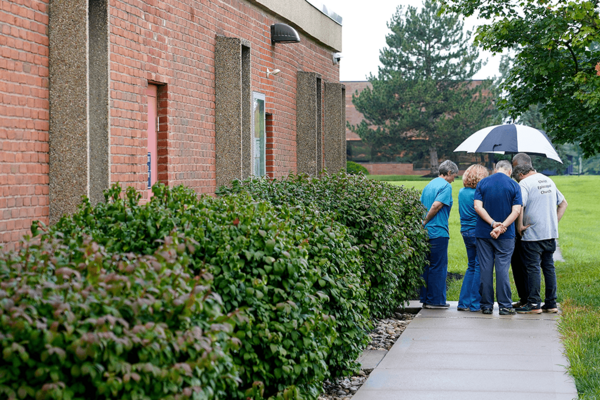
Perhaps healing begins with a return to local presence. Not nostalgia for a time when politics seemed quieter or more manageable, but commitment to the ground beneath our feet where life is shared and responsibility to one another can take root. The practice of presence might mean going to a public meeting, staying for the full discussion, asking questions when necessary, and following up when the outcome is delayed or unclear.
After recently moving to South Dakota and feeling out of place, I found solace in a small monthly reading group on The Rule of St. Benedict. A sister from the local monastery leads our discussions with patience and wisdom, creating space for us to be vulnerable and honestly reflect on our faith and our lives. What began as discomfort for me has grown into a meaningful connection to my community and to the people around that table.
The habits that sustain this kind of presence are simple: Showing up. Paying attention. Staying when conflict emerges. These are modest forms of maintenance, not grand heroic acts. They hold people in place long enough to build or restore trust.
Such practices aren’t built for visibility, and they don’t scale. As Thomas Merton observed, “We tend to think massive protest is all that is valid today. But the massive is also manipulated and doctored. It is false. The genuine dissent remains individual.” These quieter forms of dissent and engagement allow us to return to a conversation after an argument or to continue meeting when no agreement has been reached. Political life will always involve disagreement, but it is less likely to fracture when people know they have to keep showing up together.
This is not to suggest a retreat from national or global responsibility. Attention to the local does not absolve us from caring about Gaza, Ukraine, or any place marked by grief. But it clarifies the scale at which most of us can act with integrity. Local presence becomes a way to ground our wider concerns, not replace them. It allows people to respond to distant suffering without turning that suffering into a spectacle. And it reminds us that far-flung concerns don’t take the place of commitment to our own towns and neighborhoods.
In a culture too often shaped by resentment, the practice of presence calls us to the generosity that makes civic life possible: giving time, withholding judgment, listening, learning from one another, and allowing people to return after conflict without being made to feel ashamed.
This can feel harder to sustain when war becomes the backdrop for so many of our interactions, making them feel naive, even indulgent. This perceived naivete is perhaps one reason so many people hesitate to take seriously the concerns and grievances of those with whom we disagree. But patience and generosity is all the more needed in times of crisis.
This kind of slow, ordinary repair doesn’t fit neatly into ever-escalating social media discourse, but it can reestablish the conditions that make meaningful discussions possible. It brings our attention back to the scale where substantial change can take place. This is how people stay connected despite a culture that encourages us to escalate arguments and walk away when things get difficult.


Did this article have an impact on you? Tell us how! Whether you’re moved to take action, have a question, or want to share a comment (good or bad), we value your feedback!