
The written word isn't going away anytime soon, and religion's effect on the publishing industry is part of the reason.
Cover Story
Jim Wallis 11-01-2004
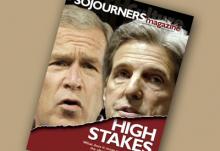
For many people of faith, the elections have shown that what is needed is nothing short of a new confession of Christ.
Amy Sullivan 11-01-2004

When candidates claim God as their campaign manager, you can be sure they're trying to divert attention from the real question: Do they walk the talk?
Richard Rohr 10-01-2004
Unless we observe and surrender our small, daily anxieties, we won't recognize the really big fears, in all their disguises, that control our politics, our denominations, our bank accounts, and the world's future.
Julie Polter 10-01-2004
Especially in a contentious election year, I find it difficult not to be skeptical when the Department of Homeland Security issues terror alerts. When the alert level was raised just after the Democratic Convention, for example, the specific details seemed convincing.
Francis MacNutt 10-01-2004
As a World War II veteran, I have always wondered how Adolph Hitler, the "Fuehrer" (the Leader), could gain so much support in a nation where most of the people were ChristianLutheran and Catholic. Why did so few raise their voices against the gathering storm?

Bill Moyers 8-01-2004
How do we nurture the healing side of religion over the killing side? How do we protect the soul of democracy against bad theology in service of an imperial state?
Rose Marie Berger 7-01-2004
Sojourners associate editor Rose Marie Berger and photographer Ryan Beiler spent a Sunday afternoon in February with Wendell Berry at his farm in Henry County, Kentucky. Berry is the author of more than 40 books of fiction, poetry, and essays including The Unsettling of America, What are People For?, Life is a Miracle, Citizenship Papers, and The Art of the Commonplace. He has farmed in a traditional manner for nearly 40 years.
Sojourners: How does your identity as a writer connect to this region and land?
Wendell Berry: I was born here in Henry County. I grew up in these little towns, and in the countryside, on the farms. All my early memories are here. All the voices that surrounded me from the time I became able to hear were from here. This place where we're sitting today is the old property known as Lane's Landing. Twelve acres, more or less, the deed says. My wife, Tanya, and I came back here in 1964 and have lived here for 39 years, raised our children here. How could you draw a line separating this place and my identity? If you've known these places from your early youth, that means that you have a chance to know them in a way that other people never will.
We're on the west side of the Kentucky River, in the Kentucky River Valley. Some people call this the Outer Bluegrass. An old ocean laid down these layers of limestone in the soil. There are lots of trees here. There are white, chinquapin, red, black, and shumard oaks. Those are the principal ones.
Rose Marie Berger 1-01-2006
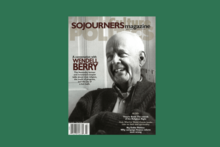
Sojourners associate editor Rose Marie Berger and photographer Ryan Beiler spent a Sunday afternoon in February with Wendell Berry at his farm in Henry County, Kentucky. Berry is the author of more than forty books of fiction, poetry, and essays, including The Unsettling of America, What are People For?, Life is Beautiful, Citizenship Papers, and The Art of the Commonplace. He has farmed in a traditional manner for nearly forty years. Berry spoke with Sojourners about religious practice, Bluegrass country, defending against Wal-Mart, usury, and Jesus. - The Editors
ROSE MARIE BERGER: Tell me about this land, about this bioregion, about the history of your farm.
WENDELL BERRY: We're on the west side of the Kentucky River, in the Kentucky River Valley. Some people call this the Outer Bluegrass; there are other names for it. We have limestone soils. An old ocean or sea laid down these layers of limestone. There are lots of trees here. There are white, chinquapin, red, black, and shumard oaks. Those are the principle ones. And we have two or three kinds of ash, maples, several varieties of hickory, black walnut, sycamore, black locust, honey locust, cedar, basswood, red elm, slippery elm. We used to have chestnuts once. Tanya and I have 125 acres altogether, 75 here and about 50 on Cane Run.
This place where we're sitting today, is the old property known as Lane's Landing. Twelve acres, more or less, the deed says. Tanya and I bought it in 1964 and moved in the next year. So we've been here thirty-nine years.
Heidi Schlumpf 6-01-2004

When you're Christian, progressive, and "pro-life," voting your conscience is often easier said than done.
Vinoth Ramachandra 5-01-2004
The gospel provides an antidote to the abuses of the global economy and invites us to act for justice wherever - and whoever - we are.
Susan Pace Hamill 4-01-2004
Susan Pace Hamill, a professor at the University of Alabama Law School specializing in federal corporate tax law, had previously worked at two prestigious law firms and at the IRS. Her research on the Alabama tax code—the most regressive and harsh on the working poor of any in the country—led her to write "An Argument for Tax Reform Based on Judeo-Christian Ethics." Her article convinced Alabama's conservative Republican Gov. Bob Riley to propose a state constitutional amendment that would have revolutionized tax policy in Alabama. The proposal failed in the 2003 vote, but the reform work continues—with the potential of spurring a nationwide movement for tax justice. This is her story, as told to Sojourners associate editor Julie Polter.
I had lived in Alabama seven years, which has more taxes than you could shake a stick at, and I had never focused on the state and local inequity. I'm not proud of that. However, I did notice that the first property tax bill for our house was so low that I thought it was for the month instead of the year. I read grocery sales slips thinking, "That's too high on groceries, that's not right." And every year for state income tax I would get refunds while I was writing checks to Uncle Sam.
Meanwhile, my kids are attending a C- funded school system, one of the few in the state I deem minimally adequate, and every year the teachers are begging for donations to cover things. The signs of inequity were there, but I refused to put them together because I didn't view it as my problem. I would think, "I'm not a state and local tax specialist. I'm a federal person—I'm too busy."
Then I took sabbatical to attend Beeson Divinity School at Samford University in Birmingham, a primarily Southern Baptist institution. At Beeson, another sign came under my nose: A little newspaper article about a big Washington, D.C. think-tank study on income taxes that ranked Alabama the worst. It stated, "Alabama's Income Tax Least Fair," and cited a $4,600 threshold [at which income-tax liability begins]. My first instinct was "That has to be a misprint! Even if we're the worst, that can't possibly be true."
Bill McKibben 3-01-2004
No politician seriously believes that Americans are willing to deal with global warming. Is it too late to prove them wrong?
Stewart Burns 1-01-2004
Author Stewart Burns talks with Sojourners' Julie Polter on King's relevance for America today.