“LIVING WITH HISTORY may be burdensome,” wrote lesbian archivist and activist Joan Nestle, “but the alternative is exile.”
After my parents died, I spent months sifting through their objets de la vie quotidienne (“items of everyday life”). Why does it sound better in French? U-Haul containers arrived in our driveway disgorging antique furniture, lamps, wood carvings, and boxes.
Stuffed with paperwork, the boxes held a cross section of the history of their professional lives as public school teachers and their faith lives as socially engaged Catholics. The boxes also included bursting photo albums, an anatomically correct Santa Claus doll made by my grandmother and her sister one Christmas, and at least 14 linear feet of my dad’s genealogy research. Yes, living with history can be a burden.
All families are wrapped in genealogies: Who are you? Who did you come from? Who did they come from? In this way, all families are fictive. By “fictive,” I do not mean false or unreal. I mean that families give us foundational narratives. These narratives are neither true nor false; they are simply one way we tell ourselves who we are. Family histories can give a partial plotline to the narrative arc of a life. As Nestle wrote in A Restricted Country, “We need to know that we are not accidental.”
Families harm and families heal. Their stories do the same. The last words my dad said to me the night he died were “I’m sorry.”
Was he apologizing for all the boxes headed my way? For demanding I buy a book for him off Amazon while he was dying? For needing me to change his pajamas when he was too weak? Or was he saying something else that I just happened to be present for? The word “sorry” comes from words that mean “full of sores” and “grieved.”
My father’s mother was born in a sod house on the Nebraska plains in February 1897; displaced Pawnee families were still walking south to Oklahoma. It was a killing winter with temperatures in the minus teens. In her world, you either did something the right way, or you died. You banked the fire properly. You repaired the doors properly. You planted the garden properly. If you did not, those relying on you might not live.
My dad couldn’t let go of a single thing of hers. Those boxes on my picnic table held his mother’s worn-through dish towels and broken rosaries. Her objets de la vie quotidienne. He was bound by a hyper-responsibility that translated into hoarding, grudges, and anger when something wasn’t done the “right way.” It also translated into profound compassion for those vulnerable to the whims of a killing world and placed a high value on celebrating neighbors and friends.
Families are certainly defined by spirals of DNA, but they are so much more.
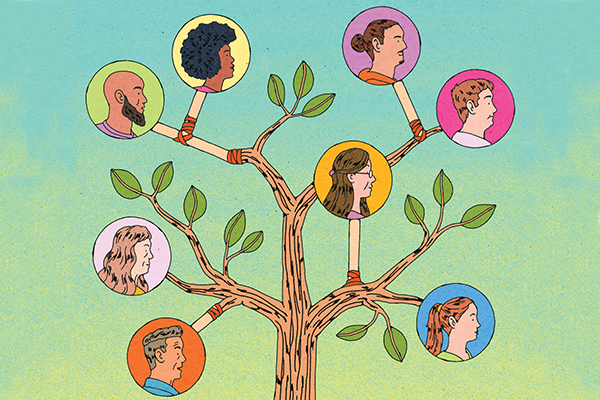
Families are certainly defined by spirals of DNA, but they are so much more. Across 60 years of marriage, my parents also had a chosen family. Their kinship family included Catholic sisters and priests, church members, teacher colleagues, strangers they struck up a conversation with at a restaurant, authors, artists, mechanics, nurses, international students, monks, imams, day laborers, librarians, and the newspaper delivery guy who also brought them doughnuts. Each one grafted their own fictive families onto ours, making us all more resilient. Families that are blended, begotten through adoption, led by a single parent or divorced parents, childless, extended, or chosen, are all seeds for stories about who we are and how we are connected.
At Christmas, we re-enflesh the stories around Jesus’ birth, his genealogy, and the family that God chose to join. The genealogies of our families and of our faith are longer and older than the current iteration of the fascist family order. Our stories offer us protection from the predations of empire.
“To live with history,” Nestle wrote, “is to have a memory not just of our own lives but of the lives of others, people we have never met but whose voices and actions connect us to our collective selves.”
Christmas is a time to tell the radical, unique, suppressed, and surprising aspects of our family stories. Trim the tree with pictures of those who came before, make the old recipes, bring out the photo albums. Talk about hard times you experienced and how it changed the family. What are you afraid of? What feels risky now? What is a question you wrestle with? Strengthen your “collective selves.”
“People without a history are more vulnerable to the hazards of the world,” wrote Hélène Giannecchini in An Army of Lovers Cannot Fail, a book on the political force of gay and lesbian friendships. The strength, imagination, and adaptability of families are not trapped inside the objets de la vie quotidienne (although I may keep the Santa Claus doll). There’s not one right way to do things. “Sorry” doesn’t have to be the last word. Instead, unwrap your stories.

Rose Marie Berger, a Catholic peace activist and poet, is senior editor of Sojourners magazine. She is author ofBending the Arch: Poems.

Did this article have an impact on you? Tell us how! Whether you’re moved to take action, have a question, or want to share a comment (good or bad), we value your feedback!