MAGA's 9-Hour Prayer Festival Is Based on a False Idea

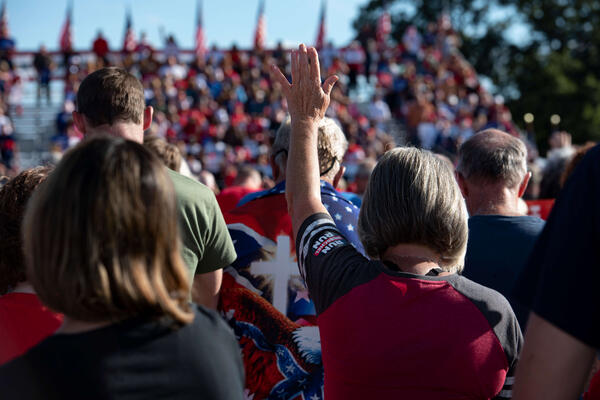
Evangelical Trump supporter rally on Sept. 25, 2021, Perry, Ga. Credit: Reuters

On Sunday, May 17, members of the Trump administration will participate in “Rededicate 250: National Jubilee of Prayer, Praise & Thanksgiving,” a nine-hour prayer festival on the National Mall in Washington, D.C. The purpose of this festival is to call for America to rededicate itself to its Christian roots.

So, for what feels like the millionth time, a chorus of researchers, historians, and journalists all repeat: America’s founders didn’t want it to be a Christian nation.

This idea—that America’s Founding Fathers intended for the United States to be an explicitly Christian nation—has been gaining traction in the lead-up to America’s 250th anniversary on July 4, 2026, and it provides an all-too-easy foundation for Christian nationalism to intersect with and influence politics.

There’s one problem with the premise of this festival, though: It’s false.

The U.S. was not founded as an explicitly Christian nation, though the Founding Fathers used their varied religious backgrounds and beliefs to inform their thinking as they built it, as historian Mark David Hall told the Associated Press. But America’s upcoming semiquincentennial is providing cause for right-wing Christians to amplify this myth, and they’re finding support from many members of the Trump administration in their efforts to do so.

This festival is not the only instance during President Donald Trump’s second term that members of the current administration promoted events centered around Christian nationalist ideologies. According to reporting from The Atlantic, Trump marked the end of his first 100 days in office during his second presidential term with worship in the West Wing led by Sean Feucht. Feucht, a longtime supporter of Trump, tours the country to lead rallies that pair Christian worship music with Christian nationalist views, such as the statement he made during a 2023 performance in front of the Wisconsin statehouse that “we want God in control of government.”

And when he addressed the National Prayer Breakfast in February, he told attendees, “We’re going to rededicate America as one nation under God.” Later that month, during his State of the Union address, he boasted: “I’m very proud to say that during my time in office, both the first four years and in particular this last year, there has been a tremendous renewal in religion, faith, Christianity and belief in God.”

During my education at Duke Divinity School, I took a class on Christian nationalism from Lester Ruth, a research professor of Christian worship. He talked about the different strains of Christian nationalism, two of which are converging as part of this festival. The “Covenant Nation” strain, as identified by Ruth, focuses on a particular reading of U.S. history that emphasizes the myth that the Founding Fathers established this country to be a Christian nation under the guidance of Christ.

READ MORE: Christian Nationalism’s Power Rests On a Simple Proposition: No Questions

Ruth says that while it is not factually accurate to say the Founding Fathers meant for the U.S. to be a Christian nation, controlling the narrative of America’s founding leads to greater control of its modern citizens’ prevailing worldviews. This reflects the findings of a 2022 survey from the Pew Research Center, which showed that six out of 10 Americans believe America’s founders intended it to be a Christian nation. The upcoming prayer festival is similar to other Covenant Nation worship services that pop up around Memorial Day or the Fourth of July (or, in this case, both, given the timing and purpose of the prayer festival).

Holding a prayer service in a politically significant spot like the National Mall also hints at elements of spiritual warfare, a key practice in the strain of Christian nationalism known as “Dominionism.” According to Ruth, in Dominionism, longstanding elements of Pentecostalism are repurposed as weapons in ongoing spiritual warfare for political aims.

The Washington Post reports Sunday’s prayer festival is funded in part by millions of public dollars that have been earmarked for the United States’ 250th birthday celebration, according to the festival’s organizers. The majority of the festival’s speakers include evangelical Protestant leaders and members of the Trump administration, many of whom are proponents of the idea that America’s founders wanted it to be explicitly Christian.

Christian nationalism reveals itself to be sinful because of its idolatrous fruits—specifically, how the nation-state takes the place of God, and encourages people to embrace arrogance, pride, and an end-justifies-the-means way of thinking that both violates Christ’s commandment to love and supports violence. Americans aren’t alone in falling prey to the idea that Christ was planning to seize worldly power; the disciples thought that after Jesus’ resurrection, he was going to lead by occupying a political throne, too (Acts 1:6).

Christian nationalism reveals itself to be sinful because of its idolatrous fruits—specifically, how the nation-state takes the place of God, and encourages people to embrace arrogance, pride, and an end-justifies-the-means way of thinking that both violates Christ’s commandment to love and supports violence.

The faith leaders, politicians, and worshipers at the prayer festival on Sunday will be praying for the return of something that didn’t exist when the U.S. was founded: a tight fusion of identity and allegiances, where those in power use political and cultural means to create a vision of specific Christian practices and ethics in public life. But if the people there truly want the U.S. to be restored, they would do well to abandon their pursuit of power and focus instead on loving God and neighbor the way Jesus describes in scripture.