This Saturday, Black leaders are inviting Americans of all races and faith traditions to rally across the nation to protect minority voting rights in the aftermath of a recent Supreme Court decision weakening the 1965 Voting Rights Act.
“We believe that the gutting of the Voting Rights Act is the latest of many red flags and alarms that the state of our country is not well,” California pastor Rev. Michael McBride told Sojourners this week.
McBride, one of the key organizers for Saturday’s National Day of Action for Voting Rights, said churchgoers in particular “have a moral responsibility … to lift up our voice, that this injustice not be unmet by the faithful among us.”
In its ruling on Louisiana v. Callais, announced April 29, the Supreme Court reinterpreted part of the Voting Rights Act that bars racially discriminatory election maps. The decision is expected to weaken minority representation in government, and already several states have moved to redraw their maps and eliminate Black-majority districts.
“This moment is unlike any in my lifetime,” McBride said. “We have seen the quick rise of Christian nationalism and political extremism. We have seen, under the guise of our Christian faith, a very explicit targeting of vulnerable groups in our country by the political right. We’ve seen Black Americans and the gains of our Civil Rights freedom struggle be systematically dismantled before our eyes.”
That’s why McBride and other organizers with All Roads Lead to the South are calling on churches and others to join the National Day of Action for Voting Rights this Saturday.
Leaders emphasize urgency
The Supreme Court’s ruling “is going to disenfranchise and roll back years—sixty years or more—of progress made in this country,” said April England-Albright, the national legal director of Black Voters Matter and an organizer for Saturday’s Day of Action events.
Gerrymandered election maps—which give a political party an advantage by carving up communities of opposing voters into multiple legislative districts or packing as many as possible into few districts—previously could be challenged under the Voting Rights Act if they unfairly diluted the votes of minorities, such as Black voters.
This April, the Supreme Court ruled challengers must prove not only that an election map dilutes minorities’ voting power, but also that legislators who draw such maps do so specifically for that purpose. Rick Hasen, an election law expert who leads the Safeguarding Democracy Project at UCLA, told National Public Radio that the ruling was among the “most important and most pernicious” in the last hundred years. Atiba Ellis, a voting rights scholar with Case Western Reserve University, told NPR that the court was asking plaintiffs to find a “smoking gun, the proof of the racist intent that is sort of objectively and consciously articulated.”
“The problem with discrimination cases is that most legislators in this context know better than to say that, right?” Ellis added.
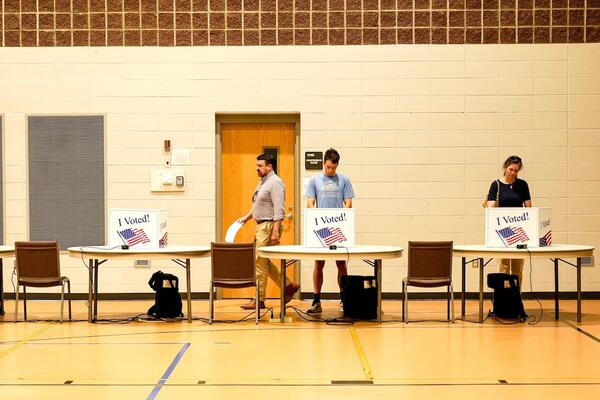
Majority Republican legislatures in several states quickly moved to redraw their state election maps, even after voting began in two states’ primary elections. South Carolina’s governor on Wednesday called for a special legislative session on redistricting to eliminate Democratic Rep. Jim Clyburn’s seat in Congress. Nearly half the voters in Clyburn’s district are Black, a statistic fellow S.C. Rep. Ralph Norman cited when he said Clyburn “does not represent the rest of South Carolina.”
260515-VRA1.png
England-Albright said voting rights advocates like her “saw the writing on the wall” years ago when cases concerning Section 2 of the Voting Rights Act started moving through the courts. She co-wrote an op-ed for The Guardian in 2022 frankly accusing the Supreme Court of trying to erase Black voters’ voice and paving “a path towards white political power at all levels of government.”
“The environment we see ourselves in is something we saw coming four years ago,” England-Albright told Sojourners. “But even now, it’s more insidious and more diabolical than we could even imagine.”
A call to meet the moment
“Churches have always been the backbone and the safe haven of how our communities organize, and today they need to play that role,” England-Albright said.
She noted that Alabama Civil Rights demonstrators attacked during “Bloody Sunday” in 1965 met up at a church before authorities brutalized them at the Edmund Pettus Bridge in Selma, Ala.
This Saturday, the main Day of Action events will take place in Selma and Montgomery, in homage to Civil Rights demonstrations there decades ago. An hour of prayer and reflection led by national faith leaders is scheduled for 9 a.m. Saturday at Tabernacle Baptist Church, McBride said.
A silent march to the Edmund Pettus Bridge will follow, then participants will caravan to Montgomery for a three-hour rally with speakers and opportunities to check their voter registration status and learn about advocacy events planned to start on Juneteenth.
260515-VRA3.png
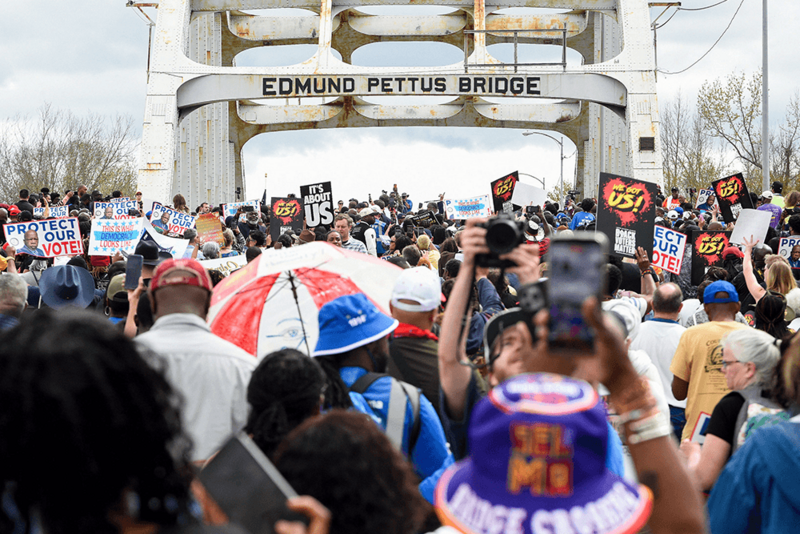
McBride said organizers are running free buses from around Alabama and eight other cities for those who sign up to ride to the day’s events in Selma and Montgomery. The Montgomery rally will be livestreamed and satellite events are planned in more than four dozen cities across the country.
Nearly 300 partnering churches and organizations have signed on to support the events, McBride said. While he and others spearheading the effort are Black, he said he encourages members of other communities to join as well.
“I believe there is solidarity needed in this moment,” he said.
He encouraged anyone to participate, donate, or volunteer during Saturday’s events; invite speakers to address their churches or organizations about civil rights; organize rallies; or attend “boot camps” to learn in depth about civil rights-related issues. “Be in the position of a learner, then go and do it,” McBride urged.
“All of our congregations in this country need to find their way to the justice side of this conversation,” he added. “Your politics should not preclude your commitment to justice. I think it’s a very important moment for churches to reclaim justice and reject this hypersensitivity to culture war issues, as a justification to allow vulnerable members of this country to be targeted and politically erased by this administration.”

Sarah Einselen is an award-winning writer and editor based in Saskatchewan, Canada. Follow her on Bluesky at saraheinselen.bsky.social.
Did this article have an impact on you? Tell us how! Whether you’re moved to take action, have a question, or want to share a comment (good or bad), we value your feedback!