american nationalism
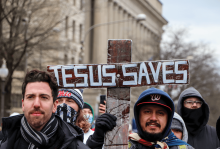
Madison Muller is a graduate student studying social justice and investigative journalism at Northwestern University's Medill School of Journalism. She spoke with Sojourners' Jenna Barnett.
“I GOT TO Federal Plaza around noon, right when Trump’s speech was starting. I sat with a group called the America First Coalition. They had plugged a phone into a megaphone and were standing in a circle listening to the speech. I sat right in the middle to listen. Ten minutes in, Trump started speaking about his distrust of the media and [how they were] complicit in the ‘rigged’ election. That’s when I started getting a little bit fearful. I could see people looking at my press pass. When I said that I was a graduate student journalist, one of them said, ‘We don’t like people in grad school.’ And then they started yelling at me, ‘We hate the media! Get out of here!’
A larger group started forming in the street. I [ended up] at the front of the group when they walked to the Capitol. I saw people in bulletproof vests, people with military tactical equipment, walkie-talkies, helmets, goggles; people had batons in their backpacks. There was this acceleration toward the Capitol. I remember thinking there is just nothing that’s going to stop the momentum of this group. I was surprised by the lack of law enforcement that I saw, especially after having covered racial justice protests since May, where there’s always such a heavy police presence.

MOST AMERICAN CHRISTIANS likely don’t know the degree to which the center of gravity of Christianity has shifted from the West to the global South. This reality has failed to penetrate the consciousness of most Christians in the U.S.—and our ecclesial imagination would be transformed if it did.
In the early years of Christianity, Paul wrote to what had already become a global church stretched across the vast reaches of the Roman Empire, from Rome to Corinth to Ephesus to Philippi and beyond. Paul’s epistles demonstrate his clear conviction that the health of the church in one place impacts the health of the church elsewhere or, as he puts it so poetically in 1 Corinthians 12, if one part of the body suffers, then all parts suffer with it.

IN THIS NEW LITURGICAL YEAR, the lectionary’s gospel readings are drawn from the book of Matthew, a story of the Messiah’s return. Matthew was a Jewish follower of Jesus living in the aftermath of the first Jewish revolt against Roman rule. The revolt, which lasted from 66 to 70 C.E., was not successful and ended with the Roman burning of Jerusalem and its temple, the very center of the Jewish world. One era of Jewish history ended, another opened up.
For some Jews, the destruction of the temple fueled their struggle against Rome, and they continued their hopeless revolt. For others—the successors of the Pharisees who led the early rabbinic movement—the fall of Jerusalem prompted them to craft a new Judaism based on the Book, instead of the temple. But Matthew’s gospel, the story of Jesus’ life and his collected teachings, offers a third option, based neither on revolt nor rabbinic tradition.
Roman reprisals after the uprising included the “Fiscus Judaicus”—a punitive tax levied on all Jews, male and female, free and slave, throughout the empire. The proceeds supported the Jupiter temple in Rome, dedicated to the deity that Rome considered responsible for the destruction of the Jerusalem temple. Humiliation was piled upon profound loss, inspiring virulent Jewish nationalism and rebellions around the Mediterranean basin. But all of the rebellions—led by Jews in Libya, Cyrene, Cyprus, and Egypt—were ruthlessly shut down by the Roman army. A final Jewish rebellion in Jerusalem gave the Emperor Hadrian an excuse to initiate a full-scale assault on Jerusalem and the villages of Judea. The results were decisive: The territory was depopulated and failed to recover.
Writing as a Jewish Christian, Matthew offered an alternative to this nationalist violence: the nonretaliatory teaching of Jesus. For instance, in his account of the temptations in the desert, Matthew concludes with Satan testing Jesus with a vision of the world’s kingdoms. “All these I shall give to you, if you will prostrate yourself and worship me” (Matthew 4:9). Here is a vision of empire, introduced into the imaginations of the time by the military success of Rome. But instead, Matthew shows Jesus, the Messiah-king, rejecting the option of empire, while linking that choice to another—servitude to Satan.

The book of Jonah places the desire for retaliatory violence within the hearts of people (especially religious people) — rather than within the heart of God. It also promotes the idea of “God” as the divine ally of all people.