endangered species
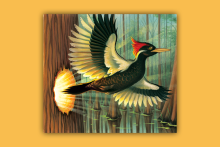
The ivory-billed woodpecker has been called “Lord God Bird,” for its massive size; “Grail Bird,” for the fervor with which people seek it; and “Ghost Bird,” for the way it hovers on the murky edge between existence and extinction. But Cornell ornithologist Tim Gallagher, author of The Grail Bird, calls it “Lazarus Bird,” after the story of Jesus resurrecting his friend Lazarus four days after he died.
Growing up in the church, I was never sure what to do with resurrection. My father’s faith didn’t emphasize the idea that Christ died for my salvation, or that Christ’s believers would be raised from the dead, but these beliefs were everywhere—in the hymns we sang in the various United Methodist churches where he served as pastor, in the creed we recited every Sunday: I believe in ... the resurrection of the body, and the life everlasting.
From my seat in the pews, the promise of everlasting life rang hollow. I did not expect decomposed bodies of believers would one day be reconstituted, nor did I see this as desirable for myself or the people I loved. But metaphorical interpretations of resurrection also fell short: A body raised symbolically from the dead is still very much dead. In graduate school, I read about Thomas Jefferson’s excision of miracles, including the resurrection, from his Bible with a sense of relief. The stories I couldn’t believe literally or understand figuratively, could be simply cut away. But as I’ve grown older, these stories resist neat excision. To dismiss resurrection entirely feels increasingly fraught: Why did faith matter if it did not transform real bodies, real lives, here on earth?
LASCAUX IS FAMOUS for its Paleolithic cave paintings, found in an underground complex in southwest France. The biggest area of Lascaux with the most abundant paintings is an echo chamber. Enveloped in sound, our human ancestors may have drummed and danced around a flickering fire whose shadows animated the natural scenes of people, animals, and their environment on the surrounding walls—all inviting transcendence. In ancient Greek religion, the lyrical music of Orpheus charmed the gods and compelled animals, even rocks and trees, to dance. Early Christian iconography developed a practice of liturgical art that both offered theological instruction and included details of the plant and animal world, both literal and allegorical, to foster spiritual reverence.
Closer to our time, great thinkers such as 19th-century German explorer-scientist Alexander von Humbolt looked beyond isolated organisms to the unity among plants, climate, and geography. In the 20th century, French Jesuit and paleontologist Pierre Teilhard de Chardin’s perception that the universe is an evolutionary process moving toward greater complexity and consciousness furthered the understanding that humans are interdependent with the created world. Albert Einstein wrote that human beings experience ourselves “as something separate from the rest—a kind of optical delusion of consciousness” and that “we will have to learn to think in a new way” if humanity is to survive. This view is echoed in new developments in quantum physics that we may be evolving toward a more coherent wholeness among spirituality, science, and art.
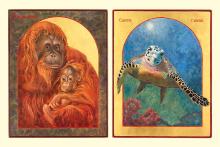
The icon paintings of Angela Manno, an internationally exhibited and collected artist, are yet another expression of this lineage in her series “Sacred Icons of Endangered Species.” I interviewed Manno by email and telephone in March.
Andrea M. Couture: As a contemporary artist, what attracted you to icon painting, one of the oldest forms of Christian art, going back to the third century?
Angela Manno: I’ve been fascinated by non-Western and ancient art forms throughout my life, from illuminated manuscripts as a child to batik while traveling through Indonesia in my early 20s; icon materials—gold leaf, pigments made from ground up semiprecious stones, earth colors; and the ethereal look of the finished product’s images of angels and saints.
In the 1980s, I developed my own personal idiom, combining the ancient art of batik with color xerography to symbolize the merging of intuition and reason. My aim was to convey a sense of the sacredness of the planet Earth. In the 1990s, no longer having access to my large studio and a photocopier, I searched for a medium that would allow me to work in a more modest space and, at the same time, I wanted to explore a truly liturgical art form. In a stroke of synchronicity, I had the opportunity to begin studying with a master iconographer from Russia in the Byzantine-Russian style, and became completely captivated by the symbolism, not only in the images, but in the process itself, and studied with him for over a decade.

As an antidote to all the stories of killing by drone, I’ve been collecting stories of the good things unpiloted aircraft can potentially do, or are already doing. Many are tasks now being carried out by piloted airplanes and helicopters, but drones bring advantages. They can fly higher, can stay in the air longer, and can fly in more dangerous terrain or situations with no risk to pilots.
Here are 10 things.
1. Monitoring crop watering. “A researcher from Ohio State University envisions the day — less than a decade from now — when a farmer waters the crops then launches an unmanned aerial vehicle to monitor precisely where the water went.” (Dayton Daily News)
2. Acting as lifeguards for beaches. “Surf Life Saving Australia says unmanned aerial drones will patrol some Queensland beaches this summer. … the drones, which have a wingspan of one metre, use cameras to search for swimmers in distress. … the drones will be fitted with flotation buoys that can be dropped down to the ocean.” (Australian Broadcasting Corporation)
3. Monitoring endangered species. “For the past few months, drones have been flying over the tropical forests of south-east Asia to map endangered species. A dozen of these unmanned aircraft, fitted with a video camera and an autopilot, have been deployed and will be joined by several more.” (Guardian)