The Hungry Spirit
SOMETIMES THE WORLD is very small.
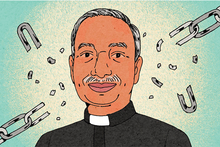
The Catholic priest from Pakistan handed me a self-published booklet in Urdu and pointed to a single English word: Sojourners. Pakistan is a third of the way around the globe from my home in California. Father Emmanuel Asi was in the Ojai Valley (where I live) for four days, visiting members of the Pakistani Christian diaspora. As part of his hosting team, I was eager to learn more about this liberation theologian from Lahore. And learn how articles from Sojourners ended up translated into Urdu.
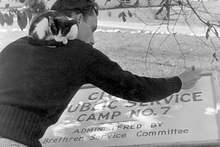
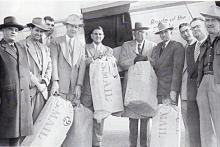
DURING WORLD WAR II, my grandmother worked as a nurse and office clerk at Civilian Public Service Camp No. 7 in Magnolia, Ark., the only one of more than 150 CPS work camps across the United States that exclusively held religious conscientious objectors to war.
IN 1969, I was in second grade at St. Ignatius Catholic School. First grade was a breeze. I loved Sr. Linda. She wore a modified habit and brought a guitar to class. Second grade was more difficult. We had to prepare for my first confession and first Communion by memorizing the catechism answers. Then we were tested to prove that we understood what we were getting into (as much as a 7-year-old can grasp sin, repentance, forgiveness, and transubstantiation).
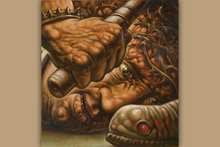
THE STATIONS OF THE CROSS is a devotion practiced by Jesus followers since earliest memory. Based on scripture and sacred tradition, the stations invite believers to walk in the footsteps of Jesus through his final hours, from sweating blood in the garden of Gethsemane to laying his lifeless body in a temporary tomb. Even in present-day Jerusalem, believers walk the Via Dolorosa. It is one of the most sacred pilgrimages for Christians.
My earliest memories of Lent include a candle-lit church smelling of beeswax and incense, with the murmur of prayers before each image of the stations. Heartrending questions prick my conscience and point me along the way: Have I stayed awake with you, Lord? When did I see you thirsty, Lord? Have I allowed you to find me when I fall? For many years, it was my father’s voice that split the silence of the Good Friday service. He read from Anthony T. Padovano’s Dawn Without Darkness, which posed the question: “What does one see from a cross?”
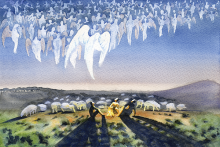
I’VE HEARD A very old story about Christmas: When Adam and Eve were in the garden, they often sang with the angels, the most perfect sound ever created. When they were banished, the song fractured. Neither choir—human nor angelic—could sing perfect praises to the Creator of the universe alone.
On Christmas, however, a miracle occurs. The heavenly hosts reunite with mortal shepherds—the band is back together, the choir again complete. At least for a day, heaven and earth are reconciled in song.
Why is this memory of the Nativity important for us now?
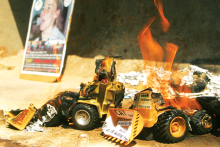
IN 2003, RACHEL CORRIE, 23, a U.S. college senior, was killed by a bulldozer. This was not a freak accident. Corrie was in Gaza with a team of peace activists, nonviolently protecting Palestinian homes from demolition. The bulldozer operator was an Israel Defense Forces soldier. The Cat D9 was made in East Peoria, Illinois. Corrie’s family subsequently sued Caterpillar for war crimes and extra-judicial killing — without success.
This June, the United Nations released an investigation into the corporate machinery sustaining Israel’s ongoing anti-Palestinian project. The report adds 48 international corporations, institutions, and charitable organizations to a list of more than 1,000 corporate entities that, violating international law, profit from Israel’s project to displace, replace, and now eliminate Palestinians.

TWENTY-FIVE YEARS ago, I visited the city of Chiclayo in northern Peru, then famous for its mercado de los brujos. Now it’s famous for producing Pope Leo XIV, new spiritual leader for 1.4 billion Catholics.
I was shocked when the conclave chose as pope Robert Prevost, a Chicago native and a Peruvian citizen. Prevost first went to Peru in 1985, when he was 30. After he served in various roles for his Augustinian order in northern Peru, Pope Francis appointed Prevost to the Diocese of Chiclayo, where he became bishop and served for nine years. Prevost worked with the Peruvian conference of Catholic bishops and on the conference’s economic council and commission for culture and education. In 2023, Pope Francis appointed him head of the Pontifical Commission for Latin America, putting Prevost in much closer contact with bishops across the continent. That same year, he became a cardinal. He is not “the first American pope”: Jorge Bergoglio, from Argentina, was. But Prevost, as the first U.S.-born pope, signals that Catholicism in the United States has come of age in the global Catholic Church.
Prevost-the-missionary-cardinal appears well-suited to institutionalize Pope Francis’ prophetic and expansive vision. However, Prevost-the-first-U.S.-born-pope seems more unpredictable.
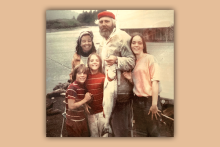
IT'S AN IMPOSSIBLE task to write and offer a eulogy for one’s father. When a father dies — especially a good one — it’s like mountains crumbling, the sun going out, like a tsunami. There is life after all these things — but essentially a world is ending. It is catastrophic.
And yet. We also hold the ancient wisdom that we are made of ash and the breath of God and to ash and the breath of God we shall return.
John Henry Berger, son of Catherine Helena Gingrich and Henry Joseph Berger, has returned to ash and the breath of God.
While sorting through my Dad’s den, we found one file folder marked “funerals.” In it was a copy of a scripture passage that he had starred and highlighted. It begins, “Happy the one who has found a woman of worth. Her value is far beyond rubies. Her husband trusts her judgment; therefore he does not lack income. She brings him profit, not loss, all the days of her life.” In it we hear his humor and his wisdom. Even when he wasn’t acting out of his best self, he knew he had married Barbara Ely Bird, a strong-willed woman of worth, warmth, wisdom, and humor, one whose value is far beyond rubies or precious jewels. Dad loved Mom.

I LOVE WORDS. I love etymological dictionaries packed with word genealogies. I love that apricot is a cousin to precocious, kitchen, and charcuterie. That the word word (from the Old English) is rooted in utterance and promise, in the theological sense. As in, to give one’s word.
Words spoken are different creatures than words written. Christians designated written words as more trustworthy than oral composition, but early Judaism prioritized oral transmission of sacred words — as many Indigenous communities do still. But written words (like these) can be controlled and manipulated. Writing prevents the breathed utterance from passing through the orator’s flesh to be inhaled by the communal body. Orality is to literacy as wildfire is to candle flame.
Maybe that is why I moved heaven and earth in 2000 to hear Irish poet Seamus Heaney read in person, accompanied by Liam O’Flynn on the uilleann pipes. Having studied Heaney’s written word, especially the collection Station Island, I wanted to hear the man himself, to hear him orate (from the roots of utter and praise before an assembly). I wanted to inhale his language (tribal and tongue).
IT'S JUNE. It’s south Arkansas. The humidity is so high even the horseflies have prickly heat. I am sitting on a scorching metal bench outside Burge’s diner in Lewisville waiting on a catfish po’boy. A black Lincoln hearse rolls up. The doors swing open, pumping out chilled air. Two women from the local funeral home approach the counter. They order Tiger’s Blood snow cones, to go.
I’m headed to Magnolia, another 20 miles east. My mom’s family settled there in the early 1800s. Beginning in the 1920s, my great-grandfather scooped up as much land as he could. He bought and sold timber, then mineral rights. The Magnolia Oil Field was discovered in 1938. For a while it was the largest producing field (by volume) in the United States. When oil decreased, companies shifted to bromine extraction. All sucked up from the Smackover Formation, a Jurassic-era limestone aquifer that stretches from Texas to Florida full of oil, natural gas, and mineral-heavy water. Albemarle, the largest producer of bromine in the world, is headquartered in Magnolia — a town of 10,000 with a 25 percent poverty rate.
My great-grandfather was what novelist Wallace Stegner called a “boomer” — motivated by “the deal,” a desire for property, upwardly mobile, ambitious, with a craving to get as much as he could take.
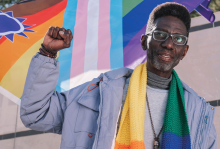
WITH HIS 78-YEAR-OLD mother in court watching and praying, Friedel Dausab calmly waited for the judges’ decision. Would Namibia’s post-colonial Constitution uphold human dignity for gay men, or would it cling to apartheid-era Calvinist laws that criminalized same-sex conduct?
Dausab, a born-again Christian, was raised in a deeply religious family. His faith undergirds his 25 years of service and advocacy for those living with HIV/AIDS. His work culminated most recently in Namibia’s landmark legal decision in June to decriminalize gay sex. Dausab was the primary litigant.
I spoke with Dausab to learn more. His testimony of faith holds strands of God’s work in history.

ONE SUMMER NIGHT in 1985, I was sitting alone in a banged-up rowboat listening to trees creaking in the breeze, held in that sweet rocking motion made by night wind on water. Suddenly, the stars began to wink out and I was caught in a full-fledged squall. Water whipped up into whitecaps. Leaves and branches swirled overhead. The shore was yards away, so I wasn’t in danger, but the storm’s speed and ferocity were unforgettable. I’ll also never forget that it happened on the Sea of Galilee.
I remember this experience each time I hear the story, told in all three synoptic gospels, about Jesus and the disciples in a similar storm. Surrounded by crowds of suffering people and after several days of healing, perhaps Jesus felt the miracle was turning into a sideshow. He told the disciples to jump into a boat at the Capernaum docks and strike out onto the Sea of Galilee. Jesus led them from the suffering of the masses on the Jewish side to a confrontation with the demon Legion that was occupying a man on the militarized Roman side. Out of the frying pan and into the fire. But first, they must deal with a mid-lake tempest and a god who sleeps through it.

WHEN MY WIFE and I moved into our new house, one of the first things we did was tear out the surveillance system. The Ring cameras, the security keypads, the wires arming windows and doors — all of it. Previous owners, according to neighborhood lore, had run a small meth lab out of a camper on the property (until they caught themselves on fire and burned much of the house down). They survived, but the “all-seeing eyes” of an ADT Smart Alarm did not protect them from themselves.
As we envisioned how our house would become a home, we did not desire the kind of security and protection that depends on surveillance products. More importantly, we wanted to order our lives in a way where true security is based on neighboring — not false security sold by techno-corporations.
In God, Neighbor, Empire, Old Testament scholar Walter Brueggemann identifies three characteristics of ancient and contemporary empires: wealth extraction from the vulnerable to the powerful; policies of commodification in which everything and everyone can be bought and sold; and willingness to use violence “on whatever scale was required” to secure the first two.

IN HER MOST famous poem, “Not Waving but Drowning,” Stevie Smith offers an unsentimental vignette of standers-by on a beach watching a man drown. Is he waving to us or drowning? The title holds the dead swimmer’s response.
I recalled Smith’s line this fall when one image from the carpet-bombing of Gaza pinned itself to my memory. A girl’s hand in the rubble, waving around, trying to attract the attention of rescuers. We stand speechless before our own human brutality. We are all complicit in this supply chain of suffering.
Lent is a time of great silences. Silence can be duplicitous. Silence can be traumatic. Silence can be holy.
Last Lent, I was feeding owls on Good Friday at the raptor rehab center where I volunteer. Wings in flight across the mews are felt, not heard. A ripple of air. A slow shadow. The warning clack of a beak.
The prophet Isaiah names owls as one of the first to return after the Lord has laid waste to empires that God had found guilty of hoarding wealth and acting like there was no God. Isaiah describes the rubbled landscape: “They shall name it ‘No Kingdom There,’ and all its princes shall be nothing” (34:12). Owls are birds of desolation. In the half-light of the aviary, a great horned flicks its ears, stretches one wing, turns its yellow eyes to me.
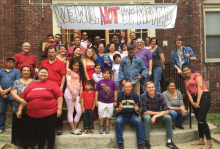
FIDEL WAS FOUR years old when I met him in 2014. His family lived in an apartment building around the corner from us in Washington, D.C. He liked to fly around the apartment entryway with arms extended, making airplane sounds. He liked to say “no.” He played with toy cars during tenant organizing meetings.
Fourteen families shared the 26-unit building, which had decades of deferred maintenance. The absentee landlord (a Palm Beach-based Episcopalian, real estate magnate, and attorney, who preserves wealth for his children, practices elite philanthropy, and once served as protocol officer for Spiro “Bag Man” Agnew’s reelection campaign) had abandoned the building—except for rent extraction.
In Fidel’s one-bedroom apartment, he maneuvered around handfuls of roach motels and rodent snap traps. His mom sealed his clothing in airtight plastic bags to keep out the night-crawling, blood-sucking bed bugs. Upstairs, a neighbor slept with her “rat stick.” Water from the tap often ran brown or didn’t run at all. Stoves were rusted. Toilets leaked. Frigid winter air poured in through broken windows or damaged frames. Ceilings collapsed. Lead paint and mold flecked the baseboards where Fidel played and slept.
The tenants submitted repair requests. The building manager ignored them or responded inadequately. The sooner he could drive them out, the sooner the owner could flip the property to luxury condos and realize astronomical profit. One day, the owner notified tenants of a 31.5 percent rent increase. Failure to pay risked eviction. The owner’s preferential option for profit over people sent Fidel a clear message: You are disposable.
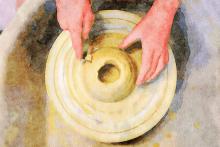
“CENTER THE CLAY.” I had one task for class and three hours to complete it.
Take two pounds of raw potential. Place it on the potter’s wheel. Use the strength of your hands and forearms to force the clay into balance.
For the full three hours, I failed. Unable to find the calm point of pressure to rest my human musculature between the universe’s centrifugal and centripetal forces. The clay fought back. It bucked and shimmied, slid and skidded. I pushed and pulled.
The teacher said, finally, “This clay does not yet want to be a bowl. You have not shown it how.” A gentle correction that expertly undermined my fixation with “the primacy of the real,” as French philosopher Gaston Bachelard calls it. Really, shouldn’t I be able to subdue this clay?
IN THE EARLY days of the pandemic, I started a death scroll. Not to be confused with “doomscrolling” (a malady related to one’s smartphone), my death scroll was a physical length of paper on which I penned names and death dates as I learned of them.
Across the top I scrawled: “Blessed are you, Lord Our God, Who Is Keeper of the Book of Life. Today, we learned that Sister Death called ...” On March 13, 2020, I wrote the first name: Barbara Clementine Harris. A towering figure in the American church, Harris registered Black voters in Mississippi in the 1960s, marched from Selma to Montgomery in 1965, and was one of the first 11 women “irregularly” ordained as Episcopal priests in 1974 and the first female bishop in the Anglican Communion. But, because of the COVID lockdown, no churchwide memorial service was held for her.
Pandemics bring death. And, as Christians, it’s impressed upon us to remember. Remember the Sabbath. Remember that your ancestors were slaves in Egypt. Do this in remembrance of me. Remember my chains. But ... I have a very bad memory. So, I made the scroll. When I stopped collecting names in late 2022, my scroll held 36. How many names would your scroll hold?
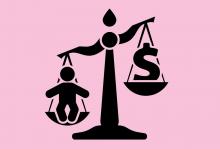
“Wisdom speaks her own praises, in the midst of her people she glories in herself.” What a luscious, full-bodied image from the biblical book of Sirach (24:1). Wisdom has sass! In an increasingly combative society, I’m drawn to Sirach’s prudence, poetic excess, and the authoritative agency of Lady Wisdom.
I’ve been keeping phrases from Sirach, also known as Ecclesiasticus, in mind as post-Roe legislation rolls across the states. The health of women and children (born and unborn) has been weakened, rather than strengthened. Political and social platforms ring out with dangerous nonsense about making criminal statutes apply at the time of fertilization, allowing the death penalty for abortion, or, conversely, promoting violence against “pregnancy crisis centers.”
How do we stop the howl when we feel urgently that lives are on the line? Sirach, which is part of the Catholic canon, says, “The fear of God is an abundant garden; its canopy higher than all other glory” (40:27). “Fear” means “body-trembling awe” before our Creator. Amid so much that I don’t understand and don’t know what to do about, this strange scriptural juxtaposition feels like Lady Wisdom speaking to our present condition.

HAVE YOU EVER had one of those perfect moments?
My wife and I sat on a bench at the farmers market with a plate of steaming hot tamales before us and a bag of crisp fennel bulbs, Pink Lady apples, and fresh spinach at our feet. The air smelled of salt and cooking oil. A deep yellow and iridescent gold light wrapped around us. Every noise fell away in a holy hush. We met, however fleeting, the “still point of the turning world” described by poet T.S. Eliot. Held and beheld.
To be honest, I usually miss these moments. Though I try (religiously) to keep custody of my mind and attention, the world we live in now beeps, dings, buzzes, and updates 24/7. It’s hard for God to break in. Perhaps this description of digital architecture’s pointed intrusions into our one beautiful life is too minimalist. Most days, I’m holding my breath against the crushing dynamics of digital onrush and knowledge outflow. I miss the still points between the crest and lip of that wave.
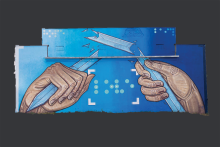
YOU NEVER KNOW where you’ll see the hands of Christ.
In central Kyiv, a mural depicting two elegant hands breaking a sword is surrounded by towering apartment buildings. Painted in 2016 by Ukrainian artist Sergii Radkevych, “Fragments of Hope” was one of a series of murals organized in response to the 2014 conflict in eastern Ukraine. It was public art on a mission to inspire a Ukrainian vision for peacemaking.
Radkevych combines religious iconography with street graffiti and realism. He pays particular attention to expressive hand gestures. “Fragments of Hope” became a frequent gathering point for protests in solidarity with eastern Ukrainians in 2017 and 2019. “This is my manifesto against violence and cruelty, a call to mutual understanding,” said Radkevych at the time. When I was in Kyiv in May, after more than three months of intensive Kremlin-led violence, I was grateful to find the mural still standing.