worship music
As artificial intelligence-generated songs and musicians multiply across streaming platforms, Contemporary Christian music audiences and creators are reckoning with the technology’s meaning for the booming genre, the opaque industry, and the very heart of Christian music.
In November 2025, Christianity Today reported on Solomon Ray—an AI-generated artist who boasts 499,000 listeners on Spotify. But Ray is not the only CCM AI artist garnering thousands of listeners. Minimal artist descriptions, quick release schedules, no contact methods, no website, and no tours or physical appearances are all indicators of potential AI-generated artists, and CCM has no shortage. Smaller accounts still have thousands of monthly listeners, including the likes of Jaxon Maverick Phoenix at over 39,000, The River Sons 59,000, and Glory in the Ruins 68,000.
Their music is nothing elaborate and draws firmly from the CCM tradition: “I’ve read the words, I know they’re true but some days they feel far from view / I’m still holding on to what you said, even when the lies scream loud instead,” are some lyrics to “Faith Over Fear,” by The River Sons. The band’s page description is equally vague.
I WANT TO believe there’s a live band at a church somewhere in the U.S. playing Joy Oladokun’s latest album, Observations From a Crowded Room. After all, Oladokun is no stranger to sanctuaries: By the time she was 16, Oladokun was leading the worship music at the charismatic nondenominational church her family attended. But around the age of 24, she quit, explaining in an interview with NPR, “I just felt like so much of my attention was going towards taking care of people and singing the right songs and not saying the wrong thing on Sunday.”
I think, for a long time, I’ve been looking for a church willing to risk singing the wrong thing on Sunday—to risk singing something like these lyrics from Oladokun’s “Dust/Divinity”: “I’m a skeptic who still prays / ... ’Cause though it hurts me to believe / It kills me not to / And I am trying to find my way through the middle / And I am desperate to receive every good thing / From now until eternity / From dust until divinity.”
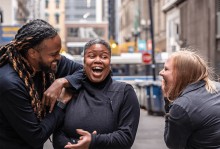
AT THE TIME most people head home after a typical workday, four musicians are just getting started. In a living room filled with holiday decorations and religious artwork, with inspirational phrases on the walls and bookshelves, Darren Calhoun, Leslie Michelle, Hannah Rand, and Gary Rand are rehearsing.
Together, with Leonora Rand, they are The Many, a Chicago-based, social justice-focused worship band that pulls from gospel and indie pop to sing about topics not usually mentioned in worship music or church. Their songs touch on police brutality, LGBTQ and immigrant inequalities, economic hardship, identity and uncertainty about faith and God, and doubt and justice amid violence.
“We were trying to find some songs that could give honest voice to our congregation, to what we were dealing with,” says producer Gary Rand, a longtime musician and former director of worship at LaSalle Street Church in Chicago, as well as former director of worship and adjunct professor at McCormick Theological Seminary for 20 years. He says the band always felt a need for this kind of music, but once the group solidified in 2016 with its current members, its mission of speaking truth with a social justice lens to community issues took off.
What I am learning is that the new normal is not that I no longer experience God, but that God is meeting me in new ways. The new normal is that I don’t need to hear people play guitar telling me to feel God’s love from a stage. I find God’s love in much less conspicuous places, from the stranger behind me who felt too awkward to shake my hand, to the silly doodles my kids were making on the church bulletin. The new normal is that I no longer find authority in celebrity pastors preaching at me, but I do find it listening to unheard voices of small bloggers and older people who aren’t social media savvy.
The new normal is that I hear the "Roman Road" gospel preached and find it dull and superficial, and yet feel overwhelming conviction in the cross lived out by people who forgive their enemies.
The new normal is that although God has not changed, I have changed. And like a parent who stops cooing in baby talk, God is starting to speak in new, fresh ways to me.