refugee crisis
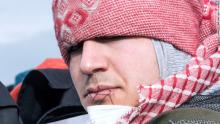
Migrants are stitching their own lips shut to protest the French government’s clearing of the refugee camp in Calais, known as the "the Jungle." Authorities are clearing the southern half of the camp and relocating the refugees, they say in response to unsanitary conditions. They bulldozed a church and a mosque in the camp on Feb. 1.
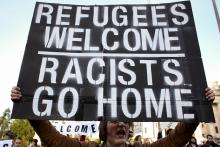
Johnson Ferry Baptist Church, a Southern Baptist megachurch north of Atlanta, has helped resettle a Syrian family, despite an order from Gov. Nathan Deal that the state would not accept Syrian refugees.
Bryant Wright, the church’s pastor and former president of the Southern Baptist Convention, told CNN Dec. 9 he understands the governor is “concerned about the security of the citizens of the state. But as Christians and as a church, we want to reach out with the love of Christ to these folks.”
He told The Atlanta Journal-Constitution that his church had been planning to help the family before the recent attacks in France.
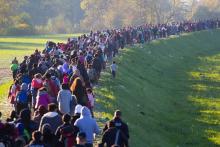
Faith-based agencies that resettle refugees in America stand to gain more than a clear conscience if the United States — after what is expected to be a fierce debate in Congress — accepts a proposed 10,000 Syrian refugees next year.
More refugees also means more revenue for the agencies’ little-known debt collection operations, which bring in upwards of $5 million a year in commissions as resettled refugees repay loans for their travel costs. All nine resettlement agencies charge the same going rate as private-sector debt collectors: 25 percent of all they recoup for the government.
This debt collection practice is coming under increased scrutiny as agencies occupy a growing stage in the public square, where they argue America has a moral obligation to resettle thousands of at-risk Syrian refugees. Some observers say the call to moral action rings hollow when these agencies stand to benefit financially.
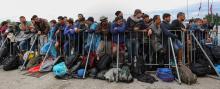
God’s been telling the story of restoration since Genesis when we were created selem Elohim, in the image of God. We were created into perfect communion with God. From Genesis 3 until the end of the Old Testament, we see a narrative of a people in exile and God giving opportunities for reconciliation and restoration of relationship that humanity is incapable of accepting. Reconciliation is an exchange of something worthless (our condition of sin) for something immeasurably worthy (communion with God).
In the New Testament we see a biblical narrative through Jesus of now-but-not-yet restoration. In Jesus we see the coming of the Kingdom of God and get to be reconciled back to God. We even get a glimpse of an eternity where there is no more death or mourning or crying or pain.
If we truly believe we are the image of God, it changes how we approach the image of God in the world. Our call then is to actively partner with God in taking the world somewhere.
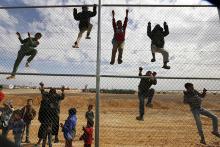
Evangelicals may be united that the Bible is the ultimate source of authority, but they are divided on how the Bible would lead us to respond to the growing crisis of refugees fleeing from Syria.
What is the best way to show Christian love and compassion? How is the church’s role different from the state’s? How do we show wisdom and prudence in securing the safety of our neighbors and nation?
These are just a few of the questions that evangelicals are grappling with. One evangelical pastor today told me, “My church members are all over the place on this!”
World Relief, which calls itself the "biggest evangelical refugee resettlement agency in America" is urging political leaders around the country -- many of whom consistently court evangelical votes -- to support the resettling of Syrian refugees in this country. Politico.com quotes World Relief's vice president Jenny Yang who says that talk of shutting such refugees out "does not reflect what we've been hearing from our constituencies, which are evangelical churches across the country."

I’ve thought about this obedience to vulnerability in light of the current conversation our nation has been having about the refugee crisis, in particular since the attacks in Paris this weekend. The fearful calls to close our border have been disheartening, especially as we begin to enter the season of Advent. Jesus, as God incarnate, saw our sin and flaws and darkness — our hostility even — to the Light and still made himself vulnerable to live among us and die at our hand. Through the cross he offered a generous hospitality to us while we were still enemies of God — a feast of himself, for us to taste and see that God is good.
It should not be any different for us as followers of Christ. As any Christian knows, being part of the Body of Christ is often a dangerous proposition. We are in danger of getting hurt any time we come into contact with another person. We will sin against each other, we will experience conflict, and if we’re doing it right, we’ll bear each other’s suffering. We are knit together with people we may not typically associate, people who view the world in ways we may find misguided at best and dangerous at worst. It doesn’t matter — we’re still invited to the same feast and we’re still joined together in the same family, drinking out of the same cup the way family members and close friends do.

"The people who are fleeing Syria are the most harmed by terrorism, they are the most vulnerable as a consequence of civil war and strife. They are parents, they are children, they are orphans. And it is very important — and I was glad to see that this was affirmed again and again by the G20 — that we do not close our hearts to these victims of such violence and somehow start equating the issue of refugees with the issue of terrorism.
"When Pope Francis came to visit the United States, and gave a speech before Congress, he didn’t just speak about Christians who were being persecuted. He didn’t call on Catholic parishes just to admit to those who were of the same religious faith. He said, protect people who are vulnerable."

One of Germany’s largest Protestant regional churches has come under fire from other Christians for speaking out against efforts to convert Muslims just as tens of thousands of refugees from the Islamic world are streaming into the country.
In a new position paper, the Evangelical Church in the Rhineland says the passage in the Gospel of Matthew known as the Great Commission — “Go therefore and make disciples of all nations, baptizing them in the name of the Father and of the Son and of the Holy Spirit” — does not mean Christians must try to convert others to their faith.
“A strategic mission to Islam or meeting Muslims to convert them threatens social peace and contradicts the spirit and mandate of Jesus Christ and is therefore to be firmly rejected,” the paper entitled “Pilgrim Fellowship and Witness in Dialogue with Muslims” argues.

My thoughts go to the recent perilous journey of a close Iraqi friend — I will call him Mohammed — and his son, whom I will call Omar. Already the survivor of an assassination attempt, this trusted translator, driver, guide, and confidant received a death threat in early August. He fled under cover of night, taking Omar with him. On that same day, 15 men were kidnapped in his village. He left behind a wife and six other children.
From Baghdad, Mohammed and Omar fled to Kurdistan and into Turkey. Next they boarded a boat from Turkey to a series of Greek islands, where, much to their relief, they were at last able to get on a ferry to Athens.
Mohammed wrote letters throughout his journey. The messages that came were understandably brief. I often did not know what to advise him. But having lived with this dear family, I felt as if I were on the hazardous and exhausting 42-day journey with them.
What follows are excerpts from those letters.

The bishops released the private letter they sent to Cameron last month after the Prime Minister’s office failed to reply.
In it they called on the prime minister to increase the number of refugees that Britain is prepared to take in over the next five years — the expected lifespan of the parliament.
Specifically, church leaders called on the prime minister to absorb an additional 30,000 refugees, far beyond the 20,000 Cameron had committed to, and to consider involving the church in a national effort to “mobilize the nation as in times past.”
David Walker, Bishop of Manchester told the BBC Oct. 18 that the figure of 50,000 was acceptable to his parishioners and was, he said, “sustainable” on a national basis.

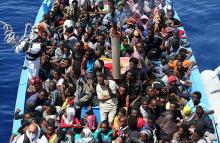
A surge of migrant deaths in deadly voyages across the Mediterranean Sea has become a modern-day refugee crisis.
But the Rev. Mussie Zerai, a 40-year-old Roman Catholic priest from tiny Eritrea, north of Ethiopia, has moved to help migrants trapped in the North African deserts and rickety wooden boats drifting across the sea.
“It is my duty and moral obligation as a priest to help these people. For me it’s simple: Jesus said we must love one another as we love ourselves,” Zerai said in a telephone interview.
The little-known priest, now based in Rome and Switzerland, was among this year’s nominees for the 2015 Nobel Peace Prize, along with Pope Francis. (The prize, announced Friday, was awarded to the National Dialogue Quartet, which helped build a pluralistic democracy in Tunisia.)
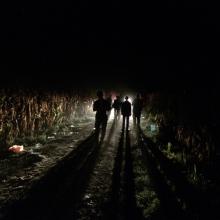
Many of the refugees are well-educated people who speak English fluently, so it was not difficult for us to communicate with them. Some of them reported their experiences of walking for weeks and months since they left Syria. Their feet were hurting, and many walked with crutches or were assisted by wheelchairs. The most moving moments were the scenes of small children walking with their parents on the dusty dirt road through the cornfields leading into Croatia during the blistering heat of late summer.
In two days, with our four cars, we drove nearly 100 children, mothers, and people with walking difficulties the last miles to the Croatian border, and even farther when approved by the Croatian border police. All of us on the team had frequent moments when we could not hide our tears.
As we distributed food, water, clothes, and shoes to at least 2,000 refugees in three days and offered warm hugs and handshakes, we heard the refugees saying in a number of different ways: “Our people have forgotten us, but you Christians love us.”
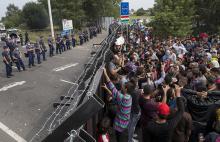
Western claims to stand for human dignity and human rights usually look pretty hollow whenever a major refugee crisis hits. That is what is happening now, as millions of refugees seek asylum in Europe — and mainly run into closed doors and cold shoulders.
The current crisis is a grave one. According to Amanda Taub, 19 million people today are refugees. They come from all over, though today especially from Africa and the Middle East. Four million have fled Syria since 2011. They are making global headlines as they surge into Europe, which is for many just the latest stop on a desperate odyssey.
They are dying in disturbing numbers — in rickety boats, sealed trucks and squalid refugee dumping grounds. They are not wanted where they come from and not wanted where they are going.

There is no political outcome that will make these children not drowned. There is no politics that will pull their shirts down to cover their exposed tummies, the way a parent’s loving hand would do. There is no politics that will make their drenched clothing anything other than the last outfit their parents ever clothed them in, unaware when they did so that it would be the clothing in which their children would die. There is no politics that will give these children another life that does not end in terror and despair and cold water. (God, God, how does one write words like this?) There is no politics that will give their parents anything but the end they had: of going into the dark knowing that their dear ones were lost forever.
All this is permanent. It is done and cannot and will not and will never be undone. And while I am all for good politics, which is to say I am all for a good future, and so I am all for doing better by the refugees that yet live, I also refuse to let the past go as if it were merely the gravel under the sub-foundation of whatever shiny tomorrow we happen to build next.
There is no politics that can redeem what time has irretrievably taken. To stand as witness to the past is to stand either in utter nihilism and despair, or in the desperate, desperate hope that in the end a Redeemer will walk upon the earth, who will bring forth those whose flesh was destroyed, to see and be loved forever by God.
Pope Francis on Wednesday said people who shut out refugees should seek forgiveness, after clashes on Italy’s borders as European countries try to push back against a wave of migrants fleeing by boat from Libya.
Addressing crowds in St. Peter’s Square, Francis drew his followers’ attention to the U.N.’s World Refugee Day this Saturday.

Editor's Note: Jarrod McKenna is an Australian Christian leader behind #LoveMakesAWay, a movement of Christians seeking an end to Australia's inhumane asylum seeker policies through prayer and nonviolent love in action. Read more about McKenna, #LoveMakesAWay, and the indefinite imprisonment of immigrants in Australia HERE. This article originally appeared at Junkee.
If you care about the cause of asylum seekers in Australia, you know there’s not been much to cheer about lately – the government descends further into cruelty, while much of the populace just shrugs.
So when a group of priests and pastors were arrested for peacefully occupying the Sydney offices of immigration minister Scott Morrison in March, praying and demanding the release of kids in detention, it turned a few heads and went a bit viral. When it happened again and again in the following months, it felt like a movement. To date, more than 100 leaders from many different faiths have been arrested at Love Makes A Way prayer vigils in politician’s offices all over the country (the PM wasn’t spared; his digs were targeted in May).
The charmingly polite stubbornness with which they’ve taken the government to task has earned many supporters of all persuasions, even if the prayer bit is lost on some of them. Along with other “cranky Christian” activists like Gosford Anglican Church’s Father Rod Bower (he of the irrepressible message board) and rogue Catholic priest and Triple J presenter Father Bob, they’ve been a pain in the conservative arse even an atheist could love.
One of the main minds behind Love Makes A Way is Perth-based radical Christian leader Jarrod McKenna. With his blond dreadlocks, casual vibe, and jokes about how Christians are “daggy,” he’s hardly the sanctimonious, Bible-bashing type. But when the subject of human rights and nonviolent resistance comes up, the charismatic McKenna becomes passionate, even evangelical.