doctors
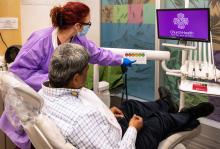
IN SEPTEMBER 1987, ordained Methodist minister and practicing physician G. Scott Morris opened Church Health, a faith-based health care center in Memphis, Tenn. The first clinic tended to 12 people. Over 35 years later, more than 80,000 different individuals have come through Church Health’s doors. When they started, Memphis was the poorest city in the country, but Morris and companions didn’t open Church Health center as an act of charity. Church Health’s mission has always been about demanding justice. His book Care: How People of Faith Can Respond to Our Broken Health System tells the story of clinics across the U.S. where people practice Jesus’ command to heal. — The Editors
I FIRST CAME to Memphis in 1986. Having completed my theological and medical education, I was determined to begin a health care ministry for uninsured people working in low-wage jobs. I had dreamed of this for years as I slogged my way through the training that would make it possible. When the time came, I chose Memphis because historically it is one of the poorest major cities in the U.S. Today we see patients in clinics for primary care, urgent care, dental work, and optometry services. Behavioral health, life coaching, and physical rehabilitation are integrated into our clinics, and we have a teaching kitchen offering classes on culinary medicine for patients and the community. The Church Health model is used in more than 90 clinics around the country. There are about 1,500 free and charitable clinics in the U.S., many of which have faith-based connections.
God calls the church to healing work. Jesus’ life was about healing the whole person, and Jesus is the church in the world. Tradition suggests that Helena, the mother of the emperor Constantine, was the first to open a hospital specifically to care for the poor. The ancient world never had a system to care for the sick who were poor until Christians offered hospitals. Even Julian the Apostate, a fourth-century Roman emperor who did not have much use for Christians, wrote, “Now we can see what it is that makes these Christians such powerful enemies of our gods, it is the brotherly love which they manifest toward strangers and toward the sick and poor, the thoughtful manner in which they care for the dead, and the purity of their own lives.” We are still Jesus’ disciples, the body of Christ running after God’s priorities in the world together. What does it look like to have a healing ministry in today’s world?


An airstrike in Aleppo, Syria, has killed at least fourteen patients and staff at a hospital supported by Doctors Without Borders. Among the dead is one of the last pediatricians in the city.
Neither the Syrian air force nor Russian military are currently taking responsibility for the attack. The United States and Russia agreed to support a truce between warring parties earlier this year, but those talks have largely broken down in recent months, according to The Washington Post.
CONSIDER A FATHER from rural Liberia who shows symptoms of Ebola. There are no health clinics in or near his village, so he and his family make the 10-hour trip to Liberia’s capital, Monrovia, using public transportation, potentially infecting others at every stage of their journey.
They arrive at the city’s public hospital, which is overflowing with patients because the facility is understaffed and underresourced. Staff members don’t have sufficient training or the tools to treat Ebola’s symptoms, the space to isolate infected patients, or the appropriate equipment to protect themselves from danger. They can’t cope with the sheer number of patients—those with the virus or with other illnesses—and the father likely dies.
What if, instead, the father is seen by a community health worker in his village? She notes his fever, vomiting, and diarrhea and knows he needs fluids immediately. The nurse who supervises her concurs, and they begin treatment. In the meantime, the nurse sends word for an ambulance from the nearby clinic to retrieve him, and she tells the family to limit their contact with others and to watch for similar symptoms in themselves for three weeks.
The local clinic is fully staffed and resourced. Doctors and nurses in full protective gear meet the ambulance, take the father to a hospital bed that is placed at some distance from others, and continue administering fluids. Because his community health worker spotted his symptoms early, and because high-quality care is close by, the father likely lives.

Today I was catching up on emails and came across two messages that deeply affected me, maybe because I read them back-to-back.
The first one is from a friend who helped release the “Collateral Murder” video via Wikileaks, showing US troops shooting some unarmed folks in Baghdad, including two children sitting in a van as their family stopped to pick up the wounded and dead. It is one of the most disturbing and heartbreaking videos I’ve ever seen. Feel free not to watch it.
NOTE: If you do watch the video inside the blog, please know that it is contains vivid images of war. It was released here:
The other email message I read was just the opposite. It was about life.
At first, I thought I had the flu because I didn't get a flu shot this year and naturally had to be punished by the medical community.
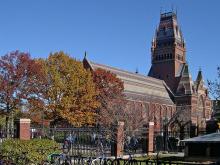
There is something fundamentally wrong with our education system when the draws of a huge salary and big bonuses consistently trump the aspirations and dreams that were front and center in our lives just four years earlier. Debts, a lack of job opportunities in other fields, your basic standard-issue panic — or maybe a simple absence of imagination can take hold and send us running into the arms of the recruiter with the flashy suit, a Hollywood smile and promise of a better life.
As Terkel reminds us: “Young people will continue to go work in the financial sector as long as its pay is disproportionately higher than alternative careers. It's basic human nature: Follow the money.”
But what would it look like if we didn’t follow the money? What if Wall Street paid no more than schools or hospitals?
What would our economy look like if these leading young minds chose not to work for big banks and consultants, but instead were the teachers that helped turn failing schools around, the innovators and engineers who were designing products that would create thousands of new jobs?
What needs to be done so that the finest members of the 2012 graduating class head to Main Street instead of Wall Street?