bureaucracy
In short, I find myself quickly going beyond the limits set by those who speak most loudly about “getting the government out of our lives.”
I acknowledge, of course, that there are legitimate arguments that can — and should — be carried on about many specifics. When can a given service be most effectively provided by non-government groups and agencies? When does a top-heavy governmental bureaucracy itself become a detriment to the common good? These are important questions that must debated.

THE EXTRAORDINARY film Leviathan takes place in a tiny coastal town on the other side of the world, but it relates to all our dreams and fears.
A man is tormented by bureaucracy, as the authorities try to take his house. He has an unhealthy relationship with alcohol, and a very unhealthy one with his partner. He works on people’s cars, does favors for people who ask him, and tries to raise his son as best he can. And he’s caught between the wheels of historic oppression and emerging forms.
Leviathan, this year’s Russian nominee for the Best Foreign Language Film Oscar, is a work of uncommon cinematic bravery, for the people who made it take on the corruption of their current political masters. Vladimir Putin appears briefly, as a portrait looming over the office of the mayor trying to take our hero’s house. But the graft, selfishness, and cruelty of Putin’s imperial reign are palpably present in the mayor, who has been fighting the householder for years to get his property, for reasons that owe more than a little to the legacy of Soviet-era patriotic ideology. Communism has been replaced by a heady mix of nationalistic pride and elitism religion, whose boundaries are enforced with no mercy. Pussy Riot’s punk prayer gets a mention in a priest’s litany of things that are undermining Mother Russia. It’s the same old story, there and everywhere—keep the nation pure, confuse spirit and law, and wreck your own life by denying the glories of human diversity.
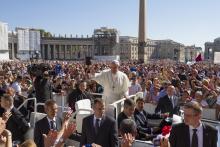
Pope Francis has once again given a startlingly candid interview that reinforces his vision of a Catholic Church that engages the world and helps the poor rather than pursuing culture wars, and one “that is not just top-down but also horizontal.”
The pope’s conversation with Eugenio Scalfari, an atheist and well-known editor of the Italian newspaper La Repubblica, took place at the pope’s residence in the Vatican guesthouse on Sept. 24 and was published on Tuesday.
His newest bombshell come just two weeks after the publication of the pope’s lengthy, groundbreaking interview with a Jesuit journalist in which Francis said the church was “obsessed” with a few moral issues, like abortion and homosexuality, and needed an “attitude” adjustment if it hopes to strike a “new balance” in its approach to the wider world.