american criminal justice system
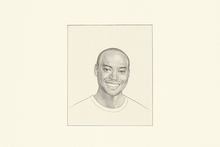
AS MY FAMILY and I entered the pre-visit check-in area of Pelican Bay, a supermax prison in Crescent City, Calif., three guards stood stiffly behind a long counter at the other end of the room. The guards didn’t budge. We followed their gaze to a tiny TV on the wall above what was supposed to be a “kids’ corner” (just a dingy rug and a mini kid-size table). Their eyes were locked on the movie Frozen.
It was 8 a.m. I took a deep breath as I realized this was going to be a long day. We sat and waited as they watched their movie on the state’s dime. My husband, who often visits prisons as a forensic psychologist, assured our sons and me, who’d never been to a prison before, that this is just how it goes sometimes.
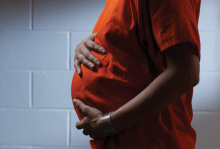
KADIJA CLIFTON LEARNED she was pregnant with her second child while being booked at a Maryland county jail. She had no idea that she was expecting. She was halfway through her pregnancy before she got her first ultrasound. On that day, two armed sheriffs escorted her to the medical facility with her wrists cuffed in front of her belly. A female correctional officer sat in the corner of the room while she was being examined. Clifton felt she had no privacy — “it was invasive and not fun at all.”
Clifton, who has been out for several years and is raising her son with her parents’ support, recalls that she spent the rest of her pregnancy in the county jail worrying about the health of her unborn child. She was already anxious about leaving her then 5-year-old daughter to be raised by her ex. The news of the pregnancy made things even more complicated.
“During those months I remember simply wanting a comfortable place to sit, versus plastic chairs or stools with no back support. I was seriously pregnant,” says Clifton. “Then there was the food, or lack of it. You have a limited amount. You get three meals a day, and if you are pregnant, it is just not enough.” Luckily, by the time Clifton was due, she was able to pay the bail bond and was awaiting trial at home.
I first met Clifton at a graduation ceremony in Alexandria, Va., for Together We Bake, a workforce training program. Clifton shared her life story in front of a handmade collage while hugging her then-5-year-old son. She had completed a 10-week training, learning about food safety, business administration, job readiness, and other critical life skills. Two months later, she became a senior adviser to a podcast on reentry I was producing at the time. Clifton now works as a night supervisor in a facility that hosts at-risk LGBTQI+ youth. Her daughter, now 14, still lives with her dad, but she and Clifton speak regularly.
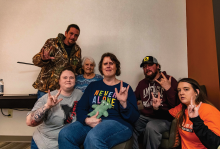
WE WERE MARRIED for two years. He was full of love, compassion, didn’t hold grudges or anything like that, quick to forgive, just an amazing man. Loved his family, not just us here, but his family there at Holman [Correctional Facility]. He’s not a monster. Kibby was my nickname for him: “Kenny” and my “hubby” mushed together. This doll I am holding became Kibby Bear. It’s made from his pants. One of the guys [on death row] made it and dyed it green because that’s my favorite color. It’s got a lock of Kenny’s hair in it. It helps me feel close to him.

This article comes by way of Empowerment Avenue, a nonprofit that works to normalize the inclusion of incarcerated writers and artists in mainstream venues by bridging the gap between them as a path to decarceration and public safety. — The Editors
IN A DIMLY lit room, Noah sits hunched over his half-finished masterpiece. The canvas comes alive under his skilled hand, revealing the weathered face of an old field worker — the grandfather of a dear friend. Every stroke tells a tale of resilience, etching lines of wisdom and hardship that speak to a life often overlooked. As the evening unfolds, Noah’s focused concentration becomes a beacon, drawing curious onlookers who gather around to witness the birth of art.
This is how I think of Bonifacio Alcantar-Maldonado, who I know by his prison handle, “Noah.”
Known outside by his childhood nickname “Junior,” Alcantar-Maldonado is incarcerated at the Washington Corrections Center in Shelton, Wash., where I am serving a life sentence. His life is now defined by two cruel political realities — heartless immigration policies and harsh criminal laws. His story illustrates the waste of human potential by a politics that promotes fear of those struggling in other countries and at home.
