
Scripture constantly should be challenging our assumptions about our lives and in every aspect of society. Transformation is needed on a personal and also a political level. Scriptural priorities shouldn't be glossed over in order to protect political ideologies and comfort zones.
If we believe that what Jesus taught remains just as relevant today as it did when he physically walked among us, then it should still be a comfort to those on the margins of society and offensive to the wealthy and powerful. That doesn't mean that the wealthy and powerful can't be good and faithful followers of Christ, but Jesus did warn them that their walk will be a hard one. Wealth and power bring unique and difficult temptations ... If you never feel uncomfortable when you read the Gospels then you aren't paying attention.
Where do we go from here?

Today (Oct. 4) Christians around the world celebrate the life of St. Francis of Assisi, one of the bright lights of the church and one of the most venerated religious figures in history.
The life and witness of Francis is as relevant to the world we live in today as it was 900 years ago. He was one of the first critics of capitalism, one of the earliest Christian environmentalists, a sassy reformer of the church, and one of the classic conscientious objectors to war.
 The puzzle here is not that readers of the Bible would tilt toward the political left. That, for me, as well as for thousands of other American evangelicals, is self-evident. Jesus, after all, summoned his followers to be peacemakers, to turn the other cheek, to welcome the stranger and to care for “the least of these.” He also expressed concern for the tiniest sparrow, a sentiment that should find some resonance in our environmental policies.
No, the real conundrum lies in the subtitle the editors of Christianity Today assigned to Franzen’s article, which was titled, “A Left-Leaning Text.” Adjacent to a picture of a Bible tilted about 45 degrees to the left, the editors added the subtitle: “Survey Surprise: Frequent Bible reading can turn you liberal (in some ways).”
The fact that anyone should register surprise that the Bible points toward the left should be the biggest surprise of all.

In his column last week, Sojourners chief Jim Wallis talked about his frustration with the perennial misuse of the word "evangelical" by various media to describe folks and ideas that, in his view, and that of many of us who self-describe as evangelicals, don't bear any resemblance to what we understand that term to actually mean.
Below is a compilation of recent media reports where the word "evangelical" is invoked. When you read these, evangelical brothers and sisters, do you recognize yourself in how the word is used and defined? Or does it ring false to you and your understanding of what "evangelical" really and truly means?
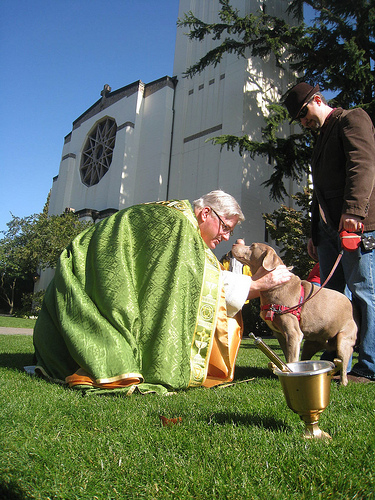 This weekend and on St. Francis Day (Oct. 4) some churches are having services for the blessing of animals. The following new hymn can be used.