
Five years ago, the Rev. Teresa K.M. Danieley had an epiphany of sorts. If people can grab breakfast on the go or pay a bill from their cell phone, she thought, why shouldn't they be able to get their ashes in a flash?
That's why, on Ash Wednesday 2007, Danieley planted herself in full priestly regalia at a busy intersection in St. Louis, smudging the sign of the cross on the foreheads of bicyclists, drivers and bus passengers.
This year, at least 49 Episcopal parishes across 12 states will offer ashes to passersby at train stations, bus stops and college campuses on Ash Wednesday (Feb. 22) as Danieley's "Ashes to Go" concept spreads nationwide.
O Lord, protect us in our struggle against evil. As we begin the Lenten journey, make this season holy by our self-denial. Grant this through our Lord Jesus Christ who lives and reigns with you and the Holy Spirit one God, for ever and ever. Amen. adapted from International Committee on English in the Liturgy (ICEL)
"You desire truth in the inward being; therefore teach me wisdom in my secret heart. Purge me with hyssop, and I shall be clean; wash me, and I shall be whiter than snow. Let me hear joy and gladness; let the bones that you have crushed rejoice. Hide your face from my sins, and blot out all my iniquities." - Psalm 51:6-9
"Carefully I crafted a loop with the string and tossed it into the river. / I never caught a fish with buttercups or a knotted string. / But I saw them swimming by in fleets of flashing silver / And for me, that was enough." - Emily Vizzo
Graham's thinking is dangerous. What he has failed to realize is that he, like many, is guilty of having a biased, preconceived "kind" of Christian and “brand” of Christianity. Often, these preconceptions fall along partisan lines. This was seen clearly in his willingness to affirm the Christian faith of candidates that share his political viewpoint (Gingrich, Santorum), but open the door for speculation on those (Obama, Romney) who do not. We can never forget that Jesus never demanded a “one size fits all” kind of faith. We must always allow room for disagreement and live with the tension of multiple opinions.
Sunday, February 19, marked the 70th anniversary of the Japanese Internment Camps. In honor of the many Japanese Americans affected, the Japanese American National Museum partnered with Ancestry.com to start the Remembrance Project to ensure these Americans were not forgotten.
It’s important for Americans to remember this part of their history, George Takei tells The Washington Post.
I’m astounded by the number of people — particularly east of the Rockies — who say to me, aghast, ‘I had no idea such a thing had happened in the United States.’

The Problem With Rick Santorum’s Holy War; Rick Santorum: 'If Government Is Going To Get Smaller, Then People Have To Get Bigger'; G.O.P. Campaigns Grow More Dependent On ‘Super PAC’ Aid; The Real Defense Budget; EU To Vote On Oil Sands Pollution; Christians Should Not Be Political Pacifists, Says Megachurch Pastor; Latino Mormons Speaking Out Against Romney Over Immigration Issue; Training Afghani Imams To End Violence Against Women (OPINION); Franklin Graham: Obama May Secretly Be A Muslim, Santorum And Gingrich Are Definitely Christian.
Does theology matter when it comes to evaluating political leaders? How does this whole faith and politics thing work?
Both Barack Obama and Rick Santorum have strong records on supporting legislation and funding policies that fight global poverty and pandemic diseases. Both men have talked about how their concern for the poor is motivated by their faith.
I feel comfortable with that and I think most people do. It is an example of political figures expressing their personal motivation behind widely held values that aren’t exclusive to a particular religious tradition.
There are some religious beliefs, such as a particular stance on infant baptism, understanding of the Trinity, or belief in what occurs when Christians observe the Lord’s Supper that are significant theological claims. But they aren’t good or appropriate benchmarks by which to evaluate political candidates.
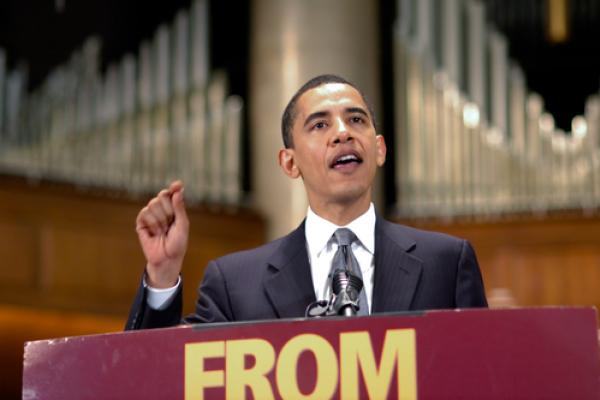
Editor's Note: Following here below is the text of Barack Obama's keynote address at the Sojourners/Call to Renewal "Building a Covenant for a New America" conference in Washington, D.C., as he delivered it on June 26, 2006.
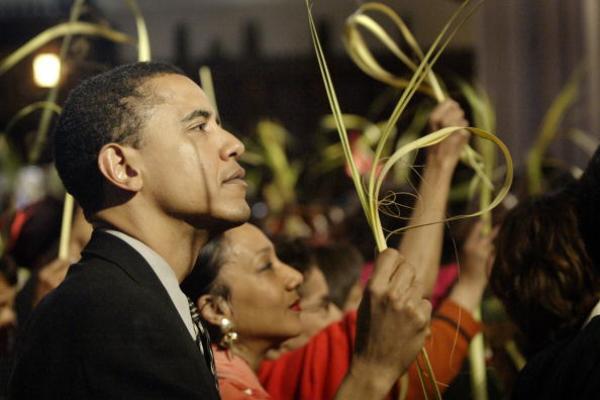
Editor’s Note: At 3:30 p.m. on Saturday, March 27, 2004, when I was the religion reporter for the Chicago Sun-Times, I met then-State Sen. Barack Obama at Café Baci, a small coffee shop at 330 S. Michigan Avenue in Chicago, for an interview about his faith. Our conversation took place a few days after he’d clinched the Democratic nomination for the U.S. Senate seat that he eventually won, and four months before he’d be formally introduced to the rest of the nation during his famous keynote speech at the 2004 Democratic National Conventio.
We spoke for more than an hour. He came alone. He answered everything I asked without notes or hesitation. The profile of Obama that grew from the interview at Cafe Baci became the first in a series in the Sun-Times called “The God Factor,” which would eventually became my first book, The God Factor: Inside the Spiritual Lives of Public People, in which Obama and 31 other high-profile “culture shapers” — including Bono of U2, Nobel Laureate Elie Wiesel, the author Anne Rice and President George W. Bush's speechwriter Michael Gerson — are profiled.
Because of the seemingly evergreen interest in President Obama’s faith and spiritual predilections, and because that 2004 interview remains the longest and most in-depth he’s granted publicly about his faith, I thought it might be helpful to share the transcript of our conversation — uncut and in its entirety — here on God’s Politics.
~ Cathleen Falsani