
Against a backdrop of heartland fears that U.S. Muslims seek to impose Islamic law on American courts, a leading Muslim group will launch a campaign Monday to dispel what it called misconceptions about Shariah.
The "Defending Religious Freedom: Understanding Shariah" campaign comes at a time when more than 20 states are considering or have passed laws forbidding judges from considering Shariah in their deliberations.
Many Americans associate Shariah with the harsh punishments carried out in a few Muslim countries like Afghanistan and Saudi Arabia, even as U.S. Muslim groups insist they have no desire to introduce Islamic law on themselves or others.
"There were all these wrong notions about Shariah," said professor Zahid Bukhari, president of the Islamic Circle of North America, which is sponsoring the campaign.
The most worrisome thing, he said, was that the level of hatred toward Shariah had spread from the margins of society to the mainstream. The ICNA campaign has already drawn fire from "anti-Shariah" groups in the United State

A Virginia judge has ordered seven congregations that broke from the Episcopal Church to return all property to the local diocese — from valuable land to sacred chalices — by April 30.
The Diocese of Virginia had wanted the properties returned by March 30, a week before Easter. But Fairfax County Circuit Court Judge Randy Bellows agreed to give the breakaway congregations more time.
In a closely watched case that reached the Virginia Supreme Court, Bellows ruled in January that congregations had the right to leave the Diocese of Virginia, but not to take church property with them.
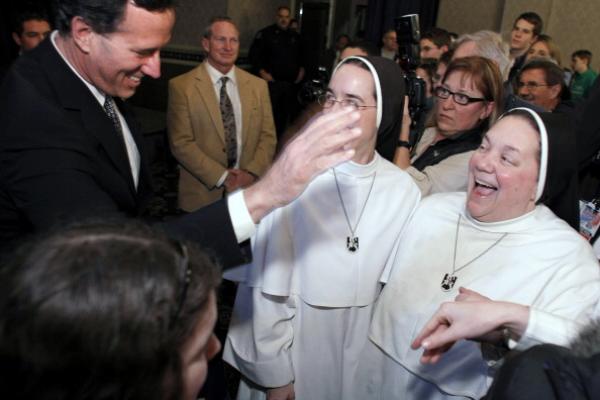
Mitt Romney has trounced Rick Santorum, an ardent Catholic, among Catholic voters, but Romney's support among evangelicals has wavered thus far in the GOP presidential primary, according to a new analysis of exit poll data.
Though he won evangelicals in two states, in general Romney has performed 15 percentage points better among non-evangelicals, according to an analysis released March 2 by the Pew Forum on Religion & Public Life.
Exit poll data is available in seven of the 11 states that have held primary contests to date, according to the Pew Forum. More detailed religious affiliations are available in six of those states.
White evangelicals formed more than a third of all GOP primary voters in each state except for Nevada (24 percent) and New Hampshire (21 percent). Romney, a Mormon, won the evangelical vote in those two states, and nearly tied for first in Arizona and Florida. But he lost the evangelical vote badly in three states: Michigan, Iowa and South Carolina.
Somewhat surprisingly, Santorum has not won the Catholic vote in a single state in which data is available, according to the Pew Forum.

A headline from Reuters stopped me in my tracks earlier this week.
It read, ‘"Pray for us" say Syria rebels as army closes in’." I was struck by how moving I found this statement, this plea.
I do my best to remember places of conflict and strife in my prayers, but very rarely have I been petitioned to pray from a conflict situation by those in the middle of the conflict. It may be a strange reaction on my part to conflate a headline from a news report to be a direct request for my prayers, but that is how I responded when I read it.
“Pray for me” is not an abstract or passive statement. When we are asked to pray for someone, or a group of people, we are charged to bring their need or suffering to God.

One of my must reads is the Sunday New York Times Book Review. There are too many books being published that I would love to read, but don’t have the time. So, I rely on reading book reviews as one way of keeping in touch with what’s being written.
Last Sunday, the Review ran an essay on how books affect Washington policy makers. Lawrence Summers, former director of the National Economic Council, says that a good review can often summarize what’s necessary for a policy maker to learn. He was quoted as saying, “If you tell me that the policy makers are reading the reviews, not the books, I don’t take that as evidence that the books aren’t influential.”
While I don’t fancy myself as a policy maker, the sentiment is also true for the rest of us.
Learn about two such new titles that may have an impact on public policy inside the blog...
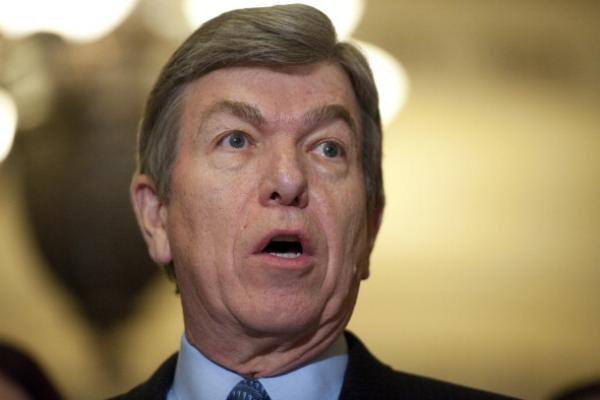
The Senate on Thursday defeated a Republican-led bid to insert a broad religious exemption into a federal mandate that requires most employers and health insurance companies to provide free contraception coverage.
The largely party-line vote was 51-48 in favor of tabling an amendment that Sen. Roy Blunt, R-Mo., had offered to a federal transportation bill.
Blunt and other Republicans had argued that the measure would protect the religious liberty of institutions such as Catholic charities and hospitals that object to contraception on moral grounds.
"It's not just the Catholic Church," Sen. Orrin Hatch, R-Utah, said during the floor debate on Thursday. "It's a moral and religious issue that should not be interfered with by the federal government."

'We Wish Like Hell We Had Never Bought': Voices From The Housing Crisis; One Nation Under Gods; Mass Appeal To Governors: Don't Privatize Prisons; “Green On Blue”; Obama To Iran And Israel: 'As President Of The United States, I Don't Bluff'; For America's Least Fortunate, The Grip Of Poverty Spans Generations; Inequality, Poverty, And Why We're Definitely Not Broke (OPINION); Jacksonville Lawmaker Says No 'Extreme Poverty' In N.C.

NORMANDY, Mo. — A popular music teacher at a Catholic Church was fired after church officials learned that he planned to marry his male partner of 20 years in New York, where same-sex marriage is legal.
The teacher, Al Fischer, confirmed that he was fired Feb. 17 from his job of four years at St. Ann Catholic School. When asked to comment on his firing, Fischer declined and referred to a letter emailed to his students' parents shortly after his termination.
In the letter, Fischer tells parents of "my joyful news, and my sad news" — the former being his plans to marry his longtime partner in New York City, and the latter, "that I can't be your music teacher anymore."
Fischer's partner, Charlie Robin, told the Post-Dispatch that the couple's relationship was not a secret at St. Ann, and that Fischer was fired after a representative of the St. Louis Archdiocese overheard him talking to co-workers about his wedding plans.

We're delighted to share with you an excerpt from Christian Piatt's forthcoming (April 1) memoir, PregMANcy: A Dad, a Little Dude and a Due Date:
“Screw it.”
These two words are what started the baby ball rolling in the Piatt household, back in January. After months of counseling, discernment, weepy nights and sleepless mornings, I submitted, succumbed, caved in like the roof of a Geo convertible.
I know “screw it” is an ironic choice of words, considering the circumstances. I also think it’s sadistically ironic that we men are biologically tuned to love sex so much, yet we’re usually the ones who freak out the most about the byproduct. I’m a typical male, visually aroused by anything vaguely resembling a boob or a booty. Also, working from home and sharing responsibility with my wife for the daily development of our four-year-old son, Mattias, makes me somewhat abnormal. And it’s this shared responsibility, I think, that makes having another kid such a big deal for me.

A small Minnesota church is finding out the high cost of standing up for same-sex equality — as well as an unexpected lifeline from the very people it decided to support.
When the Rev. Oliver White voted in favor of the United Church of Christ's endorsement of same-sex marriage in 2005, 72 percent of his predominantly African-American flock at Grace Community United Church in St. Paul couldn't stand with him.
The UCC's 2005 vote, he said, was "the beginning of the end of many UCC churches." Predominantly black churches like his suffered the most, he said, because the black community "was, and still is, very homophobic."
Because of White's vote, his church developed a reputation of being a "gay church" and people stopped coming. And stopped giving.