
A federal judge has temporarily blocked enforcement of a city law that was recently used to arrest Christian evangelists who were preaching on Bourbon Street during Southern Decadence, the annual celebration of gay culture in the French Quarter.
Part of the city's recently enacted "aggressive solicitation" ordinance orders people not to "loiter or congregate on Bourbon Street for the purpose of disseminating any social, political or religious message between the hours of sunset and sunrise."
"That's no longer in effect," American Civil Liberties Union lawyer Justin Harrison said.
U.S. District Judge Eldon Fallon granted a temporary restraining order on Sept. 21 and set a hearing for a preliminary injunction for Oct. 1.
Nine Christian preachers and activists were arrested in one well-publicized incident during the gay-themed celebration. One reportedly held a sign reading "God Hates Homos," and others shouted what witnesses characterized as slurs.
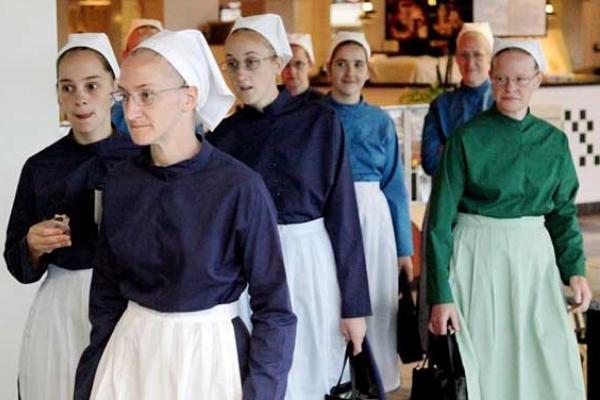
Amish bishop Samuel Mullet was convicted Sept. 20 of federal hate crimes and conspiracy for exhorting followers to forcibly shear the hair and beards of those who opposed his breakaway Ohio sect.
Mullet’s three sons, his daughter, and 11 other family members and followers from his ultra-strict Amish order 100 miles southeast of Cleveland also were convicted of conspiracy and hate crimes after a trial that attracted international attention.
The 66-year-old bishop could face life in prison for his crimes. U.S. District Judge Dan Aaron Polster scheduled sentencing hearings for Jan. 24.
Assistant U.S. Attorney Bridget Brennan said federal sentencing guidelines recommend a minimum of 17 1/2 years for the other 15 defendants given that their crimes involved violence and kidnapping.
But defense attorneys said the judge has the discretion to sentence some of Mullet’s followers to as little as time already served in jail.

Joe Scarborough said what a lot of Americans are thinking as they watch anti-American protests and embassy attacks in many places across the Muslim world.
"You know why they hate us? They hate us because of their religion, they hate us because of their culture, and they hate us because of peer pressure," Scarborough said on the MSNBC program "Mornin Joe" on Sept. 17.
"And you talk to any intelligence person, they will tell you that's the same thing, and all those people who think we're going to go over there and change them are just naive. ... They hate us because of waterboarding? No they don't. They hate us because they hate us. They hate us because of Obama's drone attacks? No they don't. They hate us because they hate us."
Now Joe would be the first to admit that “they hate us because they hate us” is ... somewhat lacking in analytical depth. But it’s even worse than that. It is a foolish step down an oil-slick slope into a deep, old rut that runs in a vicious, dangerous circle.

It’s amazing what a difference six words can make in our understanding of a figure as central as Jesus to the lives and faith of so many. Even historians and others who don’t claim Christianity personally are intrigued by the scrap of text recently discovered to contain, in Coptic, the sentence fragment: “Jesus said to them, ‘My wife…’”
Was this Jesus of Nazareth? is it authentic? Did the author have an original source to pull from, or simply word-of-mouth legend? After all, this writing seems to be several hundred years newer than the synoptic gospels. Perhaps Jesus was speaking in parable, as he often did, or maybe the “wife” was the Church, which often is referred to as “the bride of Christ.” Who knows? It’s likely we never will, but the buzz that this find creates is more interesting to me than the source of the scripture itself.
Why do we care so much if Jesus had a wife and kids or not? Why does it seem to matter if he died without ever having sex?

An open letter to my beloved sons, in whom I am well pleased,
I'm writing this fatherly letter about the difference between a career and a vocation. I learned this wisdom from Jim Forest, an old man who was a famous peace activist in the 1960s and walked many of the top spiritual activists of the 20th century. He personally taught me some important lessons on vocation that might be very helpful to you, and he specifically had you three in mind when he shared this.
When I say "career," I mean the idea of a job that you work at to make money, get promotions, become an expert, and eventually retire and earn a pension. There's nothing really wrong with having a career, or even a few careers. For example, you could say I was a "career pastor" for 20 years.
But there is something more important that we call a "vocation." A vocation may also include getting a paycheck and going to a workplace, but there is much more. A vocation is a "calling" that can span over many careers. For example, I think by vocation I am called to teach. I did that as a youth pastor, a church-planter, a college teacher, a seminar facilitator, an author, and a publisher. All of those mini-careers are just the platform I used to live out my calling.

Al Jazeera reports:
“At least three people have been killed in a suspected US drone attack in Pakistan's northwestern region along the Afghan border, according to a Pakistani security official.
“The target of Saturday’s attack was a vehicle in Dattakhel area in North Waziristan, one of seven tribal districts and hotbed of al-Qaeda-linked fighters. All three people travelling in the car were killed and the vehicle completely destroyed, the security official said on condition of anonymity.”
The attack was also reported in Pakistani newspapers DAWN and The Nation.

We’ve all heard the rhetoric. “We need to take America back for God!”
Why? Supposedly so we can regain some bygone level of ethics or moral standards. Supposedly, if we don’t, God will get tired of us “rebuking” God and remove God’s hand of protection from us. Supposedly, so God won’t test us or judge us or something.
Yet, as Gregory A. Boyd notes in his important book The Myth of a Christian Nation: How the Quest for Political Power Is Destroying the Church, taking America BACK for God assumes we were at one really belonged to God, followed God, listened to God. Boyd goes on to ask, when was this glorious age in the history of the USA?
Let’s start way back. We’ve been taught that many people migrated to North America for religious freedom. So was this glorious time when some of our forebears imprisoned, tormented, and/or hanged many suspected to be witches? Is that what so many want to take us back to?