
If you’re looking for a pick-me-up, look no further than Cincinatti’s Walk the Moon. The group recently stopped in Washington, D.C., on their world tour and performed in front of an uber-hyped audience.
Their songs blend elements of pop, rock, and dance music — like what you’d expect if you mixed The Strokes, Passion Pit, and sprinkled on some of the overall vibes from the Vans Warped Tour.
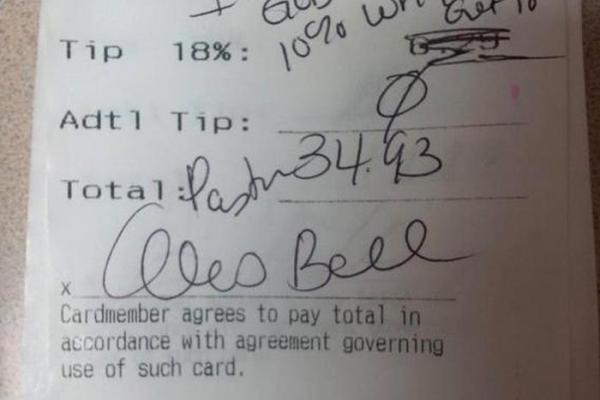
There are two personality flaws that I consider to be more or less fatal: being cheap and being unkind to the wait staff.
By “cheap,” I don’t mean frugal. I’m talking about the kind of economic stinginess that goes far beyond being a good steward of your budget and resources. Cheap is miserly, selfish, and, I believe, based in fear. And nothing good is wrought when fear is your motivation.
Another word to describe this kind of cheap is more commonly employed in British English than in our own American lexicon: “mean.” Meanness connotes the habit of being ungenerous and petty.
This meanness is what the first fatal flaw and the second have in common. If you are rude, condescending, or just plain nasty to your server in a restaurant, it is, in the immortal words of Liz Lemon who crossed over last week into the eternity of syndication, a deal breaker.
The only thing worse than being cheap and nasty to the wait staff is invoking your religious beliefs to justify your actions. And that is, sadly, precisely what one pastor did when she attempted to stiff her waitress after church one recent Sunday night at a Missouri Applebee’s.
On Jan. 25, Alois Bell, pastor of the tiny Word Deliverance Ministries church in St. Louis, headed to the local Applebee’s with nine of her congregants – four other adults and five children – for a post-worship dinner. When the unidentified server returned with the bill for $39.43 at the end of the meal, Bell crossed out the automatic 18 percent gratuity (added to parties of six or more), wrote in the tip amount of “0” and the following handwritten message: “I give God 10%, why do you get 18?” Then she signed the credit card receipt “Pastor Alois Bell.”

Some enterprises, like tech start-ups, are all dream and no structure.
A founder’s dream of making a world-changing product compels other pioneers to work long, self-sacrificial days. In what resembles religious fervor, they are like monks in constant prayer, hunched over computers, collaborating at white boards and talking shop deep into the night.
Investors, however, want structure and a return on their investment. So, eventually, do employees, who want stock offerings, benefits, and some sense that the dream has a future.
This awkward transition from dream-only to dream-plus-structure is where many enterprises fall apart. Freedom collides with accountability, jealousy emerges as some get better titles and more stock options and the freedom of “all in this together” gives way to stratification.

Last week Christian Churches Together in the USA gathered in Austin, Texas for its 7th Annual Meeting. CCT represents the breadth of Christian denominations in the United States, including historic Protestant, Catholic, Orthodox, evangelical Protestant, and historic black church denominations. In subsequent years CCT focused on issues of poverty and racism. This year leaders of this diverse body of Christian denominations focused on the need for broad reform within the U.S. immigration system.
Over the course of four days, this broad coalition of heads of communion and ecumenical officers learned the history of Immigration Reform in the U.S., sought biblical counsel, watched films about life along America’s southern border, and listened to the testimonies of “DREAMers," undocumented domestic workers, and asylum-seekers. In the end the five families of the church in the United States reached consensus on a statement calling for just and humane immigration reform that includes an “earned path to citizenship."

Editor's Note: DRONE WATCH follows daily developments about drone strikes and policy concerning the highly controversial usage of drones. To keep up to date, follow our Quick Read blog HERE.
One of the most hotly contested points of the administration’s drone policy is its claim to have legal justification for killing U.S. citizens. Now we have their rationale for that claim. Michael Isikoff, National Investigative Correspondent for NBC News, published on Monday a memo he says was given to members of the Senate Intelligence and Judiciary committees in June.
The “Department of Justice White Paper” outlines certain conditions for an attack. An “informed, high-level official of the U.S. government” must determine that the targeted U.S. citizen is a “senior, operational leader of al-Qa’ida or an associated force,” poses “an imminent threat of violent attack against the United States,” “capture is infeasible,” and the attack is conducted in a way consistent with “law of war principles.” In those conditions, the memo says, “a targeted killing of a U.S. citizen who has joined al-Qa’ida or its associated forces would be lawful under U.S. and international law.”
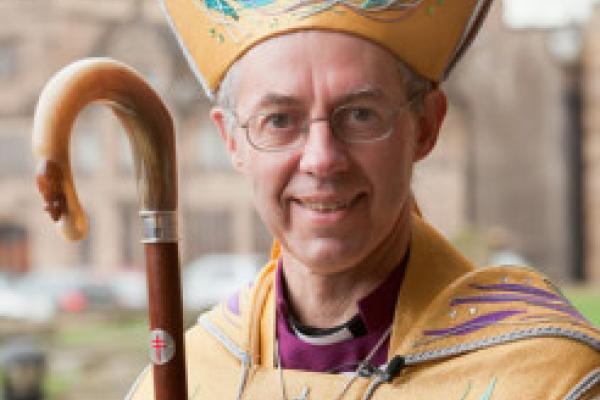
LONDON — Justin Welby was confirmed Monday as the new archbishop of Canterbury at a centuries-old service at St. Paul’s Cathedral, six weeks before his formal enthronement inside Canterbury Cathedral on March 21.
Welby, 57, was a banker and oil executive before his ordination as a priest in 1992, and has served as a bishop for less than a year.
He takes over from Rowan Williams, 62, who returned to academic life at Cambridge University after a decade of turmoil throughout the worldwide Anglican Communion over questions of human sexuality and inside the Church of England over the role of women bishops.
The new archbishop had been the bishop of Durham in northern England for eight months when he was ordered by a still unnamed person in the Church of England to apply for the church’s top job.

We know we are addicted to something when that behavior damages our relationships with people. When alcohol, drugs, food, gambling, or work is more important than mother, father, husband, wife, child, friend, or neighbor, we know we have a problem. Similarly, we know that we are worshipping an idol when a created thing becomes more important than the Creator, when we put our faith in our fears and a dead thing that cannot love us back becomes the object of our ultimate concern. We know we are worshipping an idol when our devotion fails to cause us to love and to respect our neighbor.
In a Connecticut hearing about gun violence, Neil Heslin — a father whose son died in the mass shooting at the Sandy Hook Elementary School —asked why any one individual citizen needs military-style assault weapons and high-capacity magazines. People in the room answered by quoting the Second Amendment. In this case, the Second Amendment was more important than this father’s pain. Their lack of respect for his pain indicated a deficit of both compassion and love, not only for this grieving father but for a grieving nation.
Let us be clear. The Second Amendment is not holy writ, and a gun is not God. Far too many Americans have made these created things, these inanimate objects more important than the compassion we ought to have for one another. This is fetishism. This is idolatry. This is morally wrong.