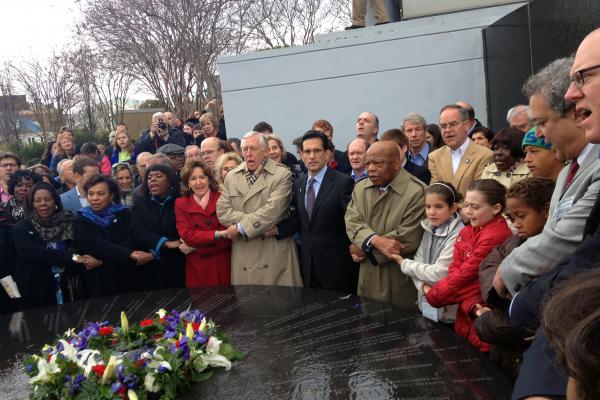
This year marks a long list of anniversaries in our nation's long march for civil rights: We now mark 150 years since the Emancipation Proclamation; and 50 years since the Stand in the Schoolhouse Door, Martin Luther King, Jr.'s "Letter from Birmingham Jail," the March on Washington, the bombing at Sixteenth Street Baptist Church that killed four little girls, and the murder of Medgar Evers in his driveway.
In remembrance of the sacred journey, The Faith and Politics Institute's Civil Rights Pilgrimage drew more than 250 people, including 30 members of Congress, for a three-day tour of civil rights landmarks and first-hand testimonies from the movement's leaders. Throughout the pilgrimage — moving from Tuscaloosa to Birmingham to Montgomery to Selma — the delegation learned, grew, and continued the conversation together: white and black, Republican and Democrat, man and woman, senior and child. We all returned to Washington, D.C., and to our homes across the country, with a renewed sense of responsibility for the common good.
A number of events made the term 'reconciliation' mean more than the definition I had somehow created for myself over the past 30 years. Reconciliation is calling the person who beat and humiliated you 'brother.' Reconciliation is sharing a platform, sharing a deeply intertwined story — and sharing an authentic embrace — with the offspring of your parents' enemies.
[Photo Gallery at the jump.]
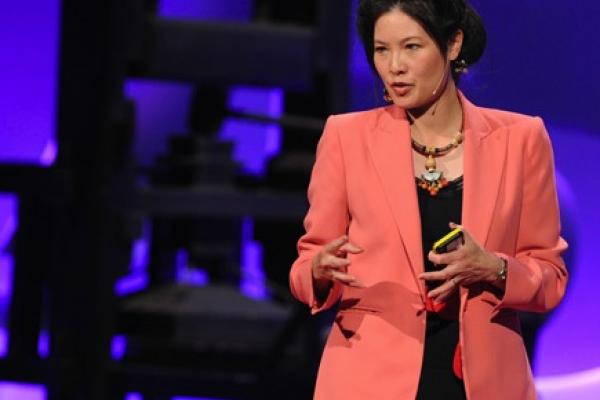
“They took the door off so the hyenas would get her.”
Sitting in the darkened room with thousands of others, I listened intently as the woman on stage continued. The speaker was no other than Sheryl WuDunn, the Pulitzer Prize-winning co-author of Half the Sky, and the setting was this year’s Justice Conference.
Having previously read Half the Sky, I was reminded again of the countless numbers of women who looked beyond their circumstances to overcome challenges, and change their families and communities for the better. I remembered the underlying causes of global gender inequality, and WuDunn’s urgent call in her book to empower girls and women. The solution to ending poverty lies in educating females and bringing them into the formal workforce. In that, women’s empowerment isn’t simply a good issue to promote, but part of creating a just world.

As I waited in the room heated to 105 degrees, my friend Molly looked for a sliver of floor space for her yoga mat. “I probably need a more relaxing type of yoga,” I whispered, almost apologizing for bringing my type-A body to the crowded Bikram class, known for its intense heat and addictive practitioners.
At exactly 10 a.m., the yoga teacher entered the room: I stood in unison with the other students, much like I rise for the procession at my church on Sundays. Surprisingly, much of what draws me to Bikram yoga also brings me back each week to the Episcopal church.

Last week, the State Department issued its next draft of the supplemental environmental impact statement (SEIS) assessing the northern route of TransCanada’s Keystone XL pipeline. Officially, the State Department does not make any recommendations on whether the pipeline should be approved or denied. But the summation language is all to the positive — making it clear that the State Department still doesn’t understand global warming and its disastrous consequences.
I’m sure the scientists, policy analysts, and environmentalists among us will soon sort out and explain the hundreds of pages released by the State Department March 1. But until then, here’s the part I found most significant: “The life-cycle carbon footprint, for transportation fuels produced in U.S. refineries, would increase if the project were approved.”
Please note that this information is buried way way way deep in the documents. The general summary by the State Department is favorable toward industry and the pipeline, though there are some conclusions drawn that I think are not supportable.
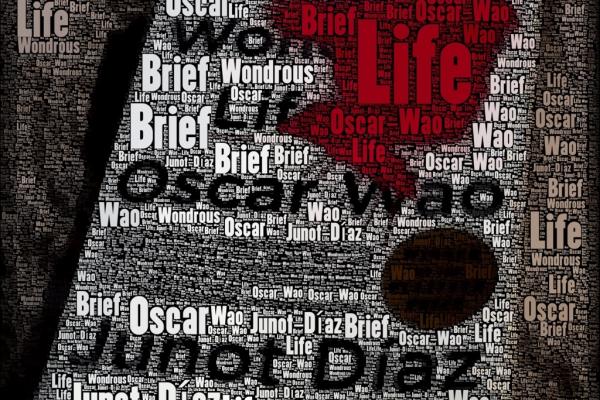
After taking my seat in a comfortably worn wingback chair, I immediately noticed a copy of Junot Diaz’s novel, The Brief Wondrous Life of Oscar Wao. My eyes lit up. Having just picked it up the week prior, I suddenly felt an imagined literary kinship with him. Appropriately, Diaz’s novel leaned up against a worn collection of liberation theology.
“How do you like Diaz’s writing?” I asked, hoping a moment of shared appreciation for words and stories would calm my nerves a bit.

When I first listened to Tame Impala, I was almost convinced they were the late-60s Beatles reincarnated. Lead singer Kevin Parker’s nasally yet gentle voice sounds about as John Lennon as you’re gonna get.
But Parker makes it work. And Tame Impala, under his leadership, sounds fresh in a world saturated with music. Critics agree that Tame Impala manage to fuse classic psychedelic rock and blues with jazzier and more modern music. And that seems pretty accurate. Ezra Pound urged his modern contemporaries to “make it new” in regard to poetry, and even though Parker’s project may not be entirely or dramatically new, it is innovative.
THIS JUST IN — horrific news from our friends in Kabul. Over the weekend two kids, age 7 and 8, were killed by NATO forces while herding cattle in the Uruzgan Province in Afghanistan.
The Afghan Peace Volunteers, with whom Shane visited a few weeks ago, took to the streets in nonviolent protest.
They were accompanied by a couple of cows, as a reminder of the innocence of these children who were killed alongside their livestock.
They carried signs that read: “We are those 2 children.” Here is a video they sent us: