On Monday, Olivier De Schutter, U.N. special rapporteur on the right to food, submitted his report Gender and Food Security to the U.N. Human Rights Council, adding to the mountains of evidence that if you empower women with education and independent rights, they can substantially, cost-effectively, and generationally reduce hunger and malnutrition. The Guardian's Poverty Matters Blog reported:
The notion that gender equality can play an important role in reducing hunger and malnutrition has gained increasing traction in development circles. The UN's Food and Agriculture Organisation claimed in its 2010-11 State of Food and Agriculture report that equal access to agricultural resources could reduce world hunger by 12-17%. Gender and food security also came under the spotlight in the 2012 edition of the World Bank's flagship annual report, where it was argued that parity in areas including landrights, employment and political representation could improve development outcomes.
These ideas are not new. Obliged to raise children, care for sick and elderly people, and run households – work that, valued in monetary terms, would be equivalent to 15% of GDP in low-income countries, rising to 35% in middle-income countries – it has long been argued that women are being denied education opportunities, marginalising them both economically and politically. The challenge lies in convincing policymakers to do something about these multiple challenges.
Says De Schutter:
"We must address how gender roles are being defined within the family and who makes the decisions in government. ...We must refuse to take existing gender roles as givens, and instead allow women to shift the burden to men;where possible, giving women access to more opportunities and better training and education, and exposure to something other than the traditional responsibilities they have been assuming."
"If local NGOs and women's organisations and unions mobilise, using the report to put pressure on the government from below, that will be even more effective than international pressure."
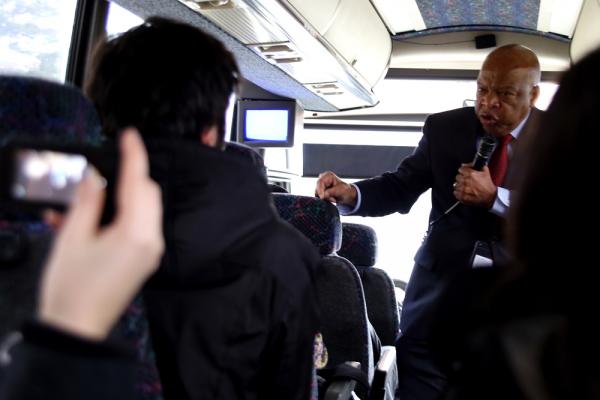
This past weekend, The Faith and Politics Institute led a three-day Congressional trip to visit Civil Rights landmarks across Alabama — from Tuscaloosa to Birmingham to Montgomery to Selma. It was an incredibly moving, emotionally exhausting, soul-quenching pilgrimage as we journeyed along with heroes of the Civil Rights movement and experienced their stories.
One such hero is Congressman John Lewis. A highlight of the trip for me is recorded at the jump.

Days after pulling out of the conclave to elect the next pope and vowing to fight the charges against him, disgraced Scottish Cardinal Keith O’Brien admitted Sunday to inappropriate “sexual conduct.”
O’Brien, who until a week ago was the highest-ranking Roman Catholic cleric in England and Scotland, had served as archbishop of St. Andrews and Edinburgh for the last seven years and was made a cardinal in 2003.

The human community exists in perpetual motion; migration is a constant feature of our local and global reality. According to the International Organization for Migration, the total of international migrants increased from an estimated 150 million in 2000 to about 214 million in 2010, and the number of internal migrants (those who move within the borders of a given country) is about 750 million. These relocations are often related to the harsh consequences of war, environmental destruction, and economic downturn. As a result, those engaged in migration often do so for the sake of safety and opportunity, yet these potential rewards are sought in spite of deep personal and financial risk.
While the rates appear to be on the rise, the phenomenon as a whole is by no means exclusive to the present. The New Testament passage often known as “The Parable of the Prodigal Son” includes some of the harsh realities that are often associated with migration. One can examine this well-known parable through the lenses of migration, and in doing so, we are given insights in how to more faithfully extend hospitality to such strangers.
As Luke’s Gospel (15:11-32) reminds us, the youngest of two sons asked for an early inheritance from his father, received it, and then traveled to a “distant country” where he “… squandered his property in dissolute living.” As the term “dissolute” typically intends to describe degenerate and/or sinful behavior, we often conclude that the youngest son was deeply immersed in immorality, thus we find it difficult to feel sympathy when he later falls into the depths of poverty. We tend to perceive the prodigal son as someone who got what he deserved, for as the parable seems to illustrate, not only did he waste the inheritance received from his father, but he did so through sinful choices that brought deep dishonor to his family.
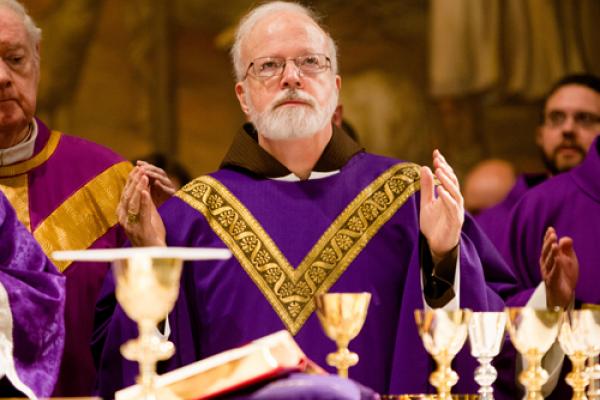
Roman Catholic cardinals on Monday met for the first of a series of closed-door meetings in the run-up to the conclave that will elect the successor to former Pope Benedict XVI.
But as cardinals filed into a Vatican conference room under the gaze of dozens of cameras, church officials said 12 voting prelates still haven’t arrived in Rome, pushing back the possibility of an early start to the conclave.

It's an important question. Mark Driscoll, the famed neo-Calvinist, wants us to believe that we are God's enemies and God desired our destruction until Jesus, God's own Son, put himself in harm's way and saved us from God. Interesting theological gloss...but there's something in this I'm pondering right seriously this morning...
...What's it like to wrestle with the Divine One? You know, like Jacob did there in the desert one night. You can contend with God, can you not? Is God not then your enemy in some way? Well, perhaps your adversary? I don't know for certain if any of this language suits, but I'm pondering it because God and I are engaged in a cage match and I am mustering all the courage I have not to pull out a folding chair or some such mess knowing full well that God cheats.

On a summer night in a Western town of flat fields and hazy sunsets, a young woman stood outside a Greyhound bus with a ticket in her hand and a backpack over her shoulder. Boarding the bus, she said later, would be the hardest thing she had done in her 18 years.
Harder than saying a last goodbye to her mother, father, and five siblings that morning. Harder than the two years since as she tried to make a new life, alone, in a strange city.
Now 20, she asked to go by the name Samya. If her true identity were known, Samya believes, her family would seek her out and possibly kill her. They would certainly try to persuade her — if not force her — to come home.
Her parents, she said, think she is guilty of two serious crimes: She rejected a marriage arranged by her father, who came to the U.S. from the Middle East when Samya was an infant. And perhaps more serious to her parents: She has become an atheist.