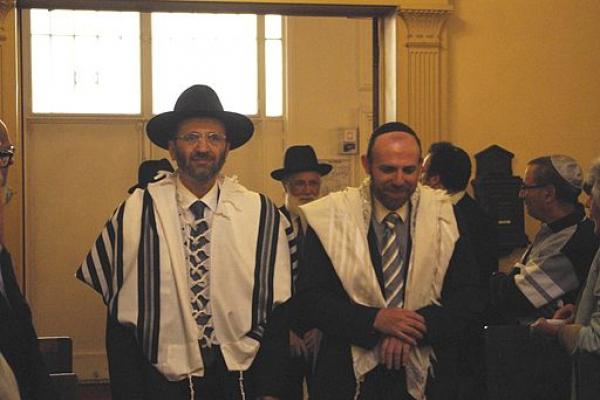
Amid a finance scandal that touched the heart of France’s Socialist government, a quieter drama played out this month as the country’s top rabbi resigned his post after admitting to plagiarism.
Rabbi Gilles Bernheim offered his apologies for “borrowing” the work of others and lying about his academic credentials, ending a leadership crisis that has rocked the country’s 600,000-strong Jewish community, the largest in Europe.
Now, as the search begins for a new grand rabbi, questions are mounting about which direction the religious leadership will take — notably whether it will continue Bernheim’s move toward a more “modern” and perhaps more inclusive French Judaism, or return to a more inward-looking faith.
Bob Edgar, president of Common Cause, died suddenly this morning at the age of 69. In a news release announcing his passing, Common Cause Board Chair Robert Reich, said, “We are deeply saddened and shaken today by the passing of Bob Edgar. Bob will be remembered for his decency, kindness, compassion and humor.”
Bob was general secretary of the National Council of Churches from 2000 to 2007. During those years, Sojourners worked with him in anti-poverty efforts, and in attempting to prevent the beginning of the war in Iraq. He was an ordained United Methodist minister, and also served six terms in the U.S. House of Representatives.
Please keep his wife Merle, and sons Andrew, David and Rob, and their families, in your prayers.

I wonder if social isolation — not extremist religion or Chechen roots — explains the two brothers who set off bombs during the Boston Marathon, killing three and wounding more than 170.
The older brother, Tamerlan Tsarnaev, was quoted as saying “I don’t have a single American friend, I don’t understand them.” One emerging theory is that, he dealt with isolation in America by seeking his heritage in Chechnya and there, some think, found purpose in violence against his unwelcoming home.
In feeling isolated, the alleged bomber isn’t alone. Isolation is the new normal in America.

CAMBRIDGE, Mass. — After two troubling outbursts at a local mosque, leaders there told Boston Marathon bombing suspect Tamerlan Tsarnaev he would no longer be welcome if he continued disrupting services.
Leaders at the Islamic Society of Boston‘s mosque in Cambridge say Tsarnaev, 26, who died early Friday after a shootout with police, “disagreed with the moderate American-Islamic theology” of the mosque, but they never had “any hint” the brothers might be violent.
On one occasion in November at weekly prayer, Tsarnaev challenged an imam who said in his sermon that it was appropriate to celebrate U.S. national holidays, such as July 4th and Thanksgiving, the statement said.
Tsarnaev argued that such celebrations are “not allowed in the faith.” When the preacher met with Tsarnaev after the prayer, Tsarnaev “repeatedly argued his viewpoint, and then left,” the statement said.

We tend to consider the crucifixion, the resurrection, and Pentecost in two ways primarily. We see them as history, stories about things that happened a long time ago. Or we consider them through theologies about what they mean for us after we die.
Yet, there is a deeper reality to all of them. The cross, the empty tomb, the moment of divine inspiration are repeated every day and everywhere. They’re ongoing and participatory.
Many experience those moments of inspiration each day. They’re moved to help someone who is hurting, inspired to care for those who are struggling, emboldened to try to change their world in some way. They sense something divine in the small moments of life. They stand up for anyone who is being treated as less than an equal child of God. They see love at work all around them.
Spirit-filled moments happen every day.

“Be still and know that I am God.” - Psalm 46:10a
From April 29 to May 5 individuals, households, and communities will celebrate Screen-Free Week by disconnecting from their screens — TV, computers, games, mobile devices — during their free time and reconnecting with relatives, neighbors, the natural world, and the quiet voices that may be drowned out by the constant barrage of electronic noise. My neighborhood celebrated early so we could offer a variety of cost-free and screen-free family activities during the school's spring break week. I organized the celebration, as I've done for the last six years. It was satisfying to see kids slow down and engage in gardening, carpentry, music making, nature exploration …
I also observed Screen-Free Week myself. Seven days of fasting from electronic media showed me how much time I spend using then mindlessly and forced me to confront my idolatries that are fed or masked by this mindless use. I'm using Michael Schut's definition of idolatry:
"An idol is anything we put before God, a partial truth mistaken for the whole Truth, a lesser good elevated to the ultimate good. … Idols [promise] what they cannot deliver."

When Uwe and Hannelore Romeike’s asylum case is argued on Tuesday before a panel of federal judges, their lawyers won’t talk about poverty, war, or any of the reasons most immigrants cite in their bid to stay in the U.S.
Instead, they’ll focus on a parent’s right to teach their children at home, which isn’t allowed in the Romeikes’ native Germany. There, homeschooling families face fines, jail time and even loss of custody if their children are not enrolled in a traditional school.
The Romeikes’ lawyers will also talk about their right to teach the Bible during the school day – an angle that has spurred more than 100,000 U.S. conservatives to sign a petition to let the family stay in Tennessee, where they’ve made their home since 2008.