
The president's plan meant that religious employers — mainly Catholic universities, hospitals and social service agencies — would not be involved in paying for or administering something they deem sinful: contraception. At the same time, all employees would still have access to the same contraception benefit, no matter whom they work for.
Critics of the president's plan, however, didn't see it that way.
"Dangerous and insulting," a group of leading Catholic bishops wrote to their fellow churchmen. "A cheap accounting trick," Robert P. George, Mary Ann Glendon and several other leading culture warriors complained in an open letter that has generated more than 100 signers.
The "compromise," said New York Times columnist Ross Douthat, "asks the parties involved to compromise their reasoning faculties and play a game of 'let's pretend' instead."
Yet that "game," as Douthat put it, is actually a venerable tradition in Catholic moral theology that for centuries has provided a way for Christians to think about acting virtuously in a fallen world.

Tuesday's New York Times carried a thought-provoking op-ed by David Brooks called "The Materialist Fallacy." I recommend that you read it: it's only 764 words long. Brooks argues that "in the half-century between 1962 and the present, America has become more prosperous, peaceful and fair, but the social fabric has deteriorated." This is not just because of job loss (the liberal explanation) or government intrusiveness (the libertarian explanation) or "the abandonment of traditional bourgeois norms" (the neo-conservative explanation).
It has more to do with declining social context and social capital, says Brooks, who never met a financial capitalist he didn't like. He really likes Charles Murray's new book, however: Coming Apart: The State of White America, 1960-2010. (If you're not up for the 416-page book, you might want to read Brooks's January 30 column in praise of it.) Both authors worry about nefarious social forces that are driving a wedge between rich and poor, productive and non-productive, law-abiding and outlaws.
Brooks is partly right, and so are his critics. Yes, there's a rip in our social fabric. Yes, it is caused or made worse by job loss, ill-advised government programs, and shifting (or abandoned) values. Yes, it diminishes social capital and impoverishes social context. But also, Mr Brooks, and perhaps fundamentally, our decaying social fabric is the direct result of our enthusiastic worship of Mammon--the love of money that is the root of all evil (1 Timothy 6:10).
I don't need to remind anybody about rapacious financiers, bloated CEOs, unscrupulous lobbyists, and corrupt politicians. But there were plenty of those in the 1890s and the 1920s, and, as Brooks points out, the social fabric still stayed more or less intact back then. Even two World Wars and a Great Depression didn't unravel it. People still finished school, still got jobs, and still got married before having children, if not always before getting pregnant. Why did things start to break down in the 60s?

Usually when I hear people talk about finding the good in the midst of a difficult situation, my cynical radar goes up. I picture the scene in Monty Python’s Life of Brian where Brian and the two thieves are being crucified while whistling and singing “Always look on the bright side of life.”
Yeah, right.
I reminds me a girl named Cathy that I knew in high school who already lived on her own before she had even graduated. At school she was the perpetual ray of sunshine, always offering warm smiles and hugs, but hardly concealing a deeper undercurrent of sadness that you could nearly taste.
But once in a while, we have an opportunity to catch a glimpse of grace in the middle of the worst humanity has to offer. And it’s in those moments that I tend to recognize God in our midst.
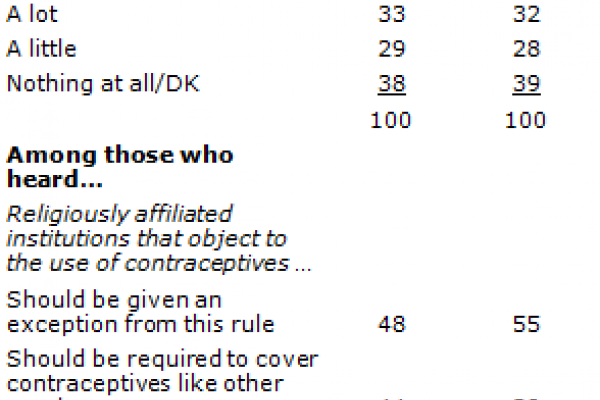
The American public is closely divided over the federal rule that would require employers, including most religiously-affiliated institutions, to cover birth control as part of their health care benefits, according to the latest survey by the Pew Forum on Religion & Public Life.
On Feb.10, the Obama administration announced it would modify the mandate in response to criticism that the rule would force religious organizations to violate their religious beliefs in providing contraception coverage. The latest Pew survey shows little difference in opinions among people interviewed before the administration’s proposed modification and those interviewed afterward.

Chances are you feel one of two ways about Valentine’s Day — you either love it, or your loathe it. For you, it’s either the time to shower that special someone with extravagant gestures or it’s a hyper-commercial day that doesn’t mean anything because you should show someone how much you love them every day.
Sound familiar?
If so, why don’t we agree to put the debate aside for a moment and get to know a little better the man who’s name to see on cards and teddy bears and chocolates but once a year: Interesting-Things-You-
Find out what they are inside the blog...

Four Ways To Slice Obama’s 2013 Budget Proposal (INFOGRAPHIC); Britain Being Overtaken By 'Militant Secularists', Says Baroness Warsi; Clinton: Poverty Helping Fuel Violence In Nigeria; How Much Do We Spend On The Nonworking Poor?; Making Good Citizenship Fun (OPINION); Has the President Lost His Obama Generation?; College Students Crowd CPAC; GOP Revives Pipeline Push In Highway Bill; 5 Lessons From The Rise Of The BRICs; Over 600,000 Messages Against Keystone XL Flood The Senate.
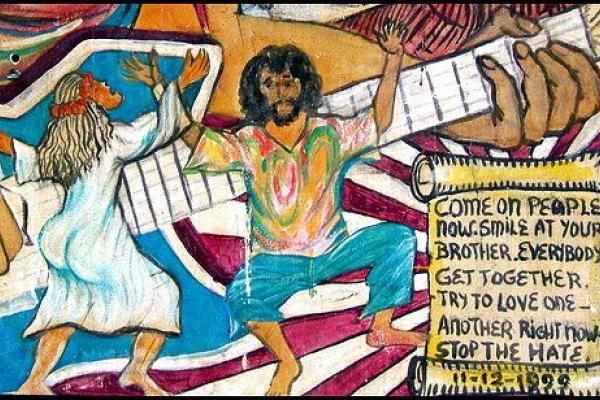
"You and I have the power to change someone’s day. And so I am going to challenge you, on this Valentine’s Day, to not only tell family members you love them, but also others whom you care for.
"In a world where people are beat up and put down, God gives us the ability to completely turn negativity, criticism and rude opinions around. “Encourage one another and build each other up,” says 1 Thessalonians 5;11. That is one of the most significant verses in all the Bible because when we do this it sets off a chain reaction of blessing.” You become the voice of God’s mercy and grace in the lives of others."
Taking a look at Valentines Day with clever recipes, cards, stories, and clothing items. Videos of love across language barriers. A couple of sentimental mixtapes. The greatest kisses in literature. And finally, nothing says romance like a tour of an NYC sweage plant.

With its unanimous ruling in Hosanna-Tabor Church & School v. EEOC last month, the United States Supreme Court handed down one of its most important church-state decisions in decades. The First Amendment bars ministers from suing the religious communities they serve regarding the terms and conditions of their employment, it said.
The Court affirmed what lower courts had held for decades: Religious bodies, not the government, must have the power to decide which individuals will minister to the faithful. This doctrine is known as the “ministerial exception.” The Court also held that the former teacher in this case, Cheryl Perich, was a minister and thus her lawsuit under the Americans with Disabilities Act (ADA) could not proceed.
An important aspect of the Hosanna-Tabor ruling is the Court’s recognition that there is simply is no good way for the state to police these matters – it inevitably ends up intruding on core religious decisions like who should speak to and for the church. When a minister is fired, the religious employer cites a religious reason for doing so, such as sermons that are inconsistent with Biblical teachings and a failure to challenge congregants to follow Jesus Christ. If the minister then sues the church for discrimination, he or she claims the religious reason wasn’t the “real” reason for the church’s actions; it was just a pretext for discrimination.

The Vicar of Dibley's Mother Geraldine is one of my all-time favorite television characters. Apart from her various entertaining antics, she also has a beautiful pastoral touch and way of communicating the grace and mercy of the gospel with honesty, passion and great humor — not unlike many of the women clergy I am blessed to know and have known over the years.
While women clergy are a given part of the life of the church for many of us, their presence in the Great Conversation remains a point of contention and controversy for not a few of our brothers and sisters in Christ. I was reminded of this Monday while reading the latest blog entry from our God's Politics contributor Nadia Bolz-Weber, pastor of the House for All Saints and Sinners church in Denver.
On Sunday, Nadia, an ordained minister of the Evangelical Lutheran Churchin America, received an email inquiry from a friend of a friend informing her of some less-than-love coming her way from her more conservative cousins in the Lutheran Church (Missouri Synod) who are aghast at something that went down at House for All's post-Easter Vigil party a while back.
As part of their celebration of Jesus' resurrection, House for All's Easter party included a three-tiered chocolate fountain set up in the church's baptismal font.