
My heart is heavy.
Every day for the last week, media outlet have told their version of the current uprising stretching across the Middle East (Egypt, Libya, Yemen). Whether it’s pictures of embassies burned to the ground, rioting citizens, or highly politicized comics, the surge of content has been anything but “feel-good” and hopeful.
And that’s because the events and corresponding responses have been anything but “feel-good” and hopeful.
My heart breaks because I know the events that are unfolding do not represent the majority of those who inhabit the Middle East. I spend a significant amount of time in there and have built deep, life-long friendships.
Just two weeks ago I sat around a table and shared a meal with Christians, Jews and Muslims in the home of a devout Muslim family in the region. A day after that, I served alongside Muslim youth workers who are promoting non-violence and reconciliation in the face of oppression and poverty.
On the same day, I sat with an Arab Christian who embodied Jesus’ teaching in the Sermon on the Mount in dealing with daily injustice by saying, “We refuse to be enemies.” Lastly — and what keeps playing over and over in my head — are the words spoken to me by a Muslim friend named Omar who said,
“Please give this message to all of your American friends. We (Arab Muslims and Christians) desire peace. The violence you see in the news does not represent us. It is not the majority, it is the smallest minority of extremism. Please listen to our story and accept our friendship.”
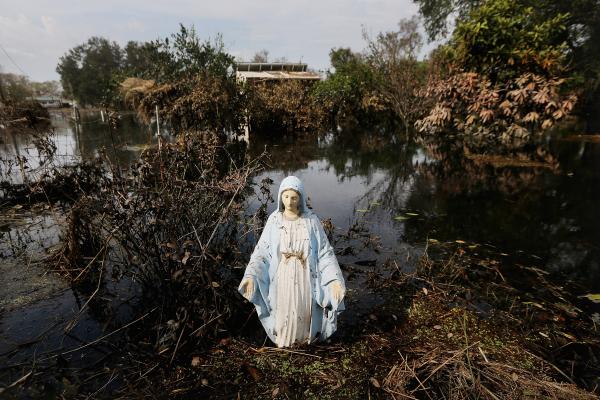
NEW ORLEANS — Faith-based ministries and local charities that are ramping up relief efforts after Hurricane Isaac say it's already clear that recovery will proceed without the national outpouring of money and volunteers triggered by Hurricane Katrina.
"From our point of view, the biggest challenge with this disaster will be getting attention and money," said Gordon Wadge, president of the New Orleans chapter of Catholic Charities.
"This is going to be on the local community — with a few national folks who follow us closely and who will rally to us."
That's a stark contrast to the conditions relief directors saw in 2005, after nationally televised images of human misery from Katrina burned themselves into the national psyche. Within weeks, faith-based ministries and secular relief groups promised to funnel millions of dollars into New Orleans over five years.
Muslim and Coptic Christian leaders in the U.S. are pledging not to let a spate of violent protests in some 20 Islamic countries derail recent efforts to improve the sometimes troubled relations between the two communities.
On Sept. 18, the Egyptian government ordered the arrest of seven Egyptian-born Copts now living in the United States who were allegedly involved in an anti-Muslim film that portrayed Islam's Prophet Muhammad as a bumbling sexual pervert.
“We cannot allow the actions of a few deceived fanatical individuals to define our communities,” said Bishop Serapion, head of the Los Angeles Diocese of the Coptic Orthodox Church, speaking during a press conference on Sep. 17 with Muslim leaders in Los Angeles.
“We call on members of both religions to lean on our faiths to counter the hate and the violence with good speech and positive work,” added the Egyptian-born bishop.
The show of solidarity comes almost a week after protesters in Egypt, where about 10 percent of the 90 million Egyptians are Coptic, attacked the U.S. embassy, setting off protests in other Muslim countries, including neighboring Libya, where American ambassador Christopher Stevens and three other Americans were killed.
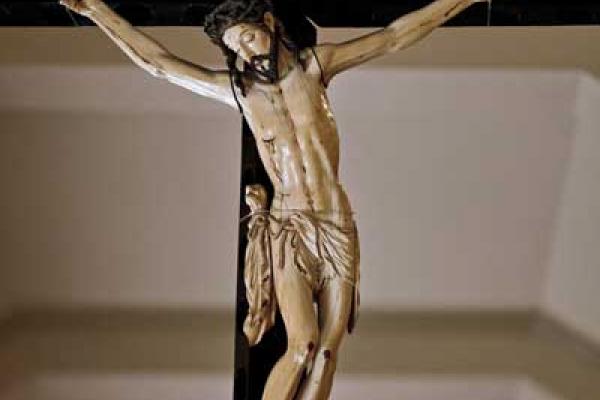
Since the ban on international trade of ivory in 1989, the ivory black market has been on the rise, and a National Geographic investigation found that demand for religious art pieces carved out of the precious material has played a considerable role.
“No matter where I find ivory, religion is close at hand,” said investigative reporter Bryan Christy, whose article, “Ivory Worship,” is included in the new edition of National Geographic magazine, released Sept. 14.
“Elephant poaching levels are currently at their worst in a decade,” Christy wrote. The Convention on International Trade in Endangered Species of Wild Fauna and Flora (CITES) estimates that at least 25,000 elephants were poached in 2011, mostly for their ivory tusks.
Philippine Catholics use ivory to construct crucifixes, figures of the Virgin Mary and other icons. The province of Cebu is particularly known for its ivory renditions of the Santo Nino de Cebu (Holy Child of Cebu), used in worship and celebration.
Prolific author Max Lucado talked to Religion News Service about grace, the topic of his 29th book, and answered a range of questions from people who follow RNS on Twitter. Lucado, 57, is the minister of preaching at Oak Hills Church, a nondenominational congregation in San Antonio.
The interview has been edited for length and clarity.
Q: You write that people don’t have a deep understanding of grace. What’s the difference between grace and mercy?
A: My hunch is that most people have settled for a wimpy grace. It’s something that doesn’t change their lives. There is a difference between grace and mercy. Mercy is the decision of God not to punish us. But grace is the decision of God to save and bless us.
Q: @tunde_ogunyinka wants to know: What is the one thing you can’t do without each day?
A. I think the one thing that I cannot do without each day is hope. If you put me in a position where you took all my hope away, I’m not sure I could make it through the day.
Q: @kaykay_ayodeji asked: Which book or writer has inspired your style of writing?
A: Early in my writing I was influenced by a man named Frederick Buechner. Back in the ‘90s I read many of his books and it really influenced my thinking and my writing. He has a slight irreverence that I thought was refreshing but it’s not an irreverence that’s unbiblical. It’s just real appreciation for God’s greatness. It’s like it released him to be a happy writer.
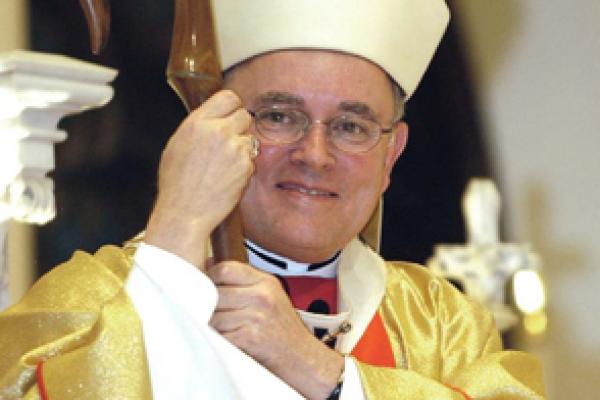
A series of recent developments are renewing questions about the Catholic bishops' alignment with the Republican Party, with much of the attention focusing on comments by Philadelphia Archbishop Charles Chaput, who said he “certainly can’t vote for somebody who’s either pro-choice or pro-abortion.”
In a wide-ranging interview published Sept. 14, Chaput also echoed the views of a number of prominent bishops when he praised Republican vice presidential nominee Paul Ryan for trying to address the “immoral” practice of deficit spending through his libertarian-inflected budget proposals.
"Jesus tells us very clearly that if we don’t help the poor, we’re going to go to hell. Period. There’s just no doubt about it,” Chaput told National Catholic Reporter.
“But Jesus didn’t say the government has to take care of them, or that we have to pay taxes to take care of them. Those are prudential judgments. Anybody who would condemn someone because of their position on taxes is making a leap that I can’t make as a Catholic.”
Chaput stressed that he is a registered independent “because I don’t think the church should be identified with one party or another.” But he said that the Democratic Party’s positions on abortion rights, gay rights, and religious freedom “cause me a great deal of uneasiness.”
He added that economic issues are “prudential judgments” open to a variety of legitimate approaches. Abortion, on the other hand, is “intrinsically evil” and must always be opposed.
That is a talking point voiced by many Catholic conservatives, including Ryan himself. Last Friday, Ryan told the Christian Broadcasting Network that opposition to abortion and same-sex marriage, and support for religious freedom, are all “non-negotiables” for a Catholic politician while “on other issues, of economics and such like that, that’s a matter of prudential judgment.”
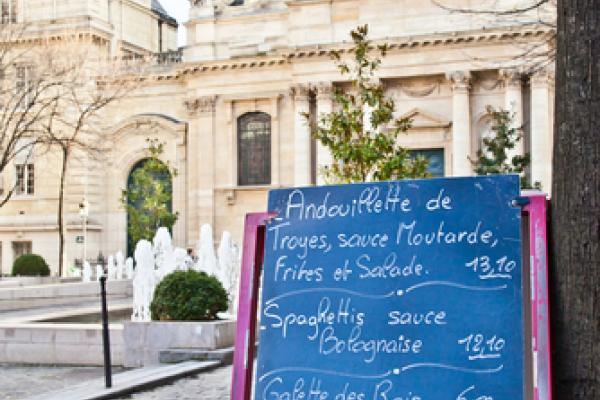
You can tell from its menu whether a restaurant expects to serve tourists, locals or regulars.
At a tourist-centered eatery like those near Times Square, the menu typically is huge: many pages, difficult to scan, sometimes difficult even to hold. There's something for everyone and it's designed to please customers who are strangers.
A restaurant catering to locals will have a much leaner menu, maybe just four or five items in each category. They will all be of a certain type—no words like "Asian fusion" to disguise lack of focus. If the joint is Korean, it will serve Korean.
A third and much rarer type is the restaurant that offers just one multi-course meal each night. Regulars go expecting to be served the chef's whim of the day, not handed a long menu.
When customers are strangers, the owner must imagine what will please a patchwork of German tourists, Chinese tourists, families from Iowa, young techies on the prowl, and marketers in town for a convention.
The better an owner knows the customers, the more focused the menu can be. If not the actual customer, at least the type of person who will come in.
Voting isn't all that different. When politics is local, candidates tend to know their people or at least know their interests, worries and hopes. This is the level at which democracy tends to work best. Leaders know their people, people know their leaders, and known interests are at stake.
Dan Brown, your phone is ringing.
A newly revealed piece of papyrus offers fresh evidence that some early Christians believed Jesus was married, according to a Harvard Divinity School professor.
A fourth-century codex in Coptic quotes Jesus referring to “my wife,” Karen King, a scholar of early Christianity, said on Tuesday. It is the only extant text in which Jesus is explicitly portrayed as betrothed, according to King.
King is calling the receipt-sized slip of papyrus “The Gospel of Jesus’ Wife.” She believes it was originally written in Greek, and later translated into Coptic, an Egyptian language.
The fragment says, "Jesus said to them, 'My wife...,'" according to King. The rest of the sentence is cut off. Another segment says, "As for me, I dwell with her in order to..." The speaker is not named.
The fragment contains just 33 words spread across 14 incomplete lines—less a full-fledged gospel than an ancient crossword puzzle.