The Washington Post reports this morning that the CIA wants more drones.
“The CIA is urging the White House to approve a significant expansion of the agency’s fleet of armed drones, a move that would extend the spy service’s decade-long transformation into a paramilitary force, U.S. officials said.
“The proposal by CIA Director David H. Petraeus would bolster the agency’s ability to sustain its campaigns of lethal strikes in Pakistan and Yemen and enable it, if directed, to shift aircraft to emerging al-Qaeda threats in North Africa or other trouble spots, officials said.
Science students are known for their interpretive dance skills, right? Well, soon they might be.
For the last five years, Ph.D. students in science from all over the globe have been participating in Science's annual Dance Your Ph.D. contest.
The rules of Dance Your Ph.D. are simple:
- You must have a Ph.D., or be working on one as a Ph.D. student.
- Your Ph.D. must be in a science-related field.
- You must be part of the dance.

Twenty-five cents was all it took. It was like magic. The punches stopped and for the first time in a long time I felt what it feels like to be normal — to be safe, to be lovable, to live without a target on my back.
But even the transaction was not a guarantee of love.
Though I continued to bring quarters that fed the monster’s craving every day, after a while even their magic stopped working.
The torture started again on the playground after school.
I walked across the schoolyard and headed home, which was only a half-block away from the school. Suddenly I was surrounded by Alice and her goons. She taunted me and pushed me, then punched me. It didn’t stop. It became a ritual.
Soon, every day, armed with only my book bag, I would duck my head and make a beeline for my house and Miss Burton (the babysitter). And every day Alice and her bulldogs would hunt me down and taunt me and push me and punch me as I walked the looooong half-block home.
Mom asked one day what I was doing with all those quarters. When I told her, she marched up to the school and had it out with Miss Williams and then my principal. I was only in that school for one year.
Alice wasn’t the last bully I had to survive. There were others. There was Tracy in the fifth grade and two white girls whose names I’ve blocked out in eighth grade. For a long time I thought I must have an invisible target attached to my back.

 Editor's Note: Kevin Gonzaga tells his story of why he's part of the 20 percent of Americans who identify with "no religion in particular." Find more stories (or share your own) HERE. Read about the study HERE.
Three years ago when I arrived at seminary to pursue my calling to fulltime pastoral ministry, one would probably have struggled to find someone in my generation more committed to the ministry and vitality of the local church.
While imperfect, I believed the church was the best hope of the world, and it was better to stay and work toward change than abandon the church and look for greener pastures. A year and a half later, I wrote a blog post explaining that I was no longer a Christian. I fear that this would only deepen the stereotype that seminary is a place where people lose their faith, so I should explain.
The truth is I am one of growing number of people who choose not to affiliate with any organized religion. I am a “none,” and my journey to “none” started a long before I left for seminary. My disillusionment with, and eventual abandonment of, Christianity did not center around one traumatic event that shattered my faith, but rather it was something that coalesced from numerous experiences over a long time.
It really started when I began studying the scriptures for myself in college. I was shocked to find many things I had been taught by the Church were wrong, were not in the Bible, or were even contrary to what the scriptures actually taught.

Editor's Note: This is part two of a three-part series from Dr. Miroslav Volf an a voice instructing us how to involve our values into our present politcal debates. To read part one go HERE. From part one:
In this year of presidential elections, I have decided to summarize key values that guide me as I decide for whom to cast my vote. ...
6. The Poor
Value: The poor — above all those without adequate food or shelter — deserve our special concern. (“The moral test of government is how it treats people in the dawn of life, the children, in the twilight of life, the aged, and in the shadows of life, the sick, the needy, and the handicapped” [Hubert Humphrey].)
Rationale: “When you reap the harvest of your land, you shall not reap to the very edges of your field, or gather the gleanings of your harvest; you shall leave them for the poor and for the alien: I am the LORD your God” (Lev. 23:22). “There will, however, be no one in need among you, because the LORD is sure to bless you in the land that the LORD your God is giving you as a possession to occupy” (Deut. 15:4).
Debate: There should be no debate whether fighting extreme poverty is a top priority of the government. That’s a given. We should debate the following: How should we generate a sense of solidarity with the poor among all citizens? In poverty alleviation, what is the proper role of governments and of individuals, religious communities, and civic organizations? What macroeconomic conditions most favor lifting people out of poverty? What should the minimum wage be?
Questions to Ask: Is overcoming extreme poverty (rather than fostering the wellbeing of the middle class) a priority for the candidate? For what poverty-reducing policies is the candidate prepared to fight?
Malala Yousafzai, the teenage girl who was shot by Taliban gunmen in Pakistan for her activism, is recovering at a hospital in Britain. The Guardian reported this morning
“Malala Yousafzai, the teenage girl flown to Britain for treatment after being shot in the head by Taliban gunmen in Pakistan, has the potential to make "pretty much a full recovery", her doctors have said.
“She is able to stand with help and is writing notes, and although the bullet grazed her brain she has not shown "any deficit in terms of function", doctors at Queen Elizabeth hospital in Birmingham said on Friday. She was "not out of the woods but is doing very well", said Dr. Dave Rosser, medical director of the University Hospitals Birmingham NHS foundation trust.”
The shooting has attracted a mass outpouring of support, both in Pakistan around the world. And Yousafzai is apparently aware of that support. According to Dr. Rosser
"She is keen that people share the details. She is also keen that I thank people for their support and their interest. She is obviously aware of the amount of support and interest this has generated around the world. She is keen to thank people for that."
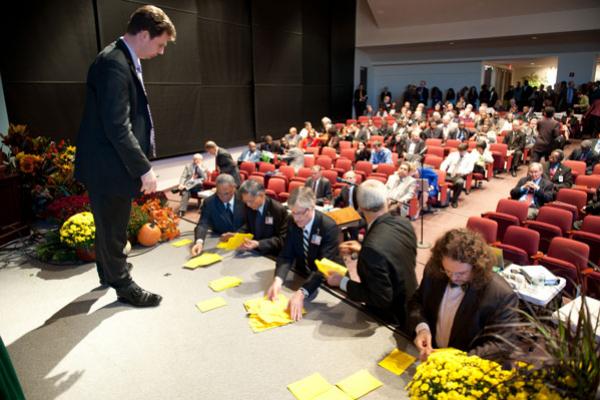
Leaders of the Seventh-day Adventist Church on Tuesday said recent decisions by two regional bodies to allow ordained female pastors were "serious mistakes," and women who are ordained won't be recognized — at least for now.
“They directly challenge two world Church decisions on the matter of ordination,” reads a statement, passed by a 264-25 vote during the Annual Council meeting in Silver Spring, Md. “They create doubts about the importance of collective decision-making as a basic feature of denominational life.”
The decisions by the Maryland-based Columbia Union Conference and the California-based Pacific Union Conference came as the worldwide church is in the midst of a broad study of the “theology of ordination” that is expected to be considered at the denomination’s 2015 General Conference Session.