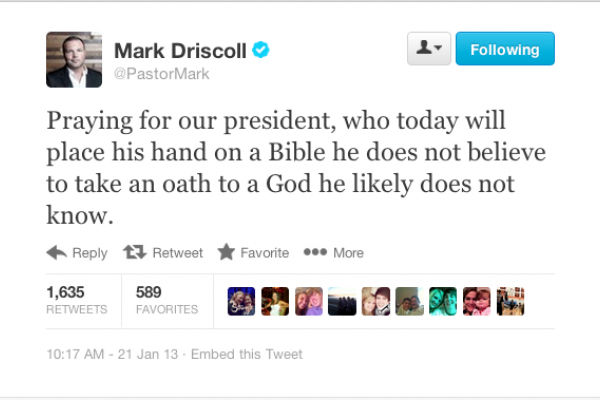
Rev. Mark Driscoll, founder of Mars Hill church, has a true gift. Just when I think I’m making at least a modicum of progress toward tolerance – if not actual Christlike love – toward the guy, inevitably he does something to make me despise him all over again.
On the Monday, before President Obama’s inauguration ceremony, Driscoll sent out the following message to his more than 300,000 Twitter followers:
Praying for our president, who today will place his hand on a Bible he does not believe to take an oath to a God he likely does not know.
As of Thursday morning, the tweet has received more than 3,400 retweets and nearly 1,350 favorites. Driscoll’s next tweet was about an iPad Mini giveaway.
In the past 20 years, the world has witnessed the death of social contracts. We have seen a massive breakdown in trust between citizens, their economies, and their governments. In our own country, we can point to years of data painting a bleak picture of the confidence Americans have in any of our traditional institutions.
Former assumptions and shared notions about fairness, agreements, reciprocity, mutual benefits, social values, and expected futures have all but disappeared. The collapse of financial systems and the resulting economic crisis not only have caused instability, insecurity, and human pain; they have also generated a growing disbelief and fundamental distrust in the way things operate and how decisions are made.
This week at the World Economic Forum in Davos, Switzerland, we are looking to the future and asking “what now?” At a Saturday session — “The Moral Economy: From Social Contract to Social Covenant” — a document will kick off a year-long global conversation about a new “social covenant” between citizens, governments, and businesses.
This is really “a call” for worldwide discussion about what values are needed to address the many difficult challenges and choices the world is now facing. Inequality, austerity, retrenchment, constraints, mal-distribution, growing conflicts over resources, and extreme poverty all raise questions about our values.
Annie Lowrey's recent New York Times magazine article "Washington's Economic Boom, Financed by You" provides a stimulating look into Washington, D.C.'s "economic boom" of the last few years. As D.C. residents, many of us encounter the ongoing transformation of our city every day. We know the area's economy has grown about three times as much since 2007 as the country — largely a result of expanded government spending (primarily in the form of two foreign wars). We also know that the greater metropolitan region is one of the richest in the country. As Lowrey noted, the Washington metro area has seven out of the top 10 highest-income counties in the U.S., including the three highest.
However, Lowrey only tells one side of the story — the rich side. The "economic boom" has largely passed by D.C.'s poor and working people. By not mentioning D.C.'s grossly high poverty rates, the article is misleading.
Amid Washington's economic boom, there is also massive economic displacement, increased economic inequality, and higher rates of poverty.
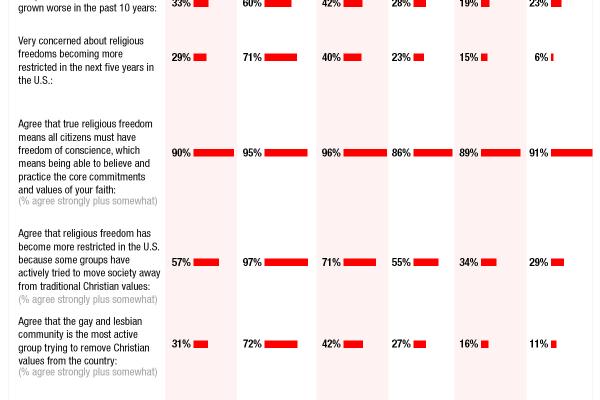
WASHINGTON — Half of Americans worry that religious freedom in the U.S. is at risk, and many say activist groups — particularly gays and lesbians — are trying to remove “traditional Christian values” from the public square.
The findings of a poll published Wednesday reveal a “double standard” among a significant portion of evangelicals on the question of religious liberty, said David Kinnaman, president of Barna Group, a California think tank that studies American religion and culture.
While these Christians are particularly concerned that religious freedoms are being eroded in this country, “they also want Judeo-Christians to dominate the culture,” said Kinnamon.
“They cannot have it both ways,” he said. “This does not mean putting Judeo-Christian values aside, but it will require a renegotiation of those values in the public square as America increasingly becomes a multi-faith nation.”
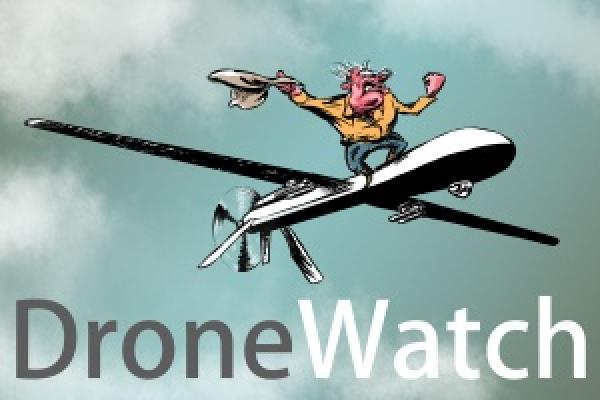
Ben Emmerson, a U.N. special rapporteur, is beginning an investigation into drone strikes in Afghanistan, Pakistan, Yemen, and Somalia, according to the Guardian.
“About 20 or 30 strikes – selected as representative of different types of attacks – will be studied to assess the extent of any civilian casualties, the identity of militants targeted and the legality of strikes in countries where the UN has not formally recognised there is a conflict.
“The inquiry will report to the UN general assembly in New York this autumn. Depending on its findings, it may recommend further action. Emmerson has previously suggested some drone attacks – particularly those known as "double tap" strikes where rescuers going to the aid of a first blast have become victims of a follow-up strike – could possibly constitute a 'war crime.'"
Several nations, including Pakistan, have requested the investigation.
This winter, fiction revealed truth about climate change.
As a teacher, I relish the escape provided by pleasure reading before I return to the classroom for the next semester at Warren Wilson College, where I teach environmental education.
In December, without reading reviews or making a list, I visited my independent bookstore, Malaprop’s and purchased two books: Barbara Kingsolver’s Flight Behavior (2012) and Lauren Groff’s Arcadia (2012). I’m a long-time Kingsolver fan and bought her book as a gift, with the goal of reading it before wrapping it. And the cover of Arcadia, with its teal VW bus and field of sunflowers, drew me into purchasing what I thought was my second random choice for recreational reading.
Both books, it turns out, integrated climate change into the plotline, weaving scientific truths about global warming into the lives of fictional characters. And just as compelling, both works of fiction featured spiritual community at the center of critical decisions about the future of the land and its inhabitants.
Of note, critics have bemoaned the lack of fiction centered on climate change, a paucity that seemed to mirror our public denial of this scientific reality. In a 2010 blog on openDemocracy, professor and author Andrew Dobson even outlined the components of a “climate-change novel” that include a grim future, characters who explore ethical choices around global warming, and (no surprise here) extreme weather events. He ended his piece with this challenge: “So there’s the recipe. Who’s going to write the book?”
VATICAN CITY — Lutheran leaders have warned the Vatican that the creation of a structure to welcome conservative Lutherans into the Catholic Church would harm dialogue and damage ecumenical relations.
In 2009, Pope Benedict created a special church structure, called an ordinariate, to allow disgruntled Anglicans to convert to Catholicism while maintaining bits of their traditions and culture.
Ordinariates have been created in the U.S., England and Australia, attracting hundreds of conservative Anglicans who oppose female and gay bishops and who seek greater lines of authority.
In recent weeks, senior Vatican officials publicly suggested the creation of a similar structure for disaffected Lutherans; the idea was first floated last October by Cardinal Kurt Koch, the Vatican chief ecumenist.
According to Catholic media reports, Archbishop Gerhard Ludwig Mueller, who heads the Vatican’s doctrinal office, said on Jan. 11 that if Lutherans asked for the creation of an ordinariate, the Vatican would consider their request.
Mueller’s words were swiftly rebuked by the Rev. Martin Junge, general secretary of the Lutheran World Federation. “The creation of such a special structure would have deep ecumenical repercussions,” he warned on Jan. 18.