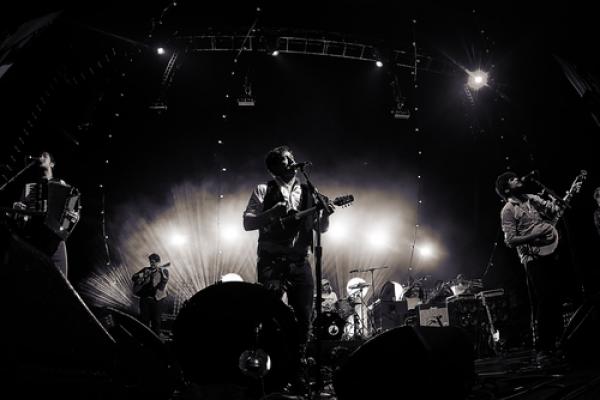
Mumford and Sons opened with a little introit called "Sigh No More" then a call to worship, "Roll Away Your Stone" and so we did. Understated and, dare I say it, reverent. Polished and yet still "honest" (this is a hipster liturgy, after all), the boys did a great job offering their work to us. They spoke with the audience. Marcus jumped off stage to give a beer to a woman celebrating her 21st birthday and then led the crowd in singing "Happy Birthday" to her. Welcome to a living room that seats 8,500.
The band played most of their published stuff, took a bow, and walked off stage. The encore set is what took it home for me. The stepped away from their usual set-up, unplugged their instruments, stood around a condenser mic and then sang. They dragged us back into devotion. Springsteen's "I'm On Fire" followed by "Sister" sung a cappella did me in. A benediction? Perhaps I'm reaching.
They closed the night with "The Cave" which had people jumping and singing along. You can find a set list here.
After the concert, my Facebook feed lit up with "it was just like church" or "that was church" by several people including some ordained church types in attendance last night. The Vineyard background has not been wasted, not by any stretch. It has been given a new venue, a new form, a venue where the truth can be sung in quiet tones, where no name is taken in vain or otherwise, where wild passion is replaced with festal devotion.

Polley’s theater family has kept a rumor for years that Sarah’s dad may not be her biological father. Nagged by persistent jokes about her striking non-resemblance to the rest of the family, and unable to ask her long-since deceased mother, Polley sets out to put the record, and her family’s memories, straight.
There’s much to love here, and what immediately distinguishes Stories is the openness — both uncomfortable and endearing — with which Polley invites the audience to see the intimate process of art-making.
In short, we see a family — recognizable, ordinary, and still very much in the process of living — grappling with what it means to be suddenly be subjects in an intimate story no longer their own.

A spokesman for the Pakistani Taliban confirmed that Waliur Rehman, the group’s second-in-command, was killed in yesterday’s drone strike. Ahsanullah Ahsan also announced that an offer to begin peace talks with the new Pakistani government was being withdrawn.The Associated Press reports:
The militant group had said earlier that it was open to peace talks. But Ahsan said Thursday that the Taliban believe the government approves of the drone strikes so they are withdrawing their offer of peace talks.
"We had made the offer for peace talks with the government with good intention but we think that these drone attacks are carried out with the approval of the government so we announce the end of the talks process," he said.
The incoming government, headed by Nawaz Sharif, promised in the campaign that it would work to bring about peace after years of violence. A U.S. drone has now called that into doubt.
Read more here.
Researchers at Harvard Medical School found immigrants contributed $115 billion to the Medicare Trust Fund over a seven-year period. In 2009 alone, immigrants contributed $13.9 billion more to Medicare than they used. The report encouraged allowing legal status for undocumented immigrants to help offset health care costs in America. USA Today reports:
"The assumption that immigrants are just a drain has been a part of the argument that people should be denied services," said Leah Zallman, lead researcher and an instructor at Harvard Medical School. "Immigration policy has been closely linked to Medicare's finances."
Read more here.
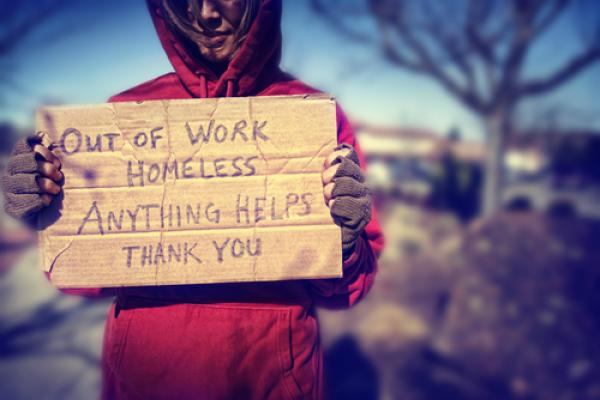
There should be no poor among you - Deuteronomy 15:4
This is one of the few commands virtually all religious people easily – even eagerly – follow.
We just do it our own way.
The biblical and cultural context and overriding assumption is that those of us with means should contribute – willingly and without conditions – to those among us who, for whatever reason, are needy.
We are not to judge – or distance ourselves – from those who have little – or cannot pay us back. In fact these are the ones Jesus commands that we – and by extension he – should invite to a banquet (Luke 14:12-14).
But we seem to have ‘no poor among us’ – we do our best to exclude, ignore, or even ban them when we do see them.
Although the Census Bureau has reported that 15 percent of Americans live in poverty, when assets and wages are factored in half of Americans are below or near poverty line. Alternet has compiled a list of five reasons poverty affects so many Americans.
1. Almost half of Americans had NO assets in 2009 - In 2009 47% of Americans has more debt than assets.
2. It’s Even Worse 3 Years Later - An OECD report states that “inequality has increased by more over the past three years to the end of 2010 than in the previous twelve,” with the U.S. experiencing one of the widest gaps among OECD countries.
3. Based on wage figures, half of Americans are in or near poverty - The highest wage in the bottom half of earners is about $34,000. To be eligible for food assistance, a family can earn up to about $30,000 for a family of four.
4. Based on household expense totals, poverty is creeping into the top half of America - After taxes and expenses, a family making $60,000 a year is left with nothing except debt.
5. Putting it in Perspective - While food support was being targeted for cuts, just 20 rich Americans made as much from their 2012 investments as the entire 2012 SNAP (food assistance) budget, which serves 47 million people.
Read more here.

An Italian university professor on Wednesday said he has found what is believed to be world’s oldest complete Torah scroll.
Mauro Perani, professor of Hebrew at the University of Bologna, said the scroll originally was believed to be no more that a few hundred years old.
But new studies and carbon dating tests suggest it was written around 850 years ago.