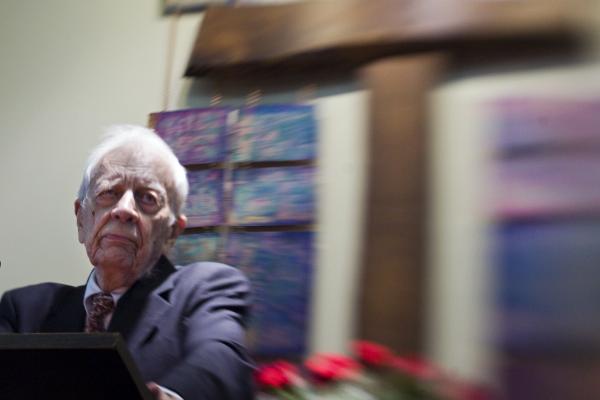
Gordon Cosby was my spiritual father, not simply a brother in Christ. This relationship continued for some 45 years until his dying days. In a time when egalitarianism defines nearly all relationships as the desired norm, it’s well to remember the role of mentors who maintain, purely through their own internal integrity and faithfulness, a spiritual authority in the lives of others. Gordon Cosby was such a person to me, and to countless others.
I first encountered Gordon when I was a young legislative aide on the rise in Washington, D.C., working for Senator Mark O. Hatfield and his legislative efforts to end the Vietnam War. Disgusted with the moral vacuity of the evangelicalism that had been my heritage, but searching for faith that was more than just following a progressive social agenda, I discovered the Church of the Saviour. Gordon’s insistence that following Jesus required a disciplined inner spiritual journey always expressed in joining God’s outward mission in the world captivated me then, and ever since.
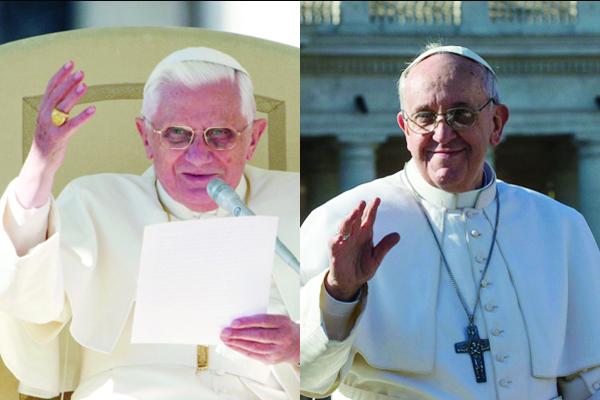
Now that the cardinals have elected and installed their new boss, Pope Francis can get to work being the Roman Catholic pontiff, with his next order of business doing something no other pope has done in centuries: meet the guy he replaced.
Benedict’s resignation — the first by a pope in 600 years — paved the way for the conclave that elected Francis on March 13, but it also created an almost unprecedented potential for confusion and division in a church hierarchy that has room for only one pope at a time.That will happen on Saturday, when Francis is scheduled to travel a few miles outside Rome to the hilltop town of Castel Gandolfo, the summer papal residence where Benedict XVI has been staying — out of sight — since he resigned and left the Vatican on Feb. 28.
“Benedict XVI could turn into a shadow pope who has stepped down but can still exert indirect influence,” said Hans Kung, the dissident Swiss theologian and friend (as well as frequent critic) of Benedict’s since he and the former Joseph Ratzinger were up-and-coming theologians.

When it comes to the Keystone XL pipeline, the oil and gas industry want you to believe that you have to choose between jobs and prairie grass. This tactic is called the “divide and conquer” or “divide and rule” strategy. It’s as old as the empires of ancient Greece and Rome. It still works because human nature hasn’t changed that much.
Two years ago I sat down across the table from Dr. Kerri-Ann Jones, the highest ranking State Department official (short of the Secretary of State) to weigh in on the Keystone XL pipeline permit process. A group of religious leaders were delivering thousands of petitions to Dr. Jones asking her to to stop the pipeline.
I said to her, "If this decision about the pipeline was made purely based on the climate science, we wouldn't be here having this discussion." She’s a scientist. She knows the score. She didn't disagree. “But,” she said, “everywhere we go across the country we hear about the need for jobs – especially in the middle of the country.”
Divide and conquer.
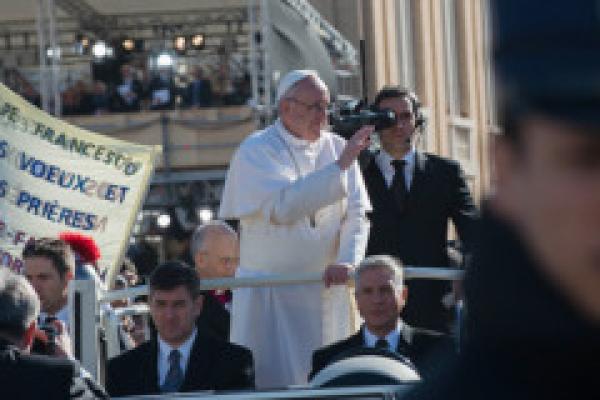
VATICAN CITY — Pope Francis on Friday called for more intense dialogue between religious leaders, particularly Muslims, as he tries to recalibrate relations between the world’s two largest religious groups.
Speaking in the Vatican’s majestic Sala Regia, the Argentine pontiff said that part of his mission is to connect “all people, in such a way that everyone can see in the other not an enemy, not a rival, but a brother or sister.”
In a meeting with Vatican diplomats and foreign leaders, Francis also reaffirmed the church’s commitment to protect the poor and the environment, an early theme in his young pontificate.
“Fighting poverty, both material and spiritual, building peace and constructing bridges: these, as it were, are the reference points for a journey that I want to invite each of the countries here represented to take up,” the pope said.

Every day, or nearly so, women and men look in mirrors, step on scales, count calories, and worry about body fat and about their appearance. It happens enough that children as young as four begin to develop anxiety over food, or express fears of being seen in a bathing suit. Even eating healthfully can become an unhealthy obsession. And often enough, people become so desperate to get control over their eating as to spend huge amounts of money on drugs, diet plans, and surgery. Occasionally, the burden of eating, of bodily existence itself, is too much to bear, and people lose their lives to anorexia — the deadliest of all mental illnesses.
On Palm Sunday many will hear the Gospel of Luke’s perspective surrounding Jesus’ celebrated entry into Jerusalem (Luke 19:28-40). In hearing this well-known portion of the New Testament, we are often led to wonder how the same crowds that so graciously and enthusiastically welcomed Jesus would passionately and viciously call for his death just a few days later. In trying to comprehend the sudden and significant shift in public opinion, we recognize that the crowds did not swing their support independently, but rather, they were acting under the influential push of propaganda.
As Luke’s Gospel reminds us, in between Jesus’ entry into Jerusalem and the calls for his crucifixion, the “chief priests and the scribes” plotted to put Jesus to death (22:2). As these powerful elites were “afraid of the people”, they conspired in a power-protecting push to have Jesus humiliated, tortured, and brutally killed. And so, while Luke’s Gospel does not provide exact details into the strategies of the chief priests and scribes, their motivations appear to be clear, as they, and others within the ruling class, perceived Jesus as a risk and thus needed to ensure his quick and clear elimination. As a result, due to the influential influx of propaganda, combined with an overly complicit public, just a short time after Jesus was welcomed as a king he was sentenced to death as a criminal.
Four people were killed in a drone attack on a vehicle in Pakistan yesterday. According to The New York Times,
"The officials said missiles fired late Thursday night from a drone operated by the Central Intelligence Agency hit a moving vehicle in Datta Khel Bazar in the North Waziristan tribal region, which is a redoubt of local and foreign militants. “Four men inside the vehicle were killed,” a tribal official said, speaking on condition of anonymity. The nationality of those killed was not immediately clear. The vehicle exploded after it was hit by two missiles, leaving the bodies charred and beyond recognition.”
This is the first reported attack in nearly two weeks.